

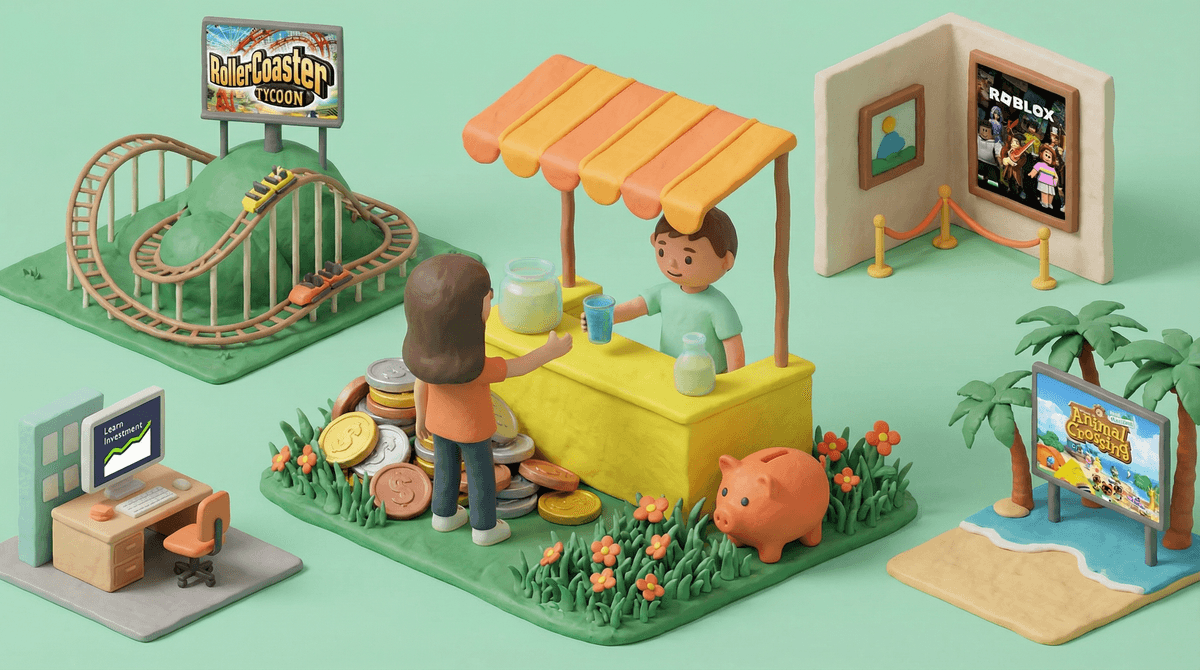
Look, we all want our kids to understand money before they're 23 and wondering why their credit score matters. Economics learning games are basically the trojan horse approach to financial literacy—games that teach real concepts like budgeting, supply and demand, investment, and resource management while kids think they're just having fun.
These aren't your dusty classroom simulations from 1997. Today's economics games range from running virtual businesses in Roblox to full-blown stock market simulators that use real market data. Some teach basic coin counting, others dive into compound interest and market economics. The best ones? They make kids feel the consequences of their financial decisions without actual financial consequences.
Here's the thing: most of us learned about money through trial and error (emphasis on error). Our kids are growing up in an economy where they can spend real money on virtual goods before they understand what "real money" even means. Robux, V-Bucks, and Minecoins feel like Monopoly money until the credit card bill arrives .
.
But beyond just "don't spend $200 on Fortnite skins," financial literacy affects everything: understanding wants vs. needs, delayed gratification, risk assessment, entrepreneurship, and how economic systems actually work. Kids who grasp these concepts early make better decisions about everything from their allowance to their first job to their student loans.
The games that actually work don't just teach "save your money." They create scenarios where kids experiment, fail, adjust their strategy, and see results. That's the kind of learning that sticks.
Ages 5-8: Building Basic Concepts
Minecraft (Ages 7+) Yeah, I'm starting with Minecraft. In Survival mode, kids learn resource management—mining materials, trading with villagers, deciding what to craft versus what to save. The trading system is legitimately educational: villagers have different prices, some deals are better than others, and kids learn to comparison shop. Plus, the whole game is about delayed gratification: you mine for hours to build something cool.
Lemonade Stand (various versions) (Ages 6+) The classic. Multiple app versions exist, but the concept is timeless: buy ingredients, set prices, watch weather forecasts, adjust for demand. Kids learn that pricing too high means no customers, pricing too low means no profit. It's supply and demand in its purest form.
Animal Crossing: New Horizons (Ages 6+) This cozy game is secretly a financial literacy masterclass. Kids take out a loan (from a tanuki, but still), learn about debt, earn money through various activities, invest in their island, and navigate a fluctuating "stalk market" (turnip prices that change daily). The game rewards patience and planning—you can't rush everything with real money, you have to actually earn and save.
Ages 9-12: Introducing Complexity
Roblox Business Games (Ages 9+)
Within Roblox, games like "Retail Tycoon 2" and "Restaurant Tycoon 2" let kids run businesses. They manage inventory, set prices, hire staff, and expand. Some kids even learn real entrepreneurship by creating and selling their own Roblox games and items. Whether Roblox is teaching entrepreneurship or just teaching microtransactions is definitely worth discussing, but the business simulation games within it have genuine educational value.
Stardew Valley (Ages 10+) Farming sim that's all about economic strategy. Plant crops with different growth times and profit margins, invest in animals and equipment, manage energy as a resource, and decide between selling raw materials or processing them for higher value. Kids learn opportunity cost: every choice means not choosing something else.
Roller Coaster Tycoon/Planet Coaster (Ages 10+) Theme park management teaches pricing strategy (charge too much for rides and people get angry, too little and you go broke), operational costs, investment in infrastructure, and customer satisfaction affecting profit. The feedback loop is immediate and clear.
Ages 13+: Real-World Economics
The Sims 4 (Ages 13+) Managing Sim households means balancing bills, career choices, investments in skills and objects, and understanding how spending affects lifestyle. It's not explicitly educational, but teens absorb concepts like "you need income to cover expenses" and "investing in your skills leads to better jobs."
Capitalism Lab (Ages 14+) Okay, this one's actually a business simulation game designed to teach economics. It's complex—maybe too complex for casual players—but for teens interested in business, it covers everything from manufacturing to marketing to R&D investment. Not exactly thrilling gameplay, but legitimately educational.
Stock Market Simulators (Ages 13+) Apps like "Investopedia Stock Simulator" and "MarketWatch Virtual Stock Exchange" use real market data without real money. Teens can learn about stocks, diversification, market volatility, and long-term vs. short-term investing. Some high schools use these in economics classes, and they're free.
Democracy 4 (Ages 14+) Political simulation that's deeply economic. Every policy decision affects the economy, and teens learn about trade-offs: cutting taxes might be popular but affects public services, raising minimum wage helps workers but might increase unemployment. It's complex and teaches systems thinking.
Not all "business games" are educational. Some are just clicking simulators designed to push in-app purchases. Look for games where:
- Decisions have clear consequences
- There's actual strategy involved
- Kids can't just buy their way to success with real money
- The economic systems mirror real-world concepts
Board games count too. Monopoly (despite taking 47 hours), The Game of Life, and Catan teach resource management and trading. They're screen-free and create natural opportunities for discussion about financial decisions.
The best learning happens with conversation. Playing alongside your kid and asking questions—"Why did you choose that?" "What's your strategy?" "What would happen if you tried this instead?"—turns gameplay into active learning. Otherwise, they might just be clicking randomly.
Real-world connection is key. Link game concepts to real life: "Remember in Animal Crossing when you had to save up for that bridge? That's like us saving for our vacation." Or "The turnip market in that game is kind of like the stock market—prices go up and down and you have to decide when to sell."
Some games say they're educational but are really just glorified ads or data collection. If a "free" financial literacy game is pushing specific financial products or services, that's not education, that's marketing.
And look—these games are tools, not replacements for actual financial conversations. A kid who's a Roblox tycoon millionaire might still blow their birthday money on the first shiny thing they see. Games teach concepts, but real financial literacy comes from real-world practice: allowances, savings goals, earning money, making choices.
Also, balance screen time. A kid learning about economics through Minecraft for six hours straight is still a kid on screens for six hours. The educational value doesn't negate the need for other activities.
The best economics learning games don't feel like learning. They create systems where financial decisions matter, consequences are clear, and kids naturally develop an intuition for economic concepts. Minecraft, Animal Crossing, and Stardew Valley top the list because they're actually fun while teaching resource management, investment, and delayed gratification.
For older kids, business tycoon games in Roblox and stock market simulators bridge the gap between game mechanics and real-world economics. And honestly? Even games that aren't explicitly educational—like The Sims—teach financial concepts through gameplay.
The goal isn't to raise a generation of day traders (please no). It's to help kids understand that money is finite, choices have trade-offs, and planning ahead beats impulse spending. If a game makes those lessons click? That's worth the screen time.
Start where your kid is. If they're already playing Minecraft or Roblox, lean into the economic aspects of those games. If they're not gamers, try a board game like Catan for a screen-free option.
Play together. At least initially. You'll see what they're learning (or not learning) and can guide their thinking with questions.
Connect to real life. Use game scenarios to launch conversations about real financial decisions your family makes.
Pair with real-world practice. Games teach concepts, but actual money management—allowance, savings goals, earning opportunities—cements the learning.
And if you're wondering whether your kid is ready for more financial responsibility or how to structure allowance and money conversations? That's exactly the kind of thing worth exploring further.