

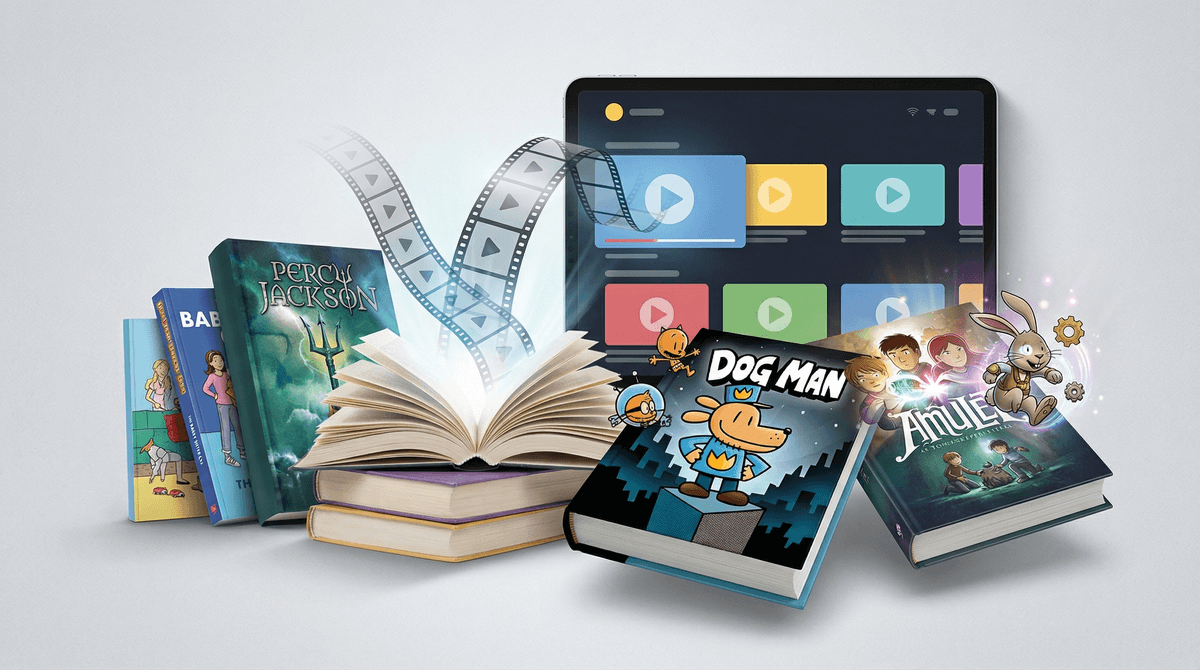
From Page to Screen: Chapter Books and Graphic Novels Your Kids Can Read AND Watch
TL;DR: The sweet spot between "more screen time pleeeease" and "can you just read a book?" exists, and it's called page-to-screen franchises. Here are the chapter books and graphic novels with TV shows or movies that actually work in both formats—so kids can read, watch, compare, and maybe even learn that the book really is better (or at least different in interesting ways).
Quick picks:
- Ages 6-9: The Last Kids on Earth (Netflix), Magic Tree House (graphic novel + upcoming adaptation)
- Ages 8-12: Dog Man (DreamWorks movie coming), Amulet (graphic novel with film in development)
- Ages 10+: The Baby-Sitters Club (Netflix series), Percy Jackson (Disney+ series)
Look, we all know the battle. "Just 10 more minutes of screen time!" vs. "You haven't picked up a book in three days." But page-to-screen franchises are the rare win-win: kids get invested in characters through the show, then want to read ahead in the books (or vice versa). It's not cheating—it's scaffolding literacy with motivation.
According to our Screenwise community data, about 40% of families let kids use streaming services like Netflix independently, while another 40% watch together regularly. Meanwhile, 50% of families use Disney+ for co-viewing. That's a lot of potential reading material sitting right there in your queue.
The trick is finding stories that don't just get slapped onto screen as a cash grab, but actually translate well between formats—and ideally, where the book adds something the show can't (inner monologue, world-building details, or just plain more story).
Ages 7-11 | Netflix series available
Max Brallier's bestselling chapter book series got the full Netflix treatment (animated series launched in 2022, still going strong), and now there's a graphic novel version too (released late 2024). It's zombie apocalypse meets middle school meets video game logic—kids fighting monsters, building tree forts, and eating endless junk food. The humor is goofy, the stakes are low (it's not scary scary), and the friendship dynamics are genuinely sweet.
Why it works: The show is fast-paced and visually wild, but the books let kids linger in the world-building. Plus, the graphic novel format is a great bridge for reluctant readers who love the show but find chapter books intimidating.
Ages 6-9 | TV adaptation in development
Mary Pope Osborne's classic time-travel series (80+ books and counting) just got a graphic novel makeover with The Knight at Dawn (released January 2024). The franchise has been in TV development for years, and the graphic novel push suggests a streaming series is finally happening. If your kid loved the chapter books in kindergarten but aged out, the graphic novels bring them back with fuller illustrations and a slightly older sensibility.
Why it works: The original books are short—like 70 pages—so the graphic novel actually expands the story visually without dumbing it down. And when the show drops, you'll have a whole library ready to binge-read.
Ages 6-10 | DreamWorks movie announced
Dav Pilkey's Dog Man graphic novels are already a phenomenon (if you have a second grader, you know), and DreamWorks is turning it into a feature film. The humor is extremely potty-joke-forward (it's literally a cop who's half dog, half man, fighting a villain named Petey the Cat), but it's also genuinely clever about storytelling, meta-humor, and even trauma (Dog Man has anxiety! Petey is trying to be a better dad!).
Why it works: The books are designed to look like a kid drew them, which makes them wildly approachable for emerging readers. The movie will inevitably smooth out the rough edges, so reading the books first preserves that DIY, chaotic energy.
Ages 9-13 | Netflix series (2 seasons)
Ann M. Martin's 1980s series got a Netflix reboot (2020-2021) that's shockingly good—diverse cast, modern issues (Type 1 diabetes, transgender characters, divorce), but still wholesome friendship drama. The books (there are like 200 of them, including spin-offs) are comfort food: episodic, low-stakes, and deeply character-driven.
Why it works: The show modernizes the stories without losing the heart, and the books let kids dive way deeper into each character's perspective. Plus, the series ended after 2 seasons, so there's tons of book material to keep going.
Ages 9-14 | Disney+ series
Rick Riordan's Greek mythology adventure series finally got the adaptation it deserved (the Disney+ show launched in 2023 and is still releasing new seasons). The books are witty, action-packed, and genuinely educational (kids will learn about Medusa, the Underworld, and the Olympians without realizing it).
Why it works: The show is great, but the books are better—Percy's inner monologue is hilarious, and the world-building is richer on the page. Kids who love the show will devour the books, and there are 5 in the main series plus multiple spin-offs (Heroes of Olympus, Trials of Apollo).
Ages 9-13 | Film adaptation in development
Kazu Kibuishi's epic fantasy graphic novel series (9 books total) has been in film development for years, and it's finally happening. The story—siblings discover a magical amulet and get pulled into an alternate world of talking animals, evil elves, and giant robots—is gorgeous, emotionally complex, and legitimately creepy in places.
Why it works: The art is stunning (think Studio Ghibli vibes), and the story deals with grief, responsibility, and family in ways that feel earned, not preachy. When the movie drops, kids will want to read ahead because the books go way further than any single film can.
If you want to stay ahead of the curve, here are the best resources:
-
American Library Association's Best Graphic Novels for Children list (updated annually)—this is where producers scout for adaptations. The 2025 list just dropped, and Publishers Weekly reports a "surge of graphic novel adaptations" coming in 2026.
-
Scholastic's Page-to-Screen guide—a running list of chapter books and picture books that have been adapted into shows or movies. It's not exhaustive, but it's a solid starting point.
-
Your streaming queue—seriously, just browse Netflix, Disney+, or Amazon Prime kids' sections and Google "{show name} book series." You'll be surprised how many have source material.
Ages 6-8: Stick with graphic novels and shorter chapter books (Magic Tree House, Dog Man, The Last Kids on Earth). The shows should be co-viewed—not because they're inappropriate, but because talking through plot differences ("Wait, that didn't happen in the book!") is half the fun.
Ages 9-12: This is the golden age for page-to-screen. Kids can handle longer series (Percy Jackson, Amulet), and they're old enough to watch independently, then discuss with you later. Just be aware: some graphic novels (looking at you, Amulet) get genuinely intense (character deaths, body horror), so preview if your kid is sensitive.
Ages 12+: At this point, they're probably finding their own page-to-screen obsessions (The Hunger Games, Shadow and Bone). Your job is mostly to keep the books coming and ask good questions: "Did you like the casting?" "What did they leave out?" "Which version hit harder?"
"Won't watching the show ruin the book?"
Sometimes! But also, sometimes the show makes the book more appealing. For reluctant readers, seeing the story first can provide scaffolding—they know the plot, so decoding the text is easier. For strong readers, the book becomes a way to get more of a story they already love.
"My kid only wants the graphic novels, not the 'real' books."
Graphic novels are real books. They require visual literacy, inference skills, and often more complex panel-to-panel storytelling than traditional prose. If your kid is reading Dog Man or Amulet voluntarily, that's a win. You can always introduce chapter books later as "the version with more details."
Screen time context:
Our community data shows families average 4.2 hours of screen time per day (4 hours on weekdays, 5 on weekends). If some of that time is spent watching a show that leads to voluntary reading, that's a pretty solid trade-off. The goal isn't zero screens—it's intentional screens that connect to other parts of life.
Page-to-screen franchises aren't a compromise—they're a legitimate literacy strategy. Kids get to experience stories in multiple formats, compare adaptations, and develop critical thinking skills ("Why did they change that character?" "Which ending was better?"). Plus, it gives you built-in conversation starters that aren't just "How was school?"
Start with whatever format your kid is already into (show or book), then introduce the other. Keep a running list of what they've watched so you can grab the books at the library. And when they inevitably say "The book was better," smile and nod—because that's the whole point.
Next Steps:
- Browse the ALA Best Graphic Novels list for upcoming adaptations
- Check Scholastic's Page-to-Screen guide for current shows with book series
- Ask your librarian—they always know what's being adapted next
- Explore more book recommendations for reluctant readers