

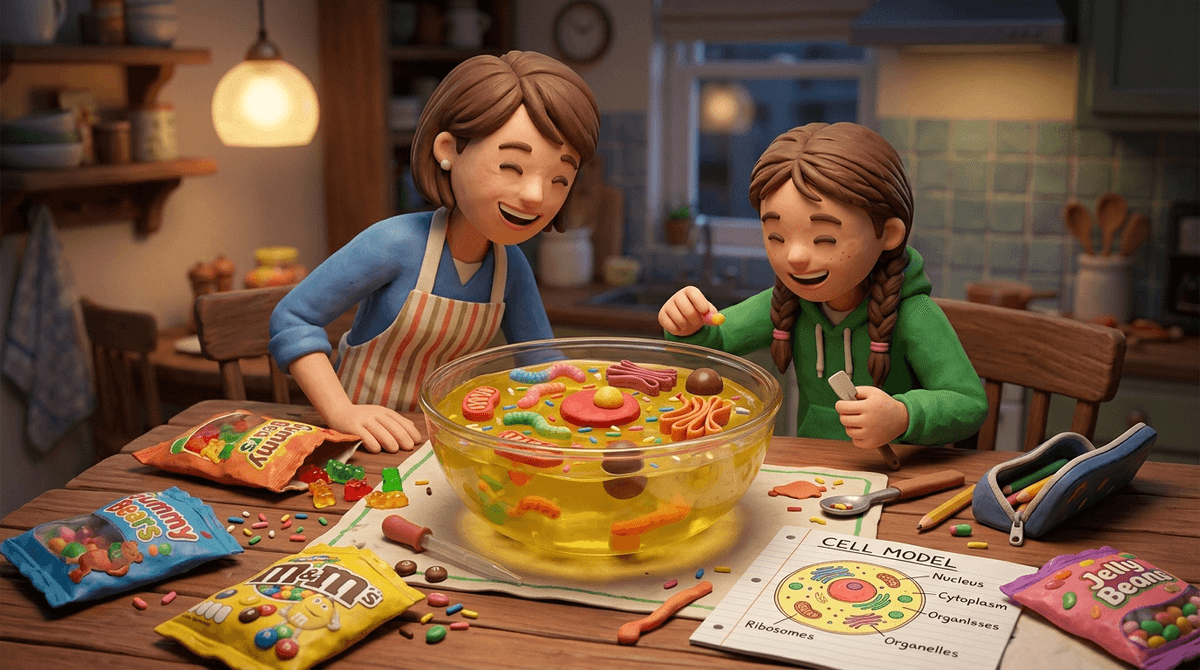
TL;DR: The Best Candy for Your Cell Model
- Nucleus: Ferrero Rocher or a large Jawbreaker
- Mitochondria: Mike and Ikes or Hot Tamales
- Cell Membrane: Fruit Roll-Ups or Sour Belts
- Ribosomes: Nerds or nonpareil sprinkles
- Endoplasmic Reticulum: Gummy worms or folded fruit leather
- Golgi Apparatus: Ribbon candy or folded Airheads
- Vacuoles: Large marshmallows or Gushers
- Lysosomes: Skittles or M&Ms
- Cytoplasm: Lemon Jello (the clear-ish kind) or a tub of frosting
Ask our chatbot for a full grocery list for this project
It’s 8:47 PM on a Tuesday. Your kid just remembered they have a 3D cell model due tomorrow. The "Ohio" energy in the house is peaking, and you’re looking at a pantry that mostly contains half-empty boxes of Goldfish and some questionable fruit snacks.
Don't panic. The "Edible Cell" is the GOAT of middle school science projects because it’s the only homework assignment that lets you eat the leftovers. It’s low-key a core memory for most of us, and honestly, it’s a great way to sneak some actual biology into their brains between rounds of Roblox.
Here is your definitive guide to matching candy to organelles so your kid can get that A (and you can finally go to bed).
Look, we spend a lot of time worrying about "brain rot" and whether Skibidi Toilet is melting our kids' attention spans. But the edible cell project is the ultimate antidote. It’s tactile, it’s visual, and it requires a bit of "entrepreneurial thinking" (the same kind they claim they’re learning in Pet Simulator 99).
Matching a candy’s physical shape and "vibe" to a biological function helps the information stick. When they have to explain why a Mike and Ike is the "powerhouse of the cell," they’re actually learning cellular respiration, not just memorizing a meme.
The Nucleus: Ferrero Rocher
The nucleus is the "brain" of the cell. It’s dense, it’s important, and it contains all the DNA (the instructions). A Ferrero Rocher is perfect because it has layers—the outer shell, the wafer, and the hazelnut "nucleolus" in the center. If you’re nut-free, a large Jawbreaker or a classic Lindt truffle works too.
Mitochondria: Mike and Ikes
The mitochondria is the powerhouse of the cell (say it with me now). You need something bean-shaped and energetic. Mike and Ikes or Hot Tamales are the industry standard here. They look exactly like the diagrams in Khan Academy videos.
Cell Membrane: Fruit Roll-Ups
The membrane needs to be thin, flexible, and capable of wrapping around the whole "cell." Fruit Roll-Ups or Sour Belts are the best choices. If you’re doing a plant cell, you’ll need a "cell wall" too—use something rigid like Graham Crackers or Kit-Kats to provide that structural integrity.
Endoplasmic Reticulum (ER): Gummy Worms
The ER is all about transport. It’s a series of folded membranes. Gummy worms (the long ones) or neon worms work great because you can fold them back and forth.
- Pro-Tip: Use "Sour" gummy worms for the "Rough ER" (the bumps represent ribosomes) and "Smooth" gummy worms for the "Smooth ER."
Ribosomes: Nerds
These are the tiny protein builders scattered throughout the cell. You need something small and grainy. Nerds are perfect because they stick to the "Rough ER" (gummy worms) easily if you use a little frosting as glue. Sprinkles or Pop Rocks also work in a pinch.
Golgi Apparatus: Ribbon Candy or Folded Airheads
The Golgi body is the "post office" of the cell—it packages and ships proteins. It looks like a stack of flattened pancakes. Ribbon candy is the most "accurate," but since that only exists at Grandma's house in December, you can just fold an Airhead or a piece of salt-water taffy back and forth.
Vacuoles: Large Marshmallows or Gushers
In plant cells, the vacuole is huge and filled with water. A giant marshmallow is the best way to represent this. In animal cells, they are smaller, so a Gusher (which literally has liquid inside) is a brilliant, high-IQ choice.
Lysosomes: Skittles or M&Ms
These are the "trash collectors" that break down waste. Any small, circular candy works. Skittles are great because you can pick a specific color to differentiate them from the ribosomes.
Check out our guide on educational YouTube channels for science help
You have two main paths here, and your choice depends on how much you value your kitchen counters:
- The Jello Mold: Use a light-colored Jello (Lemon or Lime) in a clear glass bowl. It looks the most "scientific" because the organelles actually float in the "cytoplasm."
- The Downside: You have to wait for it to partially set before adding the candy, or everything will sink to the bottom.
- The Pizza Box Cake: Bake a sheet cake (or buy one, no judgment) and use frosting as the cytoplasm.
- The Upside: It’s much easier to transport to school without it turning into a sticky puddle.
If your kid is a visual learner, don't just stare at a textbook. Use the tech they already love to get the job done:
- The Amoeba Sisters (YouTube): Their videos are the gold standard for making cell biology actually funny and relatable.
- Cells at Work! (Netflix): If you have an anime fan, this show literally personifies cells in the body. It’s surprisingly accurate and very "cool" for the 10-14 age range.
- Minecraft: If the teacher allows a digital version, building a cell in Minecraft is a massive flex. You can use Glowstone for the mitochondria and Wool for the ER.
- Ages 8-10 (Elementary): Focus on the "Big Three": Nucleus, Membrane, and Cytoplasm. Keep the candy choices simple.
- Ages 11-13 (Middle School): This is the sweet spot for the full organelle list. They should be able to explain the function of each candy choice.
- Safety Note: If you have toddlers in the house, keep the Nerds and Skittles contained. They are major choking hazards and will end up in the rug faster than you can say "adenosine triphosphate."
The "Edible Cell" project is often a kid's first encounter with complex systems. It’s a great time to talk about how different parts work together to create a whole—much like how a family works, or how a Discord server is moderated (okay, maybe that's a stretch, but you get it).
Don't worry about it being "perfect." The goal isn't to create a masterpiece for Pinterest; it's to make sure they know what a ribosome does. If the Golgi apparatus is a bit lopsided because someone ate half the Airheads, it’s not the end of the world.
The best candy for a cell project is whatever you can find at the CVS at 9 PM. But if you have the luxury of planning, go for the Ferrero Rocher/Mike and Ike combo. It’s a classic for a reason.
Once the project is graded and brought home, feel free to let them (and yourself) eat the "mitochondria." You earned it for surviving another science project season.
Ask our chatbot for more science project ideas
Next Steps:
- Check the Rubric: Make sure the teacher doesn't have a "no sugar" policy (some schools are strict about this now—if so, use clay or felt).
- Shop Early: Get the "clear" Jello before it sells out.
- Watch a Vid: Put on The Amoeba Sisters while you assemble to make it feel like "studying."