

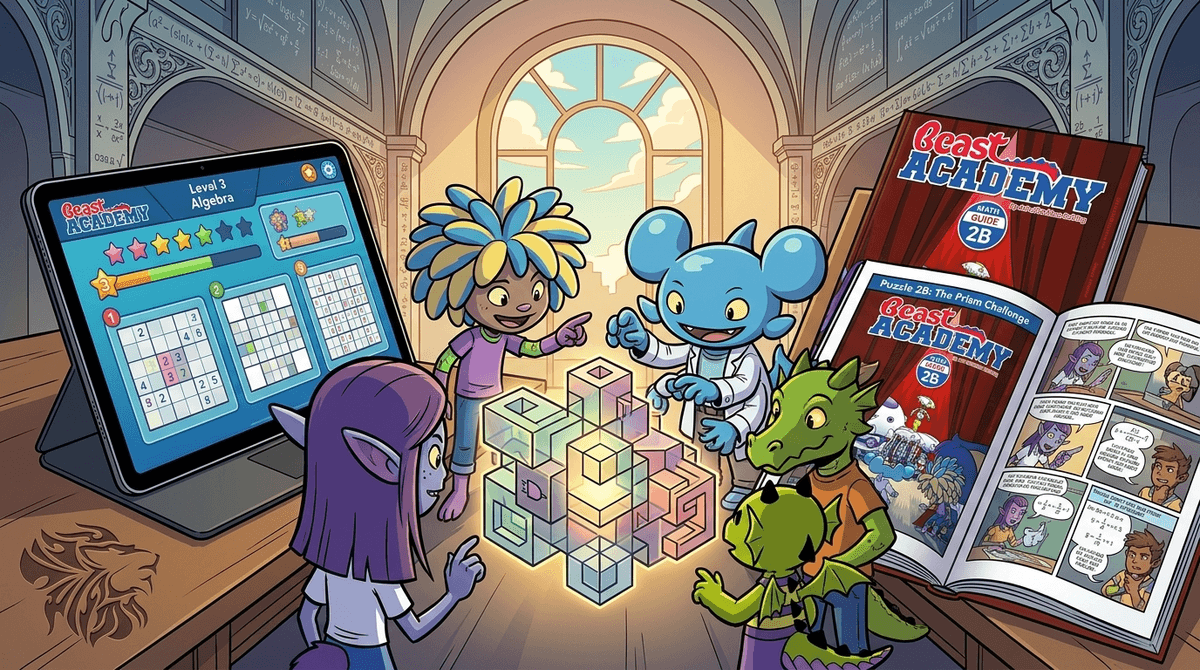
TL;DR: Beast Academy is the "Dark Souls" of elementary math—it’s challenging, occasionally frustrating, but incredibly rewarding for kids who are bored by standard school drills. It swaps dry worksheets for a graphic novel world filled with monsters and high-level problem-solving. It’s perfect for "math-curious" kids (Ages 6–13) who need to learn how to struggle productively.
Quick Links:
- The App: Beast Academy
- The Platform: Beast Academy Online
- The Books: Beast Academy Guide Books
- The Creators: Art of Problem Solving (AoPS)
If you’ve spent any time looking for math apps, you’ve probably seen the "sugar-coated" approach. You know the ones—where your kid plays a generic RPG, and every ten minutes they have to solve 5 + 3 to slay a slime. It’s essentially Prodigy, and while Prodigy has its place, the "math" is often just a toll booth you have to pay to get back to the fun.
Beast Academy is different. Produced by the folks at Art of Problem Solving (AoPS), it’s a rigorous, comprehensive math curriculum for ages 6 to 13. Instead of hiding the math, it makes the math the adventure.
The story follows a group of monsters—like Winnie, Rishard, and Grogg—at a fictional academy. The "textbooks" are actually full-color graphic novels, and the practice platform (available as an app or website) is a series of deep, logic-heavy puzzles that force kids to think like mathematicians rather than calculators.
It feels weird to say kids "love" a math program that is notoriously difficult, but there’s a psychological hook here that most educational apps miss.
- The Comic Book Hook: The Beast Academy Guide Books are genuinely well-written. The monsters have personalities, they make mistakes, and they argue about logic. For a kid who would rather read a graphic novel than do a worksheet, this is a "cheat code" for engagement.
- The "Hard Fun": We talk a lot about "brain rot" content—those YouTube videos or Roblox obbies that provide easy, mindless dopamine. Beast Academy provides "hard dopamine." It’s the feeling of finally cracking a puzzle that seemed impossible.
- Low Stakes, High Challenge: The app uses a "star" system. If you get a problem wrong, the world doesn't end. You just try again. But the problems are designed so that you can't just guess. You have to understand the "why."
We are currently living through a weird era of digital parenting. On one hand, we have Khan Academy and Khan Academy Kids, which are amazing and free but can feel a bit like "school on a tablet." On the other hand, we have the "Ohio" and "Skibidi" side of the internet—pure, chaotic entertainment that requires zero cognitive load.
Beast Academy sits in the middle. It uses the visual language of modern media (comics, avatars, badges) to teach something incredibly difficult.
In most schools, math is taught as a series of steps to memorize. Beast Academy teaches "Productive Struggle." This is the ability to sit with a problem, feel that "this is weird/hard" sensation, and not immediately quit. If your kid is the type to throw an iPad when a Minecraft build goes wrong, they might actually need the controlled frustration that this app provides.
Let’s be real: Beast Academy is not cheap. While Khan Academy is free, Beast Academy Online will run you about $15 a month or over $100 for a year.
The Pros:
- Deep Conceptual Learning: It doesn't just teach multiplication; it teaches the distributive property through visual puzzles.
- Self-Paced: If your kid is a math whiz who is bored to tears by IXL at school, this will finally give them a challenge.
- Total Ecosystem: You can jump between the Beast Academy App and the physical Beast Academy Books.
The Cons:
- The "Wall": Some kids hit a difficulty wall and have a literal meltdown. It is much harder than standard grade-level math. A Level 2 (2nd grade) problem in Beast Academy would stump many 5th graders.
- Parental Involvement: You cannot just "set it and forget it." Your kid will get stuck. You will probably get stuck. You’ll end up looking at the solution together, which is a great bonding moment—unless you’re trying to cook dinner, in which case it’s a "please just do your math" moment.
- The Interface: The app is good, but the Beast Academy Website version is often more stable and easier to navigate on a laptop.
Beast Academy is broken into "Levels" 1 through 5.
- Level 1 (Ages 6-8): Focuses on counting, shapes, and basic comparison. Don't let the "Level 1" fool you; it gets tricky fast.
- Levels 2-5 (Ages 7-13): These roughly correlate to 2nd through 5th grade, but the content goes much deeper. Level 5 covers things like variables, exponents, and negative numbers—stuff usually reserved for middle school.
Pro-Tip: If you’re starting out, start one level lower than your child’s current grade. If you have a 4th grader, start them at Level 3. They will appreciate the confidence boost of "easy" wins before the monsters start throwing the real curveballs at them.
Unlike Roblox or Fortnite, there is zero social risk here.
- No Chat: There is no way for strangers to contact your child.
- No Ads: You are paying for a premium product, so you don't have to worry about your kid being served weird "brain rot" ads or predatory "win free Robux" scams.
- Data Privacy: Art of Problem Solving is a reputable educational company. They aren't selling your kid's data to the highest bidder.
If you introduce this as "extra school work," it will fail. Full stop.
Instead, frame it as a puzzle game. Show them the Beast Academy Guide Books first. Let them read the comics. The monsters are funny, and the art style is very "modern kid-friendly"—think Diary of a Wimpy Kid meets Pokemon.
When they get stuck—and they will—don't give them the answer. Ask, "What did the monsters do in the comic when they saw this?" or "Can we draw this out?"
If Beast Academy feels too intense, there are other ways to build math confidence without the "monsters":
- This is "stealth math" at its finest. It starts with a game about moving colorful boxes and slowly, without the kid realizing it, turns those boxes into algebraic variables. It’s brilliant for younger kids.
- If you want something that aligns perfectly with what they are doing in school (Common Core), Zearn is the gold standard. It’s less "fun" than Beast Academy but very effective.
- Often called the "World of Math," this website is beautiful, interactive, and free. It’s great for visual learners who like to manipulate objects on the screen.
Learn more about the best math websites for elementary schoolers
Beast Academy is the best option on the market for parents who want to move their kids past "rote memorization" and into "deep thinking." It isn't a passive experience. It requires a subscription, a bit of grit, and occasionally a parent sitting nearby to help navigate a particularly tricky logic puzzle.
But in a world of "Ohio" memes and infinite scrolls, giving your kid a digital space where they have to use their brain to win? That’s a massive win for digital wellness.
Next Steps:
- Try the "Placement Tests" on the Beast Academy Website before buying. Seriously. Don't guess the level.
- Buy one Beast Academy Guide Book (physical copy) to see if the comic style clicks with your kid.
- If they love it, grab the Beast Academy App for on-the-go "hard fun."
See if Beast Academy is right for your specific family situation