

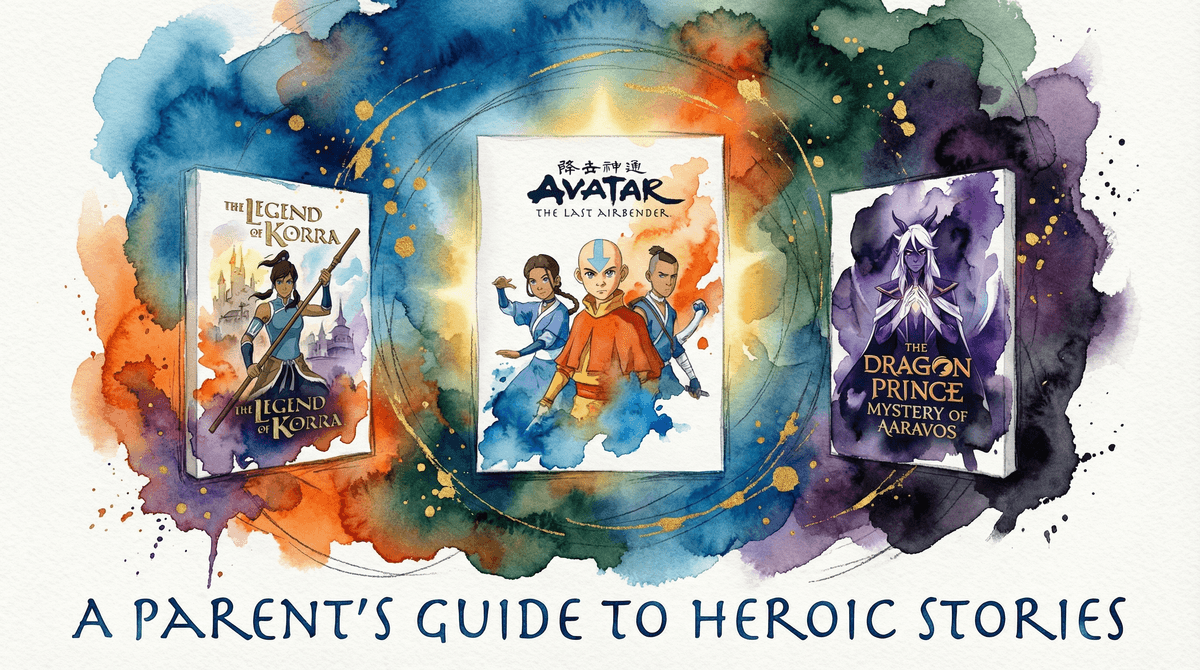
Avatar: The Last Airbender (often called ATLA) is an animated series that originally aired on Nickelodeon from 2005-2008, and it's having a major resurgence thanks to Netflix (where about 40% of families in our community have kids actively using it). The show follows 12-year-old Aang, the last surviving Airbender and the Avatar—someone who can control all four elements (water, earth, fire, air) and is destined to bring balance to the world.
Set in an Asian-inspired fantasy world during a devastating war, Aang teams up with siblings Katara and Sokka from the Water Tribe to master all four elements and stop the Fire Nation's conquest. It's 61 episodes across three seasons, with each episode running about 23 minutes.
Here's what makes it different from most kids' animation: it takes its audience seriously. The show tackles grief, genocide, imperialism, disability, and moral complexity while still being genuinely funny and age-appropriate.
ATLA has achieved something rare—it's genuinely beloved across generations. Kids who watched it in 2005 are now parents themselves, and they're introducing it to their own children.
The action is incredible. The martial arts-based "bending" fight scenes are beautifully choreographed and exciting without being gratuitously violent. Each bending style is based on real martial arts traditions, which kids find fascinating.
The characters actually grow. Over three seasons, you watch these kids mature, make mistakes, face consequences, and develop. Zuko's redemption arc is frequently cited as one of the best character arcs in television history—and yes, that includes adult shows. Kids respond to seeing characters who aren't perfect, who struggle with doing the right thing.
It's funny without being annoying. The humor lands for both kids and adults. Sokka's sarcasm, Toph's bluntness, and the show's self-aware moments work on multiple levels.
The world-building is rich. Kids love learning about the different nations, their cultures, and how bending works. It's the kind of show that sparks imaginative play and creative writing.
Best for ages 7-8 and up, though some families start younger depending on the child.
What to know about content:
- Violence: There's action and fighting, but it's stylized and not graphic. People get hurt but you don't see blood or gore. The stakes are real—this is a war story—but it's handled thoughtfully.
- Scary moments: Some episodes have genuinely intense scenes. The episode "The Puppetmaster" involves bloodbending and has horror elements. "The Southern Raiders" deals with revenge and murder. Younger or more sensitive kids might need to skip certain episodes or watch with you.
- Themes: The show opens with genocide—Aang's entire people were wiped out. This is treated seriously but not graphically. Throughout the series, characters deal with loss, trauma, and difficult moral choices.
- Romance: There's age-appropriate romance and some kissing, but it's sweet and not the focus.
Compared to other shows: It's more emotionally complex than Pokemon but less intense than many anime series. Think somewhere between The Dragon Prince (which was created by ATLA's head writer) and Studio Ghibli films.
This is quality screen time. With 92% of families in our community using TV in some form, the question isn't usually whether kids watch, but what they watch. ATLA is the kind of show that sparks conversations about ethics, responsibility, and what it means to do the right thing when it's hard.
It's a gateway to deeper interests. Many kids get interested in martial arts, Eastern philosophy, or animation as an art form after watching. It's also inspired countless kids to try their hand at creative writing and fan fiction.
The Netflix live-action adaptation is different. Netflix's 2024 live-action version is rated TV-PG and skews slightly older—it's darker and more intense than the animated series. If your kids loved the animation, the live-action isn't automatically appropriate at the same age.
It's a complete story. Unlike many shows that get canceled or drag on forever, ATLA tells its story in three seasons and ends. There's a sequel series, The Legend of Korra, which is excellent but deals with more mature themes and is better for ages 11-12+.
Watch together when you can. This is one of those rare shows where family viewing actually enhances the experience. The themes give you natural conversation starters about handling anger, making amends, and standing up to injustice.
Avatar: The Last Airbender is that rare piece of children's media that respects its audience's intelligence while still being genuinely appropriate for kids. It's earned its status as a modern classic.
Is it perfect for every family? No. Some younger kids will find certain episodes too intense, and some families prefer lighter fare. But if you're looking for something with substance that can grow with your kids—something that teaches empathy, responsibility, and moral courage while being entertaining—this is it.
- Start with Season 1, Episode 1 on Netflix or Amazon Prime Video (where 30% of families have free access for kids)
- Consider previewing "The Puppetmaster" (S3E8) and "The Southern Raiders" (S3E16) before younger kids watch
- Use Screenwise to compare with other animated series your kids might enjoy
- Talk about it together using conversation starters about difficult choices
Remember: intentional viewing means choosing shows that align with your family's values and spark meaningful engagement. ATLA delivers on both fronts.