

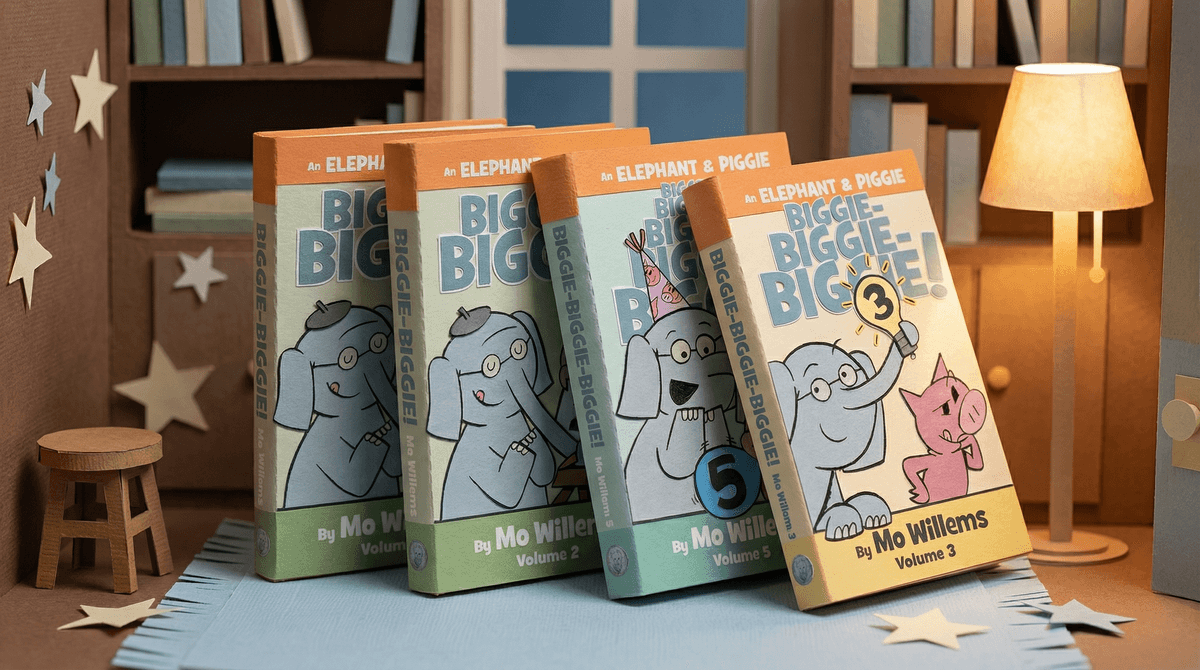
Elephant and Piggie is a beloved early reader series by Mo Willems featuring the friendship between Gerald (a cautious elephant) and Piggie (an enthusiastic pig). These aren't your typical picture books—they're designed specifically for kids making that leap from being read to, to reading independently.
The series includes 25 books total, each clocking in at around 57 pages with simple dialogue, expressive illustrations, and genuinely funny situations. Think comic book meets early reader, with emotional depth that doesn't talk down to kids.
The "Biggie" books are collections that bundle three complete Elephant and Piggie stories into one hardcover volume. There are currently five Biggie books available, each containing different combinations from the series. They're physically larger than the individual books (hence "Biggie"), making them feel substantial and special.
Here's what makes these books stick:
The humor actually lands. Mo Willems has this gift for writing dialogue that feels real and funny to both 6-year-olds and exhausted parents at bedtime. When Piggie dramatically declares something or Gerald spirals into worry, it's genuinely entertaining—not just "cute for a kids' book."
They teach emotional intelligence without being preachy. These books tackle friendship dynamics, disappointment, sharing, worry, and joy in ways that feel organic. Kids see themselves in these characters without feeling like they're being taught a lesson.
The format builds reading confidence. The speech bubbles, limited vocabulary, and repetitive phrases give early readers that "I can do this!" feeling. Many kids who struggle with traditional early readers find success with Elephant and Piggie because the format is so approachable.
They're genuinely re-readable. Unlike some early readers that become painful after the third read-through, these books hold up. The emotional beats and humor work even when you know what's coming.
Let's talk about whether these collections make sense for your family.
The math: Individual Elephant and Piggie books run about $9-10 each in hardcover. A Biggie book costs around $20-25 and contains three books. So yes, you're saving roughly $5-10 per collection compared to buying individually.
When Biggie books make sense:
- Your kid is already hooked on the series and you know you'll be buying multiple books anyway
- You want something that feels substantial and gift-worthy (these look impressive)
- You're okay with not having the complete series and are fine with curated collections
- You like having fewer, chunkier books on the shelf instead of many thin ones
- You're buying as a gift and want maximum impact
When individual books might be better:
- You're just testing whether your kid will connect with the series
- Your early reader gets overwhelmed by longer books (even though they're separate stories, the physical size can feel intimidating)
- You want to collect the complete series in order
- You like the portability of slim books for backpacks, car trips, or restaurant waits
- Your child likes the satisfaction of finishing a whole book quickly
The library angle: These are incredibly popular library books, so if you want to try before committing, your local library almost certainly has both individual titles and possibly the Biggie collections. Many families read through the series via library visits, then purchase favorites or the Biggie books for home ownership.
Ages 4-5: These work beautifully as read-alouds. Kids this age love the expressive characters and can follow the emotional arcs easily. The Biggie format is fine since you're reading to them anyway.
Ages 6-7: This is the sweet spot for independent reading. Kids are typically ready to tackle these on their own, and the success builds serious reading confidence. For brand new readers, individual books might feel more achievable than a Biggie collection.
Ages 8+: Many kids still enjoy these, especially as comfort reads or for reading to younger siblings. Don't let anyone shame your third-grader who still reaches for Elephant and Piggie—emotional regulation and friendship skills are always relevant, and sometimes we all need an easy, joyful reading experience.
These aren't "educational" in the worksheet sense. You won't find phonics lessons or vocabulary lists. But they're teaching something arguably more important: that reading can be fun, that books can be friends, and that stories help us understand feelings.
The series does end. Mo Willems completed the series at 25 books intentionally. This can actually be a gift—your kid can experience the satisfaction of completing an entire series, which builds a sense of reading accomplishment.
They pair well with other Mo Willems books. If your kid loves these, check out the Pigeon books (more picture book format) or Knuffle Bunny series. Willems has a consistent sensibility that kids tend to either love or feel neutral about.
Reading level vs. interest level. These are technically Level 2 readers (Grades 1-3), but the emotional content and humor work for a wider age range. Don't worry if your kindergartener isn't reading them independently yet, or if your third-grader still requests them.
The Elephant and Piggie Biggie books are solid investments if you know your kid loves the series or you want an impressive gift for an early reader. They save money compared to buying individually and look substantial on a bookshelf.
But there's no wrong way to approach this series. Starting with one or two individual books from the library or bookstore is perfectly reasonable. See if the humor and format click with your kid before committing to collections.
The real win here isn't about Biggie vs. individual—it's about finding books that make your early reader excited to read. If Elephant and Piggie does that (and for many kids, it absolutely does), then however you acquire them is the right choice.
- Check your library for both individual titles and Biggie collections to test-drive
- If buying, consider starting with The Elephant and Piggie Biggie Volume 1 which includes three fan favorites
- Ask your kid's teacher which titles they recommend—many elementary teachers have strong opinions about which books are the best entry points
- Explore other early reader series
 if you want to compare formats and find what works for your reader
Remember: any book that gets your kid excited about reading is doing its job. These happen to do that job really, really well.