

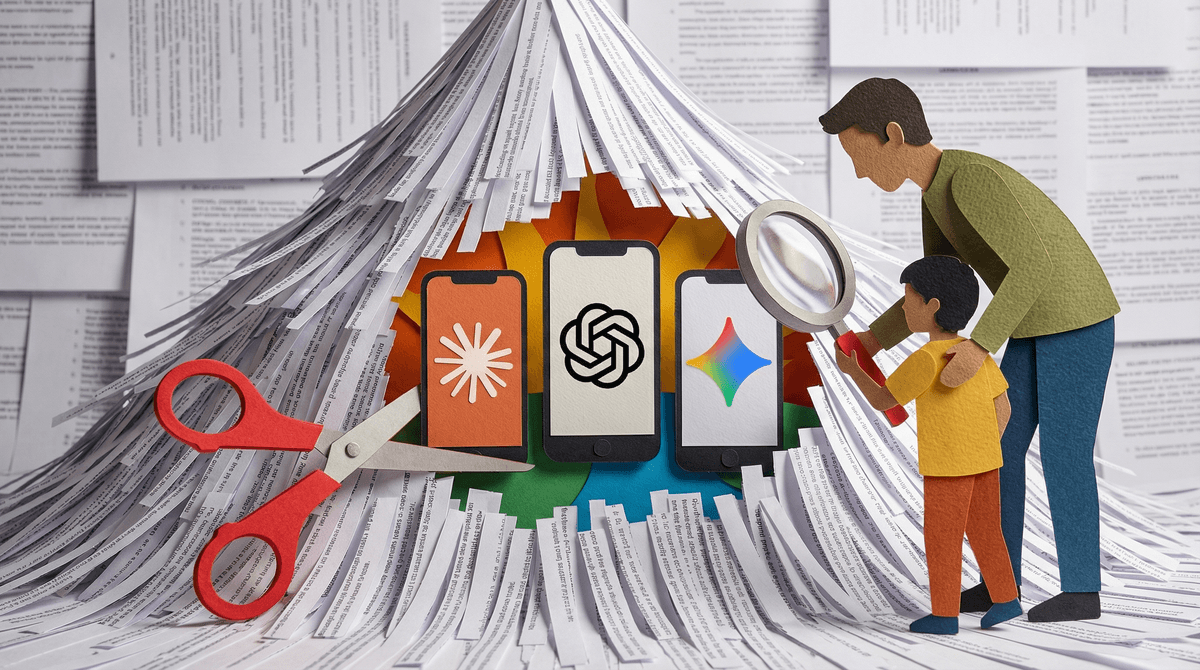
So your 10-year-old wants to use ChatGPT for homework help, or your middle schooler is creating AI art with their friends. You go to sign up and there's this wall of text about "Terms of Service" and "Privacy Policy" and something about being 13 or 18 or maybe it's fine with parental consent? And you're thinking: do I actually need to read all this?
Short answer: kind of, yes. But I'll save you the migraine.
Here's what's happening: AI tools like ChatGPT, Claude, Google's Gemini, and dozens of others have exploded in popularity. Kids are using them for everything from homework to creative writing to just messing around. But unlike traditional apps where the rules have been somewhat standardized over the years, AI policies are still the Wild West. Every company has different age limits, different data practices, and different ideas about what "parental consent" even means.
Look, I get it. You've clicked "I agree" on approximately 47,000 terms of service agreements in your lifetime without reading a single one. We all have. But AI tools are different in a few important ways:
They're learning from your kid's inputs. When your child types a question or shares an idea, that data might be used to train the AI model. Some companies say they don't use kids' data this way. Others are vague about it. Some don't even allow kids at all.
The age limits are all over the place. ChatGPT says 13+ (with parental consent for 13-17). Some AI art generators say 18+. Others don't mention age at all. There's no COPPA-style standard here yet, which means companies are making their own rules.
The content filters vary wildly. Some AI tools have robust safety features for younger users. Others... really don't. And even the "safe" ones can occasionally generate inappropriate content because, well, AI is still pretty unpredictable.
Your kid's creative work might not be theirs. This is the one that gets me. Many AI policies state that anything created using their tool has murky ownership. If your kid writes a story with AI assistance, who owns that story? The answer is often "it's complicated."
Instead of reading every word of these policies (please don't, life is short), here are the specific things worth checking:
Age Requirements
Most AI tools set their minimum age at 13 because of COPPA (Children's Online Privacy Protection Act), which regulates how companies collect data from kids under 13. But some go higher—18+ isn't uncommon, especially for AI image generators that might produce inappropriate content.
If your kid is under the stated age limit, using the tool technically violates the terms of service. Does that mean the AI police will show up? No. But it does mean the company has no obligation to protect your child, filter content appropriately, or handle their data carefully.
Data Collection and Training
This is the big one. Look for language about whether user inputs are used to train the model. The good companies will explicitly state "we do not use data from users under 18 to train our models." The sketchy ones will bury vague language in paragraph 47.
Red flag phrases:
- "We may use your content to improve our services" (translation: your kid's inputs are training data)
- "By submitting content, you grant us a worldwide, perpetual license" (translation: they own whatever your kid creates)
- Anything that's intentionally vague about children's data
Green flag phrases:
- "We do not train on user data from accounts under 18"
- "Users can opt out of data training"
- "We comply with COPPA and similar international standards"
Content Moderation
Does the tool have specific safety features for younger users? Some AI platforms have different tiers—a "family" version with stronger filters, for example. Others treat a 13-year-old the same as a 30-year-old.
Ask yourself: what happens if my kid asks this AI tool something inappropriate? Will it refuse to answer? Give a thoughtful response? Or just... go with it?
Account Control
Can you actually supervise your kid's use? Some platforms offer family accounts where parents can see activity. Others are completely private. Neither is inherently wrong, but you should know which one you're signing up for.
Elementary (under 10): Most AI tools aren't designed for this age group, and honestly, they probably shouldn't be using them unsupervised. If you want to explore AI together as a learning experience, that's different—but letting a 7-year-old have their own ChatGPT account? That's a no from me.
Middle School (10-13): This is where it gets tricky. Technically, most AI tools require users to be 13+. But plenty of 11 and 12-year-olds are using them, often with a parent's email. If you go this route, supervised use is non-negotiable. Sit with them, see what they're creating, talk about how AI actually works and why it sometimes makes stuff up.
High School (14+): At this point, they're probably using AI tools whether you know about it or not. Better to be involved and set clear expectations. Talk about academic integrity, data privacy, and the fact that AI is a tool, not a replacement for actual thinking.
1. Have the conversation before the account Don't just hand over access and hope for the best. Talk about what they want to use AI for, what the rules are, and what happens if they misuse it.
2. Use your own email for their account If your kid is under 18, register AI tools with your email address. This gives you access to notifications and makes it clear you're the supervising adult.
3. Check privacy settings Most AI platforms let you opt out of data training. Do this immediately for any account your kid uses. It's usually buried in settings under "Privacy" or "Data Controls."
4. Set boundaries around use cases AI for brainstorming ideas? Great. AI to write their entire essay? Not great. Be specific about what's okay and what crosses the line.
5. Revisit regularly AI is changing fast. What's true about a platform's policies today might not be true in six months. Check in periodically, especially if your kid is using a tool frequently.
AI policies for kids are a mess right now because we're in the early days of this technology. Companies are figuring it out as they go, which means parents have to be more proactive than usual.
You don't need to become a legal expert or read every word of every policy. But you should know the basics: How old does my kid need to be? What happens to their data? What safety features exist? Those three questions will get you 90% of the way there.
And remember: the goal isn't to keep your kids away from AI forever. These tools are going to be part of their world, probably their careers. The goal is to help them use AI thoughtfully, safely, and with a clear understanding of what they're actually agreeing to when they click that "I accept" button.
Because unlike us, they might actually need to know what's in those terms of service.