

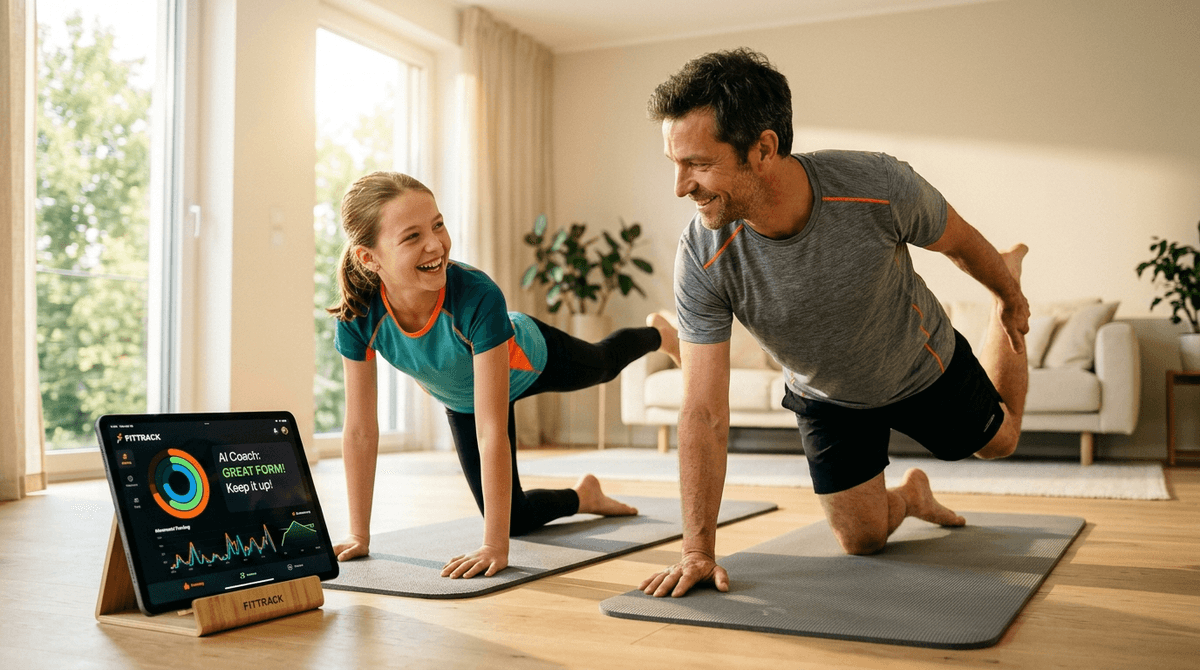

AI health coaches and chatbots can get kids excited about tracking their habits, but they rarely get kids moving more unless parents jump in too. Handing your child a fitness app is not the same as getting them off the couch.
Chatbots and AI health apps fail to increase kids' exercise half the time when kids use them alone, but they deliver real results when built around the whole family.
App stores are flooding with AI-powered wellness coaches, gamified step trackers, and diet chatbots pitched directly at teens and kids. If you are paying for a subscription or letting an algorithm guide your child's daily health routine, you need to know whether the software actually moves the needle or just adds screen time.
Novelty wears off fast. Standalone apps that rely on automated check-ins without household buy-in usually end up abandoned in a home screen folder within weeks.
Pediatricians have spent years struggling to make lifestyle interventions stick once families leave the clinic. When generative AI arrived, researchers rushed to test whether personalized, around-the-clock digital nudges could replace costly human coaching—with 86% of the research in this field published just since 2023.
Children generally enjoy talking to chatbots, but software alone struggles to change physical habits:
- Moving the needle is a coin flip: Only half of the studies that tracked actual movement saw significant improvements in physical activity.
- Engagement can be surprisingly high: One program using ChatGPT to facilitate parent discussion groups reached a 92% active participation rate.
- Clinical results are possible: The most intensive programs saw meaningful shifts, including one pediatric obesity trial where participants lost an average of 25 pounds over five months.
- Personalization is table stakes: Over 70% of programs relied on customized coaching and real-time feedback rather than passive step counting.
A slick user experience masks empty outcomes. Children routinely rate health chatbots as fun, engaging, and easy to use—even while their daily step counts stay flat.
App developers optimize for screen time and interaction metrics, but a child who spends twenty minutes chatting about nutrition with a bot has not actually improved their health. Meaningful behavioral change only happens when the digital coach points the child back toward offline, real-world routines supported by caregivers.
This field is in its infancy. Most of the 14 reviewed studies had small sample sizes, relied on self-reported activity logs rather than objective motion sensors, and took place entirely in wealthy or middle-income nations. Furthermore, the papers provided very little technical detail on how the AI logic was built or verified, making it difficult to know which commercial tools are clinically sound.
- If you are shopping for a fitness or health app for your child… choose one that features personalized coaching and feedback rather than a basic passive tracker.
- If your child wants to use an AI-powered wellness app… sign up alongside them, since 71% of successful interventions require active caregiver participation.
- If your child loves an interactive fitness bot but remains sedentary… do not assume high engagement equals physical fitness; audit their actual movement against their daily goals.
- If an app provides automated diet or medical advice… verify its recommendations with your pediatrician, as generative AI models still require human expert review for safety.
Do not expect an AI chatbot to do the heavy lifting of parenting your child toward a healthier lifestyle. Use digital tools to support shared family goals, but keep human judgment and family routines in the driver's seat.
Jiang Q, Chen XS, Patel D et al. (2026). AI and Chatbot-Supported Interventions for Physical Activity and Obesity-Related Lifestyle Behaviors: Scoping Review With Attention to Family Involvement. JMIR pediatrics and parenting. doi:10.2196/98889 — pubmed.ncbi.nlm.nih.gov