

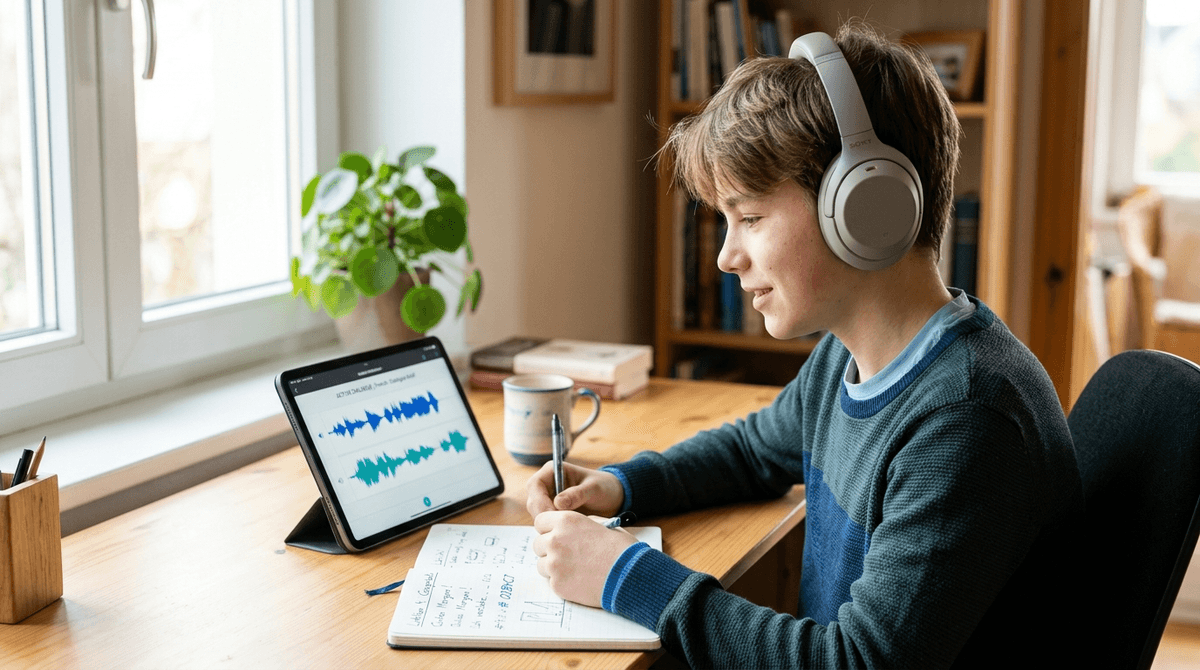
Kids retain significantly more information when educational audio sounds like a conversation between a curious student and an expert, even when both voices are generated entirely by artificial intelligence.
AI-generated lessons that use a two-voice dialogue format boost student comprehension and engagement over traditional solo lectures, performing nearly as well as lessons recorded by human teachers.
Edtech apps and online study platforms are rapidly replacing human narrators with synthetic voices to cut costs and create personalized content on the fly.
Parents often worry that robotic voices will dull a child's focus or degrade learning quality. This finding flips that concern: the structural format of the audio matters far more than whether real human vocal cords recorded it. Choosing study tools that feature back-and-forth conversation instead of a solo narrator can give your child an immediate learning edge.
Digital learning still defaults to passive, one-way lectures that bore students into multitasking. While large language models can now spin up lessons instantly, early attempts simply generated single AI voices reading digital textbooks aloud. Researchers wanted to know if structuring automated lessons as a "cognitive apprenticeship"—where a novice voice asks questions and an expert voice answers—could make automated learning genuinely stick.
Structuring instructional audio as an interactive dialogue produced better learning outcomes across the board:
- Dialogue beats the monologue: Students who listened to two AI voices conversing showed significantly higher comprehension and cognitive engagement than those who listened to a single AI voice narrating the same topic.
- Kids preferred the back-and-forth: Roughly two-thirds of learners rated the conversational format as the most enjoyable way to learn among the options tested.
- Synthetic audio matched human quality: Lessons taught by text-to-speech software were educationally equivalent to recordings by human instructors, showing zero drop-off in what students actually absorbed.
Students actually rated the single-narrator AI voice as sounding more "natural" than the dialogue format, yet they learned less from it.
Smooth listening often creates an illusion of competence—material goes down easily, so the brain glides along without working. The dialogue format forced students to track two perspectives, process clarifying questions, and anticipate answers. That extra mental friction, known as cognitive load, forced the brain to engage deeper and retain more.
Treat these findings as suggestive rather than settled:
- Preprint status: The paper has not yet completed peer review.
- Testing bias: The study tested 245 high school freshmen in Japan and used a fixed-order design, meaning every student heard the dialogue format last. Students may have performed better simply because they were more familiar with the testing format by the end.
- Content variation: The underlying lesson material varied slightly across the three tested formats, meaning the subject matter itself could account for part of the comprehension jump.
- If your teen uses digital study apps or AI homework tutors… look for platforms that frame explanations as an interview, debate, or Q&A rather than a long wall of text or a solo lecture.
- If you are hesitating to buy a learning app because it uses synthetic voices… focus on how the lesson is scripted rather than how realistic the voice sounds; effective instructional design easily offsets an artificial tone.
- If your child complains that a conversational study track sounds "clunky" or awkward… encourage them to give it fifteen minutes anyway, because the mental effort required to follow two voices is precisely what aids retention.
Stop worrying about whether educational audio uses synthetic voices, but start paying attention to the script. A robotic monologue will put your kid to sleep, but an AI conversation that models asking smart questions will help the lesson stick.
Gendo Kumoi, Fumie Watanabe, Tota Suko et al. (2026). A Semi-Automated System for Generating Dialogue-Based TTS Lessons Using Large Language Models: An Exploratory Study of Educational Potential. arXiv (preprint). — arxiv.org