

School textbooks are surprisingly full of errors, but using artificial intelligence to catch them introduces plenty of mistakes of its own.
Researchers built an AI system that caught dozens of factual errors and broken code examples in high school textbooks, proving that published curriculum materials are far less infallible than parents assume. But with an error rate near 38%, the tool still requires human experts to separate genuine mistakes from false alarms.
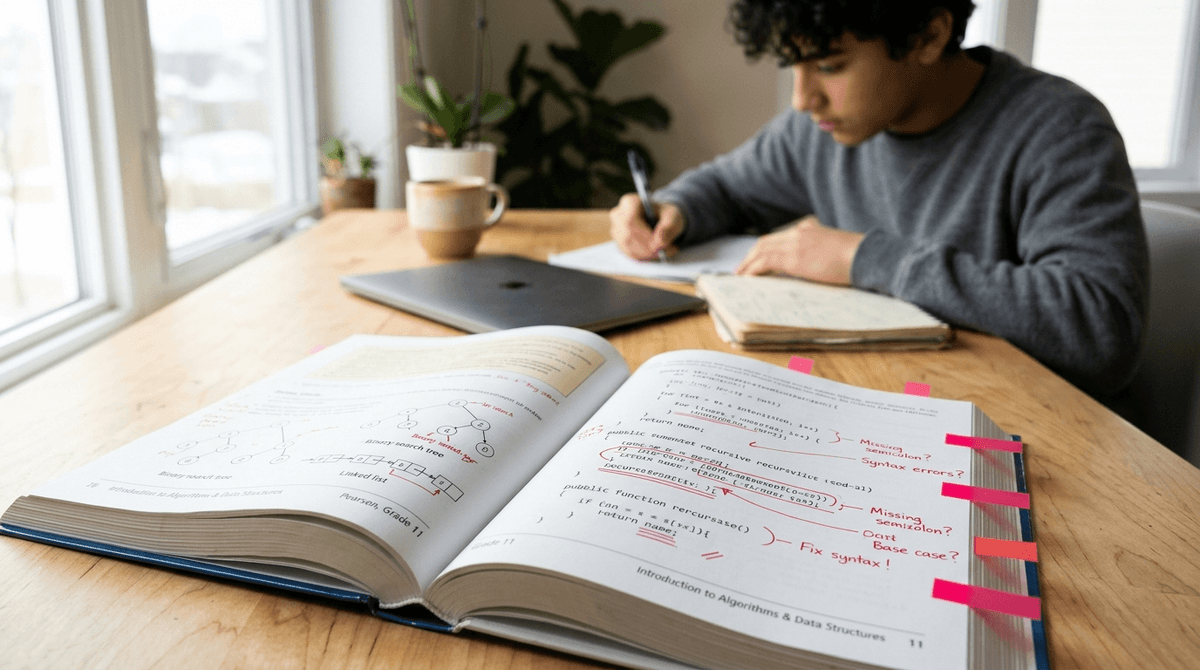
When your teenager struggles with an assigned coding exercise or finds a historical fact that contradicts what they verified online, the issue might not be their comprehension—it might be a flawed textbook. Standard publishing workflows regularly miss broken syntax, flawed definitions, and subtle factual inaccuracies.
Understanding that textbooks contain technical errors changes how you support homework. When printed sample code fails to run or a problem looks contradictory, you can validate your child's skepticism rather than assuming they simply misunderstand the material.
Traditional textbook auditing relies on manual human proofreading, which is expensive, slow, and notoriously bad at catching complex programming bugs across hundreds of pages. In fast-evolving technical subjects, curriculum publishers face massive backlogs of updates, allowing errors to sit uncorrected in print for years.
Auditing two Romanian high school textbooks—one in Computer Science and one in History and Social Sciences—revealed significant gaps in standard editorial quality control.
- Broken code in print: The AI flagged 56 technical errors in the computer science text, with human experts confirming that nearly two-thirds were genuine mistakes, including non-functional code and incorrect technical definitions.
- Factual and historical gaps: In the history and social sciences book, the system identified 72 potential issues, spanning factual inaccuracies, questionable timelines, and ideological slant.
- AI checking AI: To reduce noise, the researchers deployed a multi-agent system where a secondary "Judge Agent" evaluated each flagged error before passing the findings to human editors.
Publishers will almost certainly adopt AI triage tools to lower editing costs on future editions. While that will help eliminate embarrassing coding typos, it also means educational companies may soon rely on automated systems to flag ideological "bias" in history curricula—a subjective task far more complex than catching a syntax error.
This study is an early preprint that has not yet completed formal peer review. The researchers tested only two textbooks in a single language (Romanian), meaning the exact volume of errors may not reflect textbooks from major U.S. educational publishers. Crucially, the AI's 62.5% accuracy rate means that roughly one out of every three flagged issues was a false alarm.
- If your teen's coding homework fails to compile despite matching the textbook example… …test the printed code in an isolated online compiler to check whether the book itself printed broken code.
- If your student spots a historical contradiction between their textbook and a reputable digital archive… …use the discrepancy to teach them how to cross-reference multiple primary sources rather than assuming print is always correct.
- If your school board debates using automated AI screening to review and adopt new textbooks… …push for clear policies requiring human subject-matter experts to verify any content flagged or altered by an algorithm.
Printed curriculum carries real mistakes, and while AI can help human editors catch them faster, it cannot be trusted to run on autopilot. Give your child permission to question the textbook when the code or the facts genuinely do not add up.
Ciprian Cristescu, Adrian-Marius Dumitran, Angela-Liliana Dumitran et al. (2026). Automated Textbook Auditing with Multi-Agent LLM Systems. arXiv (preprint). — arxiv.org