

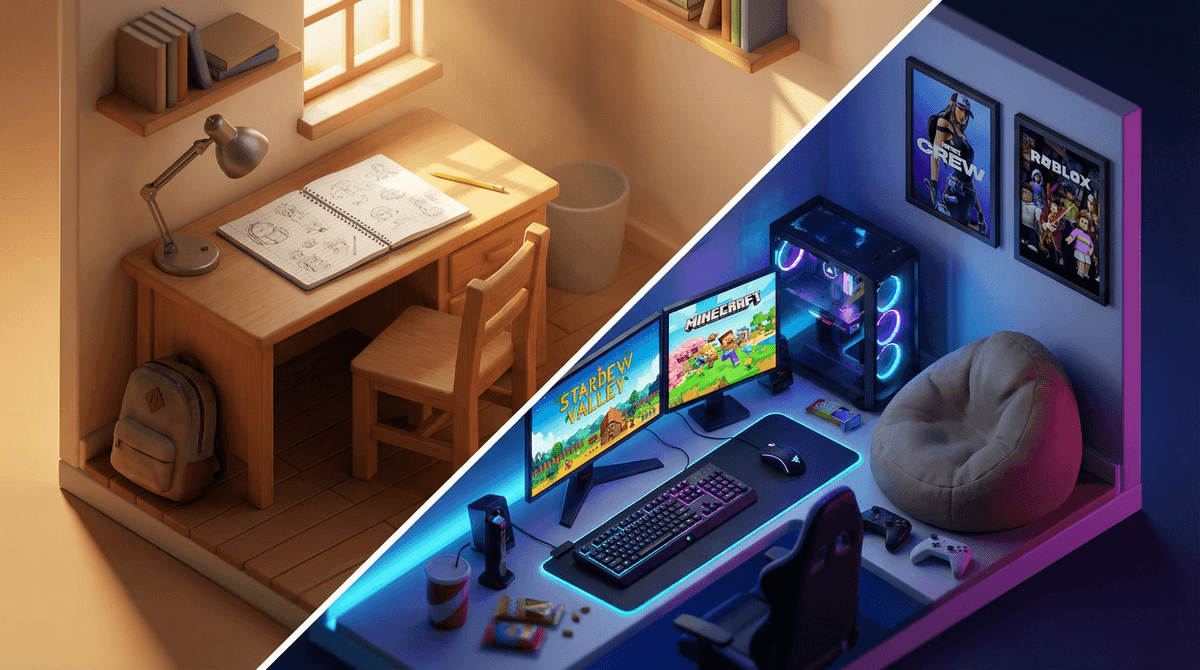
You know the drill. The bus pulls up, backpack hits the floor, shoes fly off, and before you can even ask "how was your day?" they're already asking if they can play Fortnite or Roblox.
The after-school gaming debate is one of the most common flashpoints in modern parenting. And it makes sense why it's so contentious: kids are legitimately tired after school, gaming is their preferred way to decompress, their friends are all online, and you're trying to figure out if letting them play for "just 30 minutes" is self-care or the beginning of a slippery slope where homework never happens and they eat dinner in front of a screen.
The truth? There's no one-size-fits-all answer. But there are some frameworks that can help you figure out what works for your family without losing your mind or feeling like the bad guy every single day at 3:30pm.
Before we get into solutions, it helps to understand what's actually happening here. Kids aren't just being difficult (though sometimes they are). There are real reasons the pull toward gaming is so strong right after school:
Social connection is happening right now. When your kid says "everyone is playing," they're not entirely wrong. The after-school window (roughly 3-6pm) is peak gaming time for kids. If they're not online, they're genuinely missing out on social time with their friends. It's the digital equivalent of everyone going to the park and your kid staying home.
School is exhausting. Even if your kid "just sits at a desk all day," they've been regulating their behavior, navigating social dynamics, and doing cognitive work for 6-7 hours. Gaming offers a low-stakes, high-reward activity that feels like the opposite of school.
It's a transition ritual. Just like you might scroll your phone or watch TV to decompress after work, kids use gaming as a bridge between "school mode" and "home mode." It's not inherently bad—it's just their version of decompression.
FOMO is real. Games like Fortnite and Roblox have limited-time events, daily rewards, and social dynamics that make kids feel like they need to be online. Miss a day and you might miss a special item, a friend's birthday party in-game, or a meme that everyone will reference tomorrow.
Here's where I'm going to be direct: the question isn't really "should my kid play video games after school?" The question is: what else needs to happen in the after-school window, and how do we make sure it does?
For most families, the non-negotiables include:
- Homework/studying
- Physical activity
- Family connection (dinner, conversation, etc.)
- Basic life skills (chores, hygiene, etc.)
- Sleep (which means winding down at a reasonable hour)
If gaming is preventing any of these things from happening, you have a problem. If it's not, you might actually be fine.
Elementary (Ages 5-10): At this age, most kids don't have the executive function to self-regulate gaming time, especially when they're tired. You're going to need to be pretty hands-on here. Consider:
- No gaming until other priorities are done. Homework, snack, maybe some outdoor time first.
- Set a timer. 30-45 minutes is plenty for this age group on a school night.
- Be present. Younger kids often want you nearby anyway—sit in the same room, ask about what they're playing, make it a shared experience rather than isolation time.
Middle School (Ages 11-13): This is the tricky transition age where kids want more autonomy but don't quite have the skills to manage it yet. Gaming with friends becomes much more social and important. Try:
- Experiment with "earn your time" systems. Homework done = 1 hour of gaming. Some families love this, others find it makes everything transactional. Know thyself.
- Consider the homework reality check. If your kid says homework is done but you're seeing grades slip, something's not adding up. Gaming might be happening instead of homework, not after.
- Build in flexibility for social gaming. If there's a special event in Minecraft with friends, maybe that's worth adjusting the schedule for occasionally.
High School (Ages 14+): By now, you're hopefully moving toward a more collaborative approach where your teen has more agency but you're still setting guardrails. Consider:
- Focus on outcomes, not minutes. If grades are good, activities are happening, and they're sleeping enough, maybe you don't need to micromanage gaming time.
- Watch for displacement. Is gaming replacing sleep? Replacing homework? Replacing in-person social time entirely? Those are red flags.
- Talk about self-regulation. High schoolers need practice managing their own time before they head to college. Better to learn these skills now with your support than to crash and burn freshman year.
The "Priorities First" Approach: Gaming is allowed only after homework, chores, and physical activity are done. Simple, clear, enforceable. The downside? Some kids rush through homework poorly just to get to gaming time.
The "Time Block" Approach: Gaming is allowed from 4-5pm (or whatever window works), no matter what. When the timer goes off, it's done. This gives kids predictability and control over how they use that time, but requires you to be okay with homework potentially happening later.
The "Earn Your Weekend" Approach: Minimal or no gaming on school nights, but weekends are much more flexible if the week went well. This works great for some families and feels too restrictive for others.
The "Check-In" Approach: No set rules, but regular conversations about how things are going. "I noticed you've been gaming every day this week—how's homework going? Are you feeling good about things?" This requires a kid who's pretty self-aware and honest.
Gaming isn't inherently bad for after-school time. The research on gaming is actually pretty nuanced. Moderate gaming (roughly 1-2 hours a day) doesn't show negative effects for most kids. It's when gaming starts displacing other important activities that problems emerge.
The transition is the hardest part. Most meltdowns happen when you're trying to get kids off games, not when they're playing. Build in transition warnings , use timers they can see, and try to avoid pulling kids out mid-game or mid-match when possible.
Your kid's friends' schedules matter. If all your kid's friends are allowed to play from 3-5pm and you're saying no gaming until 7pm, your kid is going to feel socially isolated. That doesn't mean you have to change your rules, but it's worth acknowledging the trade-off.
Not all games are equal. Playing Fortnite Battle Royale (high-intensity, competitive, hard to pause) is very different from playing Stardew Valley (chill, pausable, low-stakes). Consider what your kid is actually playing when setting boundaries.
After-school gaming doesn't have to be a daily battle, but it does require intentional decision-making. The goal isn't to eliminate gaming—it's to make sure gaming fits into a balanced after-school routine that includes homework, physical activity, family time, and sleep.
Start by figuring out what your family's non-negotiables are, then build a system that ensures those things happen. Be willing to experiment and adjust. What works in September might not work in February. What works for your 8-year-old might not work for your 13-year-old.
And remember: you're not trying to be the "cool parent" or the "strict parent." You're trying to be the intentional parent who helps your kid learn to balance their digital life with everything else. That's harder than it sounds, and you're going to get it wrong sometimes. That's okay.
- Have the conversation. Talk to your kid about what a good after-school routine looks like for your family. Get their input.
- Try a system for two weeks. Pick one of the frameworks above and commit to it for a trial period. See what works and what doesn't.
- Check in on the details. What games are they actually playing? Learn more about Roblox or Fortnite if those are the go-tos.
- Look for alternatives. If you want to reduce after-school gaming, you need to offer something else that's appealing. Explore alternatives to Fortnite or consider non-screen activities that actually interest your kid.
- Be willing to adjust. If your system isn't working after a few weeks, it's okay to try something different. Parenting isn't about perfection—it's about iteration.