

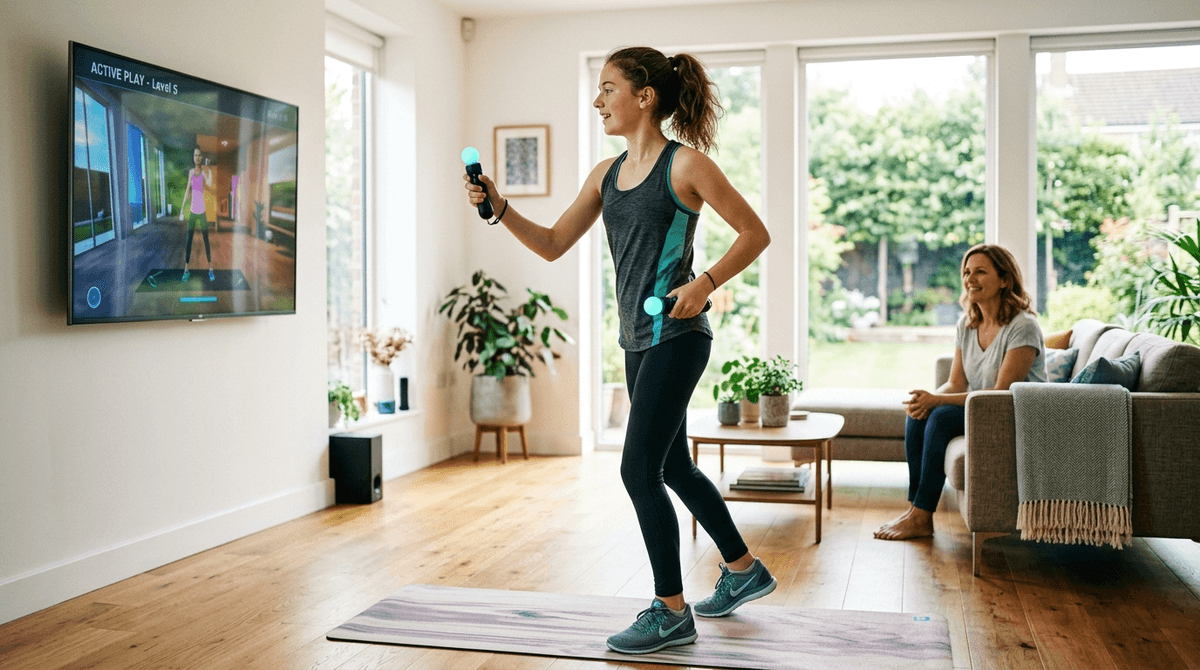

Targeted, motion-controlled video games can significantly strengthen the back muscles teenagers need to correct a slouch. Supervised gaming sessions rebuilt postural muscle activation and upper-body stability in kids with rounded shoulders far better than posture advice alone.
Eight weeks of structured, motion-based gaming strengthens the key shoulder and back muscles required to pull a slouching spine upright.
Nagging a teenager to "sit up straight" fails because slouching is rarely an attitude problem—it is a muscle activation problem. When a child develops thoracic hyperkyphosis (a visibly rounded upper back), the postural muscles between their shoulder blades become weak and unresponsive.
Standard physical therapy exercises fix this, but getting a 13-year-old to do repetitive resistance-band pulls at home is an uphill battle. If motion-controlled gaming delivers the same physical conditioning under professional supervision, parents have a reliable alternative that works with adolescent motivation instead of against it.
Sedentary screen time and heavy backpacks have accelerated postural issues in middle schoolers, but traditional clinical rehab suffers from notoriously high drop-out rates. Physical therapists need rehabilitation protocols that adolescents will actually complete. Researchers wanted to know whether commercial, motion-tracking game interfaces could fire up neglected postural muscles as effectively as clinical exercise drills.
Active gaming visibly reactivated the postural support system in young teens. Over eight weeks and 24 supervised sessions, researchers tracked specific muscle groups and movement metrics:
- Key posture muscles woke up: Children in the gaming group showed significant increases in muscle activation across the middle trapezius, lower trapezius, and serratus anterior—the primary trio responsible for anchoring the shoulder blades back and down.
- Core stability and speed improved: Beyond isolated muscle tone, players demonstrated measurable gains in upper-body balance and hand reaction times compared to the control group.
- Tension stayed balanced: Upper trapezius activation—the neck-shoulder muscle that usually overcompensates and tightens during poor posture—did not spike, meaning the games strengthened the back without creating neck strain.
The magic was not the video screen; it was the kinematic feedback loop. Motion-tracking games force players to make large, dynamic overhead and lateral reaching movements to score points or clear obstacles. Kids were performing hundreds of high-repetition therapeutic shoulder retractions without tracking sets or reps in their heads.
Crucially, the control group received standard posture education and still showed no meaningful physical progress. Handing a teenager a diagram of good posture changes nothing; the spinal stabilizers must be physically loaded under dynamic movement to adapt.
The trial was small and tightly controlled. Researchers followed 44 teenagers across eight weeks, meaning we do not yet know if these muscle gains endure six months later once the novelty wears off.
More importantly, the study compared gaming against an education-only group, not against standard, therapist-led physical therapy. We know active gaming beats doing nothing, but we do not know whether it outperforms a disciplined regimen of traditional resistance bands and rows. Finally, this was a clinical protocol run by professionals, not free-for-all couch gaming.
- If your teen was diagnosed with postural hyperkyphosis or rounded shoulders… ask their physical therapist about incorporating motion-tracking gamified protocols (like Nintendo Switch Ring Fit or VR-based active rehab) into their clinic visits.
- If you plan to try active gaming at home… set up motion sensors that require full standing, overhead reaching, and shoulder retraction, rather than wrist-flick gaming from the sofa.
- If you are currently relying on verbal reminders to fix your kid's slouch… drop the lectures and schedule dynamic, upper-body sports like swimming, rock climbing, or racquet sports that recruit the lower trapezius through play.
Stop nagging your teenager about their posture and focus on activating the muscles that hold them upright. Motion-controlled exercise games offer a clinically backed way to build real back strength without the daily parent-child power struggle.
Kardes K, Zengin Alpozgen A, Akgul T (2026). Effect of video-based game therapy on activation of scapular muscles in children with thoracic hyperkyphosis. PM & R : the journal of injury, function, and rehabilitation. doi:10.1002/pmrj.70178 — pubmed.ncbi.nlm.nih.gov