

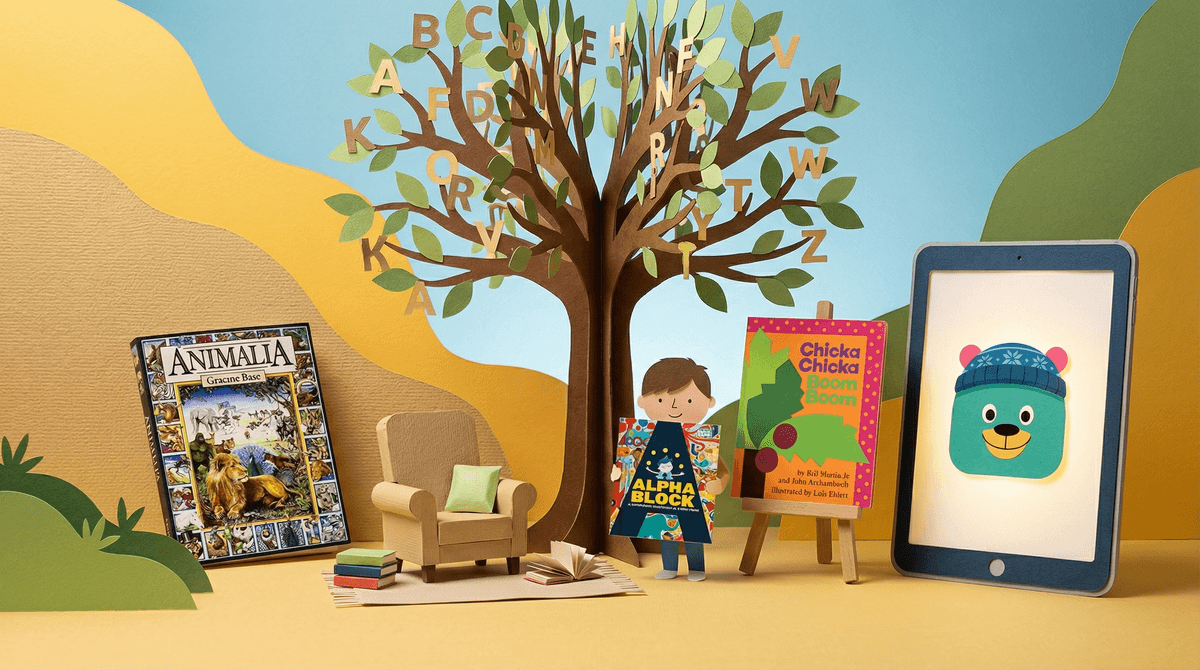
ABC books are exactly what they sound like—books that teach the alphabet through pictures, words, and stories. But here's the thing: they're not all created equal, and they're definitely not just for toddlers anymore.
The classic ABC book pairs each letter with a corresponding image: A is for Apple, B is for Ball, you know the drill. But modern ABC books have evolved into everything from beautifully illustrated art books to clever concept introductions to full-blown narratives that happen to follow alphabetical order. Some are legitimately engaging for kids well into elementary school.
And yes, we need to talk about how these fit into your family's digital life—because chances are, you've got alphabet apps on your tablet, your kid's school uses digital literacy tools, and you're wondering if physical books even matter anymore.
Spoiler: They absolutely do. But not for the reasons you might think.
Look, I get it. There are phenomenal educational apps out there. Khan Academy Kids is legitimately amazing. Endless Alphabet makes learning letters genuinely fun. Your kid's school probably uses ABCmouse or something similar.
But physical ABC books do something different:
They build print awareness. Kids learn that text flows left to right, top to bottom. They see how letters form words on a page. They start understanding that those squiggly symbols have meaning. Apps can teach letter recognition, but they don't teach how books work as physical objects.
They develop sustained attention. A good picture book requires sitting still, focusing, turning pages deliberately. There's no autoplay, no algorithm serving up the next thing, no notification pulling attention away. This is actually a foundational skill for reading comprehension later.
They create shared experiences without screens. Reading together means your kid is looking at the book, not at a screen. You're both focused on the same thing. There's eye contact during the discussion. Physical proximity. These matter more than we realize for language development and bonding.
They're better for bedtime. Blue light before bed is still blue light, even if it's "educational." A physical book doesn't mess with melatonin production or rev up your kid's brain right before sleep.
Ages 2-4: Classic Introduction
- Chicka Chicka Boom Boom - The gold standard. Rhythmic, memorable, actually fun to read aloud for the 47th time.
- Dr. Seuss's ABC - Chaotic and weird, but kids love it. Good for letter sounds.
- Alphaprints: ABC - Touch-and-feel elements keep toddlers engaged.
Ages 4-6: Building Phonics
- Eating the Alphabet by Lois Ehlert - Gorgeous illustrations, introduces vocabulary beyond "A is for Apple."
- Alphablock by Christopher Franceschelli - Die-cut pages make each letter tactile and memorable.
- P is for Pterodactyl: The Worst Alphabet Book Ever - For kids who already know their letters and are ready to laugh at English's ridiculous spelling rules.
Ages 6-8: Concept Books
- The Z Was Zapped by Chris Van Allsburg - Each letter meets a dramatic fate. Great for kids who think they're "too old" for ABC books.
- Animalia by Graeme Base - Insanely detailed illustrations, works as an I-Spy book too.
- Q is for Quark - For your budding scientist who's ready for vocabulary that goes beyond "ball" and "cat."
Here's the honest truth: you don't have to choose between physical books and educational apps. They serve different purposes.
Use apps like Khan Academy Kids or Endless Alphabet for:
- Letter recognition practice
- Phonics drills
- Interactive games that reinforce concepts
- Times when you need 15 minutes to make dinner
Use physical ABC books for:
- Bedtime routines
- Quiet time during the day
- Building the habit of reading for pleasure
- Teaching how to handle books (turning pages, not bending covers, etc.)
- Moments when you can sit together and engage
A reasonable balance for ages 3-6 might look like: 20-30 minutes of reading physical books daily, and 15-20 minutes of educational apps a few times a week. But honestly, every family is different, and the "right" amount depends on your kid's attention span, your schedule, and what's actually working.
Yes, many schools are using digital literacy tools starting in kindergarten. Some have iPads for every student. This doesn't mean physical books are obsolete—it means they're more important than ever as a counterbalance.
Kids who learn to read exclusively on screens often struggle with:
- Reading stamina (physical books require more sustained focus)
- Print materials in real-world contexts (menus, signs, instructions)
- Book handling and care
- Reading without the expectation of interactive elements
Think of physical books as the foundation and digital tools as the supplement, not the other way around.
Skip the "educational" YouTube channels for alphabet learning. Most are just low-effort content farms with autoplay that keeps kids watching for hours. If you're going to use video for learning letters, Khan Academy Kids has actual curriculum design behind it.
Be wary of apps that are more game than learning tool. If your kid is spending more time collecting coins and unlocking characters than actually practicing letters, that's not educational—that's just gamification keeping them hooked.
Don't stress about "falling behind" if your kid isn't reading by age 4. The research is clear: kids who learn to read at 4 and kids who learn at 6 typically perform the same by age 8. What matters more is building a positive relationship with books and reading.
ABC books aren't just about teaching the alphabet—they're about teaching kids how to be readers. How to sit with a book. How to turn pages. How to look at illustrations and make meaning. How to connect written words with spoken language.
Educational apps have their place, and the good ones are genuinely valuable tools. But they can't replace the experience of sitting with your kid, reading a physical book together, and building the foundation for a lifetime of literacy.
Start with 2-3 ABC books that match your kid's age and interests. Read them regularly. Let your kid request the same one over and over (this is actually good for learning). Use educational apps as a supplement, not a replacement. And don't overthink it—the best literacy tool is a parent who makes reading part of the daily routine, whether that's a fancy new release or a beat-up library book you've read 100 times.
- Check out alternatives to educational screen time for more ideas on building literacy without screens
- If you're using educational apps, read our guide on how to evaluate educational apps to separate the genuinely useful from the glorified games
- For kids ready to move beyond ABC books, explore early reader chapter books that build on those foundational skills