

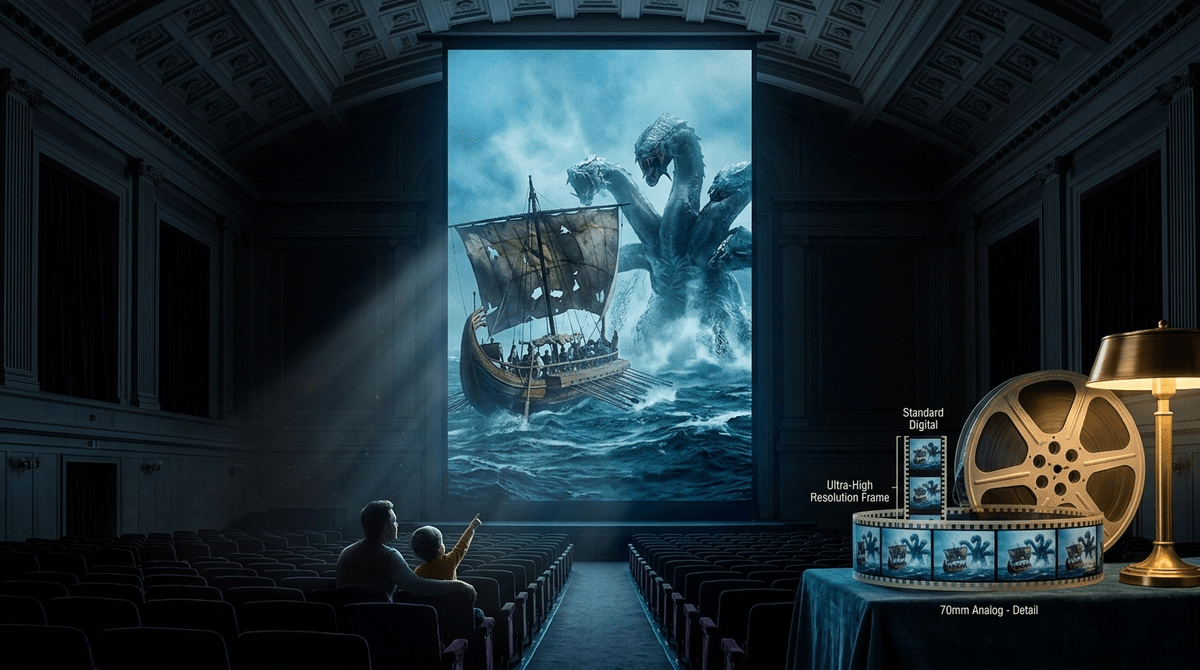
If you are planning to see The Odyssey when it hits theaters, the only version that actually delivers the director’s full vision is 70mm IMAX—and yes, it is worth the extra ten bucks and the hour-long drive. Most "IMAX" screens in local multiplexes are what enthusiasts call "Lie-MAX," which is essentially a slightly larger digital TV. Real 70mm film is a massive, towering experience that fills your entire field of vision, making it the definitive way to see an epic about the scale of the ancient world.
Seeing a movie in 15/70mm IMAX is the difference between watching a spectacle and being inside it. For a massive production like The Odyssey, the 70mm format provides a taller, more detailed image that digital projectors can't match. If you have a "Grand Theater" nearby, make the trek; if you’re stuck with a standard screen, you’re still seeing a great movie, but you’re missing about 40% of the intended picture.
Most parents assume that if the ticket says "IMAX," they’re getting the premium experience. They aren't. Over the last decade, the IMAX brand has been slapped onto hundreds of retrofitted mall theaters. These screens use digital projectors that, while better than the average screen, don't have the resolution or the height of a true film theater.
A real 70mm IMAX screen is nearly square (a 1.43:1 aspect ratio). When the movie shifts into "IMAX mode," the black bars at the top and bottom of the screen disappear, and the image expands vertically to tower over the audience. In a "Lie-MAX" theater, the screen is a standard rectangle, and you lose that verticality. If you’re taking the kids to see the scale of the Cyclops or the churning seas of the Mediterranean, you want that vertical space. It’s what makes the monsters feel like monsters.
Based on the early trailers and production notes, The Odyssey is being framed as a "native" IMAX experience. This means the director used the actual, bulky 65mm film cameras for the big action sequences. When you watch this on a standard screen, the edges of the frame are essentially chopped off to fit the format.
Expect the siren sequences and the descent into the underworld to be the "hero" moments for the 70mm format. The level of detail on a physical 70mm print is roughly equivalent to 18K resolution—far beyond the 4K digital projectors used in 99% of theaters. For kids who are used to watching everything on an iPad, seeing the grain and the light of actual film projected onto an eight-story screen is a core memory in the making.
If you decide to hunt down a real 70mm IMAX screen, you need to know what you’re signing up for. There are fewer than 30 of these theaters left in the United States that can actually run a 15/70mm film print.
- Seating matters more here: In a standard theater, the back row is fine. In a true IMAX theater, the back row is actually the "sweet spot." If you sit in the front three rows, you’ll spend the entire movie panning your head left to right like you’re watching a tennis match. Aim for the back third of the house.
- The "Film" factor: Because these are physical reels of film (sometimes weighing hundreds of pounds), things can go wrong. Projectors can jam; bulbs can flicker. It’s part of the charm for cinema nerds, but for a parent who just drove 45 minutes with three kids, it’s a risk factor.
- The volume: These theaters are built to shake your ribcage. If your kid is sensitive to loud noises, 70mm IMAX might be a "skip" or an "earplugs required" situation. The sound systems in these dedicated buildings are significantly more aggressive than the one at your local AMC.
The format itself isn't the problem; it’s the scale. A jump-scare on a phone is a blink; a jump-scare on an 80-foot screen is a full-body experience. If your kid handles our best movies for kids just fine but gets overwhelmed by loud noises or "big" visuals, the immersive nature of IMAX might be too much.
That said, for a middle-schooler who is currently obsessed with Greek mythology or the Percy Jackson series, this is the ultimate payoff. It turns a school subject into a visceral, living thing.
The biggest friction point is the "neck strain" factor. Real IMAX screens are designed to be immersive, which means they occupy your entire field of view. If you can't get seats in the middle or back of the theater, honestly, don't go. Sitting in the front row of a 70mm IMAX theater is a miserable experience that will leave everyone with a headache before the first act is over.
- The Machine: If the theater has a glass-walled projection booth (many do), go look at it. Showing kids the actual physical platters of film helps them understand that "digital" isn't the only way things are made.
- The Frame: After the movie, ask them if they noticed when the screen got "taller." It’s a great way to start a conversation about how directors use scale to make you feel small or overwhelmed.
- The Drive: If you had to drive a long way, talk about why. Is "better" worth the extra effort? It’s a solid lesson in intentionality over convenience.
Q: How do I know if my theater is "real" IMAX or "Lie-MAX"? Check the screen size and the projector type. If the screen is roughly 80 feet tall and uses a 15/70mm film projector, it’s the real deal. If it’s in a converted auditorium at a local multiplex, it’s almost certainly digital "Lie-MAX."
Q: Is 70mm IMAX too loud for a 7-year-old? It can be. The sound is uncompressed and calibrated to be extremely loud. Bringing a pair of high-quality earplugs (the kind that just lower the volume without muffling the sound) is a smart move for younger kids.
Q: Does 'The Odyssey' have 70mm film prints everywhere? No. There will likely only be a few dozen 70mm film prints in circulation globally. Most theaters will show it on digital IMAX (Laser), which is a "best of both worlds" middle ground—better than standard, but not quite the film experience.
Q: Is it worth the extra ticket price? For a visual epic like The Odyssey, yes. For a standard comedy or a small-scale drama, absolutely not. Save the IMAX budget for the movies that actually use the space.
If you’re going to see a story as big as the Trojan War and the wandering of Odysseus, go big. Find a theater listed as "15/70mm" or "Grand Theater" to see The Odyssey the way it was shot. It turns a movie into an event. If you can't find one, a standard digital screen is fine, but don't let the mall "IMAX" fool you into thinking you've seen the whole picture.
- Check our best movies for kids list for more big-screen recommendations.
- If your kid is into the tech side of this, look into books about movie making
 .
. - Read up on the Percy Jackson series if they want more Greek myths after the credits roll.