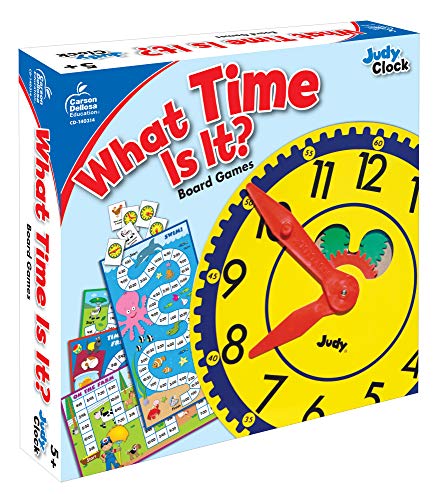
The Analog Hurdle
In an era where every microwave, oven, and tablet displays a digital readout, analog clocks have become a foreign language for many kids. But schools still expect them to decode the 'big hand and little hand' logic by the end of second grade. Carson Dellosa’s approach here is smart because it leans on the Judy Clock—a piece of classroom kit that has survived for decades for a reason. Unlike cheap plastic clocks where the hands spin independently, these are geared. When you move the minute hand, the hour hand moves proportionally. This is vital for kids to understand the relationship between the two.
Four Games in One
The inclusion of four different boards is a nice touch to prevent burnout. You aren't just doing the same farm loop over and over. Whether you're moving through the ocean or a safari, the core loop is the same: draw a card, read the time, and set your clock. It’s a race mechanic, which adds just enough pressure to make the 'work' feel like a challenge.
If your kid is a struggling decoder in reading, they might actually find this kind of visual/mathematical literacy empowering. It's a discrete, masterable skill. It won't replace a deep strategy game like Ticket to Ride, but as a bridge between schoolwork and play, it’s a solid addition to the shelf for the K-2 years.