The Logic of the Drop
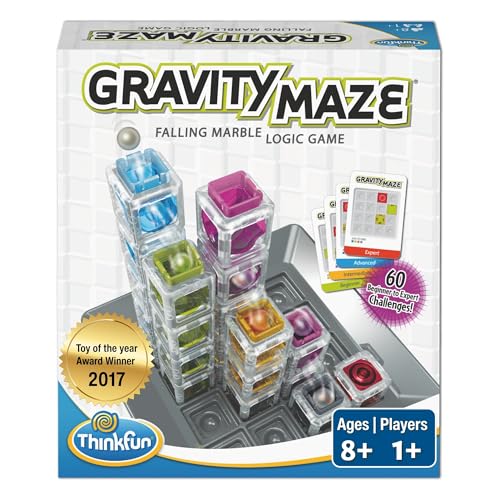
ThinkFun has a knack for turning abstract concepts into plastic toys that don't feel like 'homework.' Gravity Maze is their best execution of this. The premise is simple: you have a starting point, a target, and a set of towers you must use to connect them. But because the towers have different internal ramps and exits, you have to visualize the marble's path in three dimensions before you ever drop it.
Why it sticks
Unlike most board games, this is a solo mission. In a house with multiple kids, it's a great tool for the 'one-in, one-out' strategy where one kid is doing something high-energy while the other needs to regulate and focus. The 60 challenge cards are tiered well; the first ten are basically tutorials, while the last ten will have you, the parent, scratching your head and double-checking the physics.
Comparison to other ThinkFun games
If your kid liked Rush Hour (the car sliding game), they will love this. While Rush Hour is about 2D sequencing, Gravity Maze adds the verticality that makes it feel more like 'real' engineering. It’s also more forgiving than Circuit Maze, which can feel a bit more clinical. This is about motion and gravity, which is inherently more satisfying to watch play out.
If you're looking for a gift that won't end up in the donation bin in six months, this is a safe bet. It’s the kind of thing that gets pulled off the shelf every time a new friend comes over just to show off the 'expert' solutions.