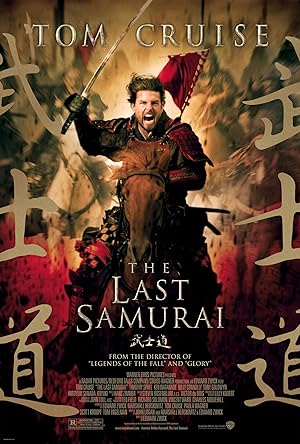
The Shōgun overlap
If your teen spent the last year obsessed with the Shōgun series or is deep into the history of the Meiji Restoration, this is the logical next step. It hits many of the same notes: the "stranger in a strange land" perspective, the friction between feudal tradition and Western technology, and the obsession with bushido.
But where a modern series might take ten hours to let the culture breathe, this is a 2003 Hollywood blockbuster. It moves fast. That means you get the lush cinematography and the epic scale, but you also get a narrative that centers a Western protagonist in a way that feels a bit more "period-piece trope" than "historical deep-dive." Critics weren't entirely sold on it at the time—the 65% Rotten Tomatoes score reflects a certain fatigue with this kind of "outsider finds himself" story—but the 83% audience score is the one to trust here. It’s a crowd-pleaser that actually has something to say.
The friction of the "White Savior" trope
We have to talk about the Tom Cruise of it all. In 2026, the "white savior" narrative is a well-documented cliché, and The Last Samurai is often cited as a prime example. If you’re watching this with a kid who is sensitive to how different cultures are portrayed, they’re going to notice that the story hinges on an American soldier becoming the "most samurai" of them all.
The saving grace is Ken Watanabe. His performance is the anchor of the film. He doesn't play a sidekick; he plays a man watching his entire world evaporate, and he does it with a gravity that often outshines Cruise. If you want to make this a "teachable moment," focus on Watanabe’s character and the actual history of the samurai rebellion. It turns a standard action movie into a conversation about what happens when a country decides to trade its soul for a seat at the global table.
This isn't "fun" violence
The R rating here isn't for a few stray F-bombs or a brief suggestive scene. It’s for the heavy reality of 19th-century warfare. Most modern PG-13 action movies use "bloodless" violence where people fall down and the camera cuts away. This movie does the opposite.
- The final battle involves Gatling guns versus cavalry. It is a slaughter, not a duel.
- The "friction" for most parents won't be the swords; it’ll be the psychological weight. Algren is a man broken by his participation in the American Indian Wars.
- The flashbacks to the massacre of Native American villages are short but visceral. They aren't "cool" action beats; they are depictions of war crimes meant to make you feel Algren's self-loathing.
If your kid is used to the stylized, consequence-free violence of a superhero movie, this will be a shock. It’s much closer to Braveheart or Gladiator in terms of how it treats the human body.
If they liked the "Samurai vibe" elsewhere
If your teen is coming off a binge of high-quality anime or historical dramas, they’ll appreciate the craft here. The production design is incredible—the armor, the villages, and the choreography all feel "expensive" in a way that CGI-heavy modern movies often miss.
It’s a great "bridge" movie. It takes the philosophical themes of classic Japanese cinema and packages them in a high-octane Hollywood structure. Just be prepared for the "after-movie Google." They’ll likely want to know if Nathan Algren was a real person (he wasn't, though he’s loosely based on a French officer) and how much of the ending actually happened. It’s one of those rare blockbusters that actually rewards a trip to Wikipedia afterward.