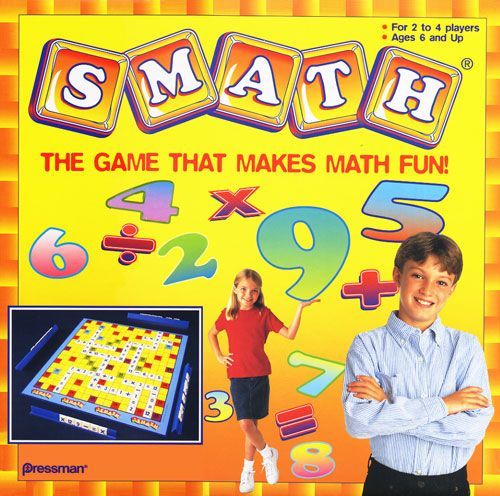
The Scrabble of Arithmetic
There is a reason Smath has been around since 1978. It borrows the most successful board game mechanic of all time—tile-laying crosswords—and swaps letters for numbers. It’s an 'educational game' in the most literal sense. It doesn't try to hide the math behind a fantasy theme or a wacky gimmick. You are there to build equations, period.
For parents, the real value is in the customization. You can literally pull the multiplication and division tiles out of the bag if your first grader isn't there yet. This makes it one of the few games that can actually grow with a kid from ages 6 to 10.
However, we have to be honest: it’s a bit dry. In the world of modern board games, where titles like Prime Climb or Kingdomino offer deep strategy alongside math skills, Smath feels its age. The BoardGameGeek community gives it a fairly low rating (4.2), likely because hobbyist gamers find it simplistic and repetitive. But for a kitchen-table session to reinforce what's happening in 3rd-grade math, it’s a reliable, no-nonsense pick.
It’s best used as a 'supplemental' game. Don't make it the centerpiece of a Friday night, but keep it on the shelf for those rainy afternoons when you want to keep their brains moving without the friction of a workbook.