Our reviews and ratings are 100% unbiased. As an Amazon Associate, Screenwise earns from qualifying purchases, so if you buy a book or game through one of our links, we may earn a commission. We don't get any credit if you just Google it instead :)
Screenwise Verdict
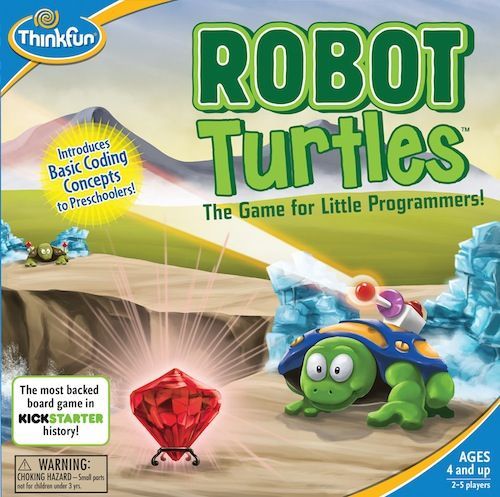
This is one of those rare educational games that actually delivers on its promise without feeling like homework. Robot Turtles teaches legitimate programming fundamentals—sequencing commands, debugging, even basic procedures—through tactile, screen-free play that involves silly voices and racing turtles to cheese.
The genius is in the 'Bug' card mechanic, which lets kids yell 'Bug!' and undo their last move. It normalizes mistakes as part of the process, not failures. Parents consistently report kids laughing and engaged, not frustrated.
The catch: you need to be the 'Turtle Master,' moving pieces and managing the board. This isn't a babysitter game. But if you're looking for quality parent-child time that sneaks in real STEM learning? This is a solid choice. Just know that once your kid hits second grade, they'll probably have maxed it out.
Age Fit
Best for ages 4-8, with the sweet spot around 5-6. Younger kids can play with heavy parent support; older kids will master it quickly but may enjoy teaching younger siblings. Not much here for kids beyond early elementary unless they're genuinely interested in the coding concepts.
WISE Breakdown
Wholesome
88
Cooperative parent-child gameplay with silly noises and laughter. Multiple reviews emphasize fun over frustration, with a 'bug' mechanic that lets kids undo mistakes without penalty. Encourages turn-taking and problem-solving in a low-stress environment. The tone is playful and supportive.
Imaginative
79
Teaches fundamental programming concepts (sequencing, debugging, procedures) through physical play. Each game setup is different with maze walls and warp tunnels, allowing kids to plan routes and think spatially. However, it's more about executing sequences than open-ended creativity—you're solving puzzles, not building worlds.
Safe
95
Board games don't get much safer. No mature themes, no conflict-inducing mechanics, no gambling elements. The game explicitly encourages parents to be 'Turtle Masters' who facilitate rather than compete. Social dynamics are positive—kids are racing turtles, not attacking each other. Durable components that won't become choking hazards.
Enriching
85
Genuinely teaches coding fundamentals—sequencing commands, debugging with the 'Bug' card, and basic computational thinking. STEM skills including problem-solving and critical thinking are baked in. Multiple parents report kids don't realize they're learning. Scales in complexity as kids master basics. Amazon rating of 4.3 and enthusiastic parent reviews confirm real educational value.
Parent Info
✓
Why It Might Be Great
Actually teaches real programming concepts (sequencing, debugging, procedures) without a screen—kids are learning computational thinking while moving physical turtles around
The 'Bug' card lets kids undo mistakes without shame or penalty, normalizing debugging as part of the process instead of failure
Scales beautifully—you can start simple with just forward cards, then add turns, lasers, and obstacles as kids master basics
Parent reviews consistently mention lots of laughter and silly turtle noises—it feels like play, not a lesson
Each game is different with customizable maze layouts, so it doesn't get stale after three plays
⚠
What to Watch For
Requires one parent to be 'Turtle Master' (the facilitator/board manager)—this isn't a 'set it up and walk away' game, especially for younger kids
Very young players (3-4) may need significant hand-holding with card sequencing
Once kids hit 7-8 and master all the mechanics, they may outgrow it unless you have younger siblings to play with
Conversation Starters
"If you could program a robot to do one thing for you, what would it be?"
"What happened when your turtle didn't go where you expected? How did you fix it?"
"Can you think of other things in real life that follow a sequence of steps, like your turtle cards?"
"Why do you think programmers need to be able to 'debug' their code? What if they couldn't fix mistakes?"