The Anti-Screen Brain Trainer
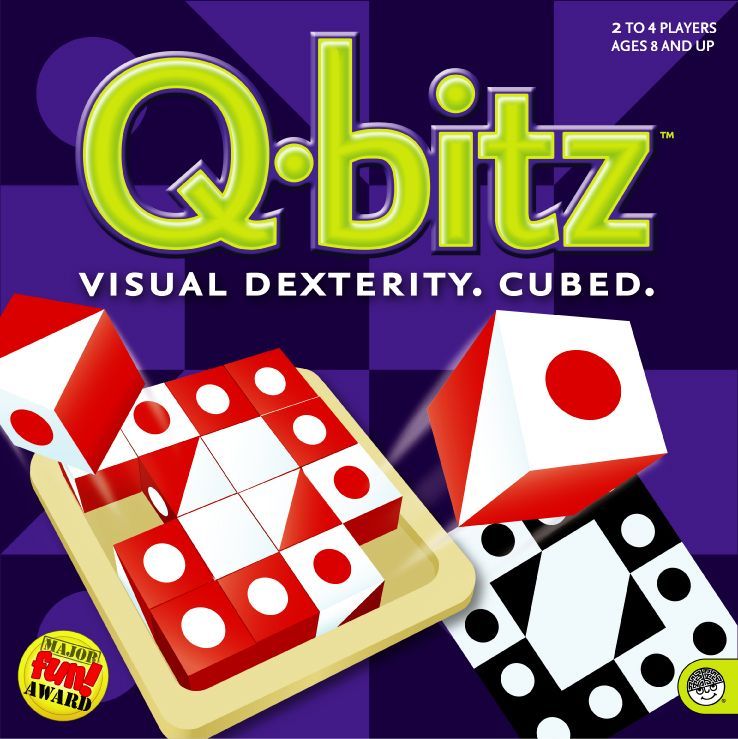
Q-bitz has been around since 2006, and there’s a reason it hasn't been buried by newer, flashier titles. It taps into that specific part of the brain that loves Tetris or Tangrams, but adds a competitive social layer that makes it feel like a sport.
Each player gets a wooden tray and a set of 16 cubes. Every face of the cube has a different geometric pattern (a solid color, a half-triangle, a circle segment, etc.). When a card is flipped, the race is on.
Why the Three Rounds Matter
The genius of the game is the structure. Round 1 is pure speed. Round 2 introduces a luck element where you have to roll your cubes like dice and can only use the faces that land correctly. Round 3 is the memory round: look at the card for ten seconds, flip it over, and build it from your head. This variety ensures that the kid who is fastest with their hands doesn't necessarily win the whole game. It levels the playing field for kids who are more methodical or have better visual recall.
Practical Advice for Parents
If you have a kid who gets 'speed anxiety' or melts down when they lose a race, start with Round 2. The dice-rolling mechanic slows everyone down and adds enough luck that the outcome feels less like a personal failure of speed and more like the 'luck of the roll.' Once they get the hang of the patterns, you can introduce the high-speed Round 1.
It’s also a fantastic solo activity. If you need 15 minutes to get dinner on the table, challenging a kid to see how many cards they can complete against a kitchen timer is a much better use of their 'wait time' than a tablet.