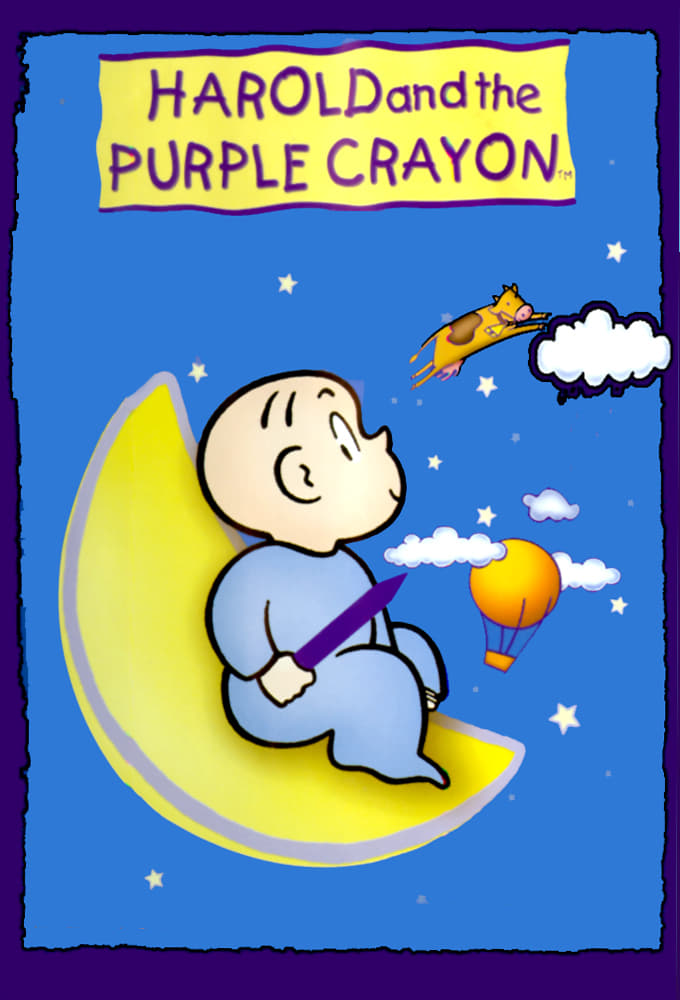
While most children’s programming from the early 2000s has aged into a blurry mess of primary colors and dated CGI, this version of Harold and the Purple Crayon remains a masterclass in restraint. It doesn't try to compete with the loud, neon spectacles of the modern era. Instead, it leans entirely into the logic of a toddler’s dream. If you’ve ever watched a child tell a story where one thing leads to another with zero transition—"and then there was a boat, and then there was a giant pie"—you’ll recognize the rhythm here immediately.
The logic of the line
The brilliance of the show lies in how it handles Harold’s purple crayon. It isn't a magic wand that makes things appear; it’s a tool for problem-solving. When Harold is hungry, he draws a feast. When he’s lost, he draws a landmark. This creates a very specific kind of narrative flow that is rare in television. There are no jump cuts and no frantic scene changes. The camera follows the tip of the crayon as it moves across the screen, which forces a child’s eyes to track a single point of focus. In an era of "hyper-stim" media, this is basically a meditation session for preschoolers.
The voiceover is equally intentional. It’s calm, rhythmic, and avoids the high-pitched, performative excitement that defines a lot of modern "educational" content. Critics on sites like Common Sense Media often point to this as a top-tier choice for kids who struggle with sensory overstimulation. It’s the visual equivalent of a warm glass of milk.
Making the transition from "loud" TV
If your kid is used to the frantic pacing of modern YouTube or high-energy cartoons, they might find Harold boring for the first ten minutes. That’s a feature, not a bug. It’s a great tool for "downshifting" a child’s brain after a long day at daycare or before starting a bedtime routine.
To make it land, don't just treat it as background noise. Because the show is so quiet, it actually rewards active viewing. Ask your kid what Harold should draw before he does it. The show is based on the Crockett Johnson books, which you can find through HarperCollins, and the transition from the page to the HBO series is almost seamless.
The "Crayon on the Wall" factor
Let’s be real about the one friction point: the central premise of the show is a kid drawing on every surface he sees. If you have a toddler who is already prone to "muraling" your hallway, this show might feel like an instructional video for vandalism.
The best way to handle this isn't to skip the show, but to pair it with a specific outlet. Give them a big roll of butcher paper on the floor or a dedicated chalkboard. Tell them they can be like Harold, but only on the "magic" paper. By leaning into the creative spark the show provides, you turn a potential household disaster into a genuine developmental win. It’s one of the few shows that actually makes a kid want to turn the TV off and go do something else, which is the highest praise you can give a piece of media in 2026.