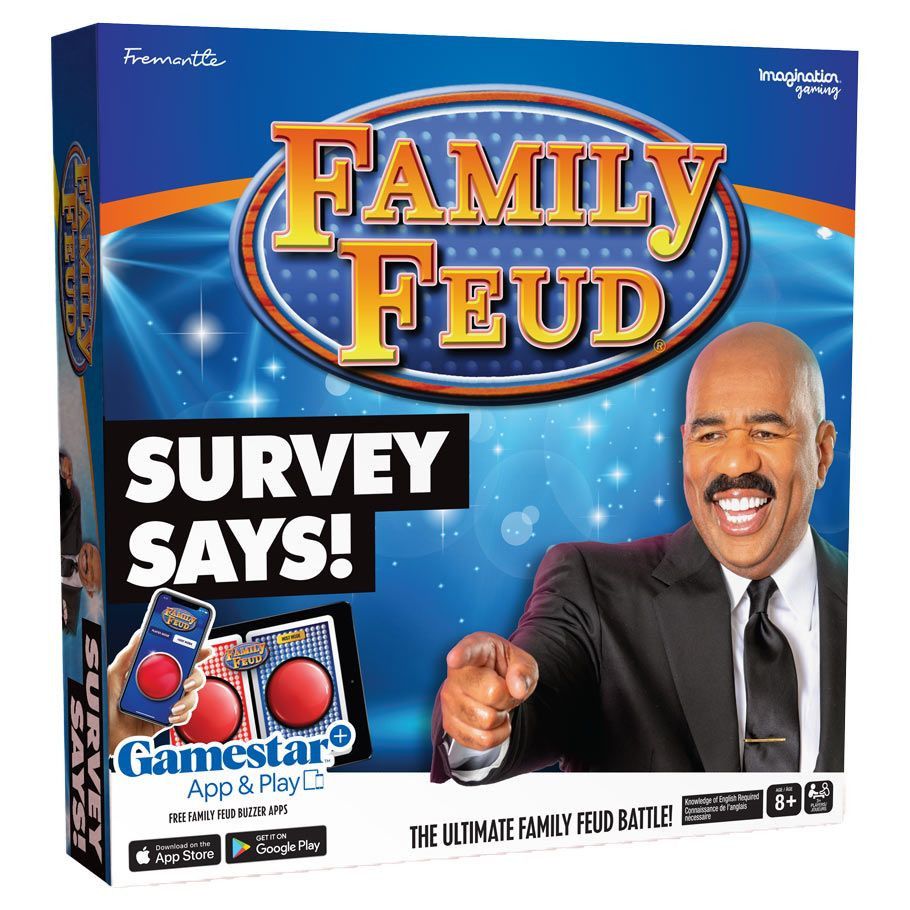
A snapshot of the 1977 hive mind
Playing the original Family Feud board game in 2026 is less about trivia and more about sociology. The game functions exactly like the show: you get a prompt like "Name something you find in a doctor's office," and you have to guess the top answers from a survey of 100 people.
The friction isn't in the rules—which are dead simple—but in the data. The survey results are from the mid-70s. This leads to moments where a kid might say "iPhone" for a prompt about what's in a purse, only to find the 'correct' answer is "checkbook" or "compact mirror." It's a great way to show kids how much the world has changed, but as a competitive game, it can feel unfair when the 'right' answer is something they've never heard of.
Why it still works (sometimes)
Despite the dated questions, the core loop of Family Feud is still one of the best for large groups. It avoids the 'smartest person in the room' trap that ruins games like Trivial Pursuit. You don't have to be a genius; you just have to be average. For kids, this is empowering. They don't need to know the capital of France; they just need to know that most people think of 'baguettes' when they hear 'France.'
If you're going to play this, the move is to play in teams. Put a kid with a grandparent. The grandparent handles the 1977 context, and the kid handles the logic. It's one of the few games where 'knowing stuff' is actually a disadvantage if you can't filter it through the lens of a 1970s survey respondent.