Boggle – WISE Score & Parent Review | Screenwise
Boggle

Boggle

Board Game

Toys & Games, Games & Accessories

WISE
83%

WISE Score

6.2

Board Game Geek

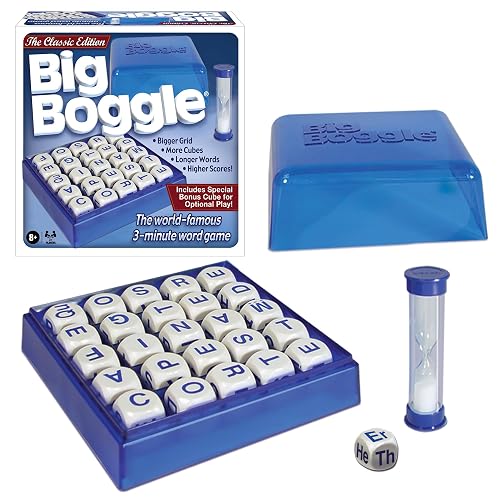
Shake, spot, score—the 3-minute word hunt that's been making families realize their vocabulary isn't as good as they thought since 1972.

Amazon4.8
Board Game Geek6.2
Common Sense Media

Where to Play

Our reviews and ratings are 100% unbiased. As an Amazon Associate, Screenwise earns from qualifying purchases, so if you buy a book or game through one of our links, we may earn a commission. We don't get any credit if you just Google it instead :)

Screenwise Verdict

Boggle is that rare thing: an educational game that doesn't feel like vegetables disguised as dessert. It's just genuinely fun to race against the clock hunting for words, and the learning happens as a side effect.

The 3-minute timer is the secret sauce—it's short enough to keep energy high and long enough to find a decent word list. Unlike trivia games where you either know the answer or don't, Boggle rewards both vocabulary knowledge and visual pattern recognition, so different types of thinkers can succeed.

The main consideration is skill gaps. A 4th grader playing against a parent with a graduate degree isn't exactly balanced competition, but that's also how kids naturally expand vocabulary—by seeing words they didn't know existed. Keep a dictionary nearby for disputes and learning moments.

At a BGG rating of 6.2, it's not winning awards for innovative game design, but that's not the point. It's a reliable, 10-minute, brain-engaging family activity that's been around since 1972 because it works. Throw it in your game rotation.
Age Fit

Best for ages 8-14 as primary audience, though younger strong readers (6-7) can join with help, and adults genuinely enjoy playing. Once kids hit high school, they typically move on unless playing with younger siblings or in a nostalgic family game night setting.

WISE Breakdown
Wholesome
88

Classic word game with zero conflict, no mature themes, and wholesome competitive fun. Players race to find words independently, then share lists—creating moments of 'how did I miss that?' rather than direct confrontation. The 3-minute timer keeps energy high without chaos. Only minor dings for occasional frustration when opponents spot obvious words you missed.

Imaginative
72

Pattern recognition and word-spotting engage spatial reasoning and linguistic creativity—you're literally seeing words emerge from random letters. The 'double letter' cube in Big Boggle adds variability. However, it's bounded creativity within vocabulary constraints rather than open-ended building or storytelling. Replayability is solid since the grid shakes differently each round, but the core mechanic is repetitive.

Safe
95

Board games don't get safer. No mature content, no gambling mechanics, no toxic social dynamics. The simultaneous play means no ganging up or kingmaking. Competitive but not cutthroat—you're racing the clock more than each other. Only minor consideration: vocabulary gaps between players of different ages/skill levels can create imbalance, but that's educational friction, not harmful.

Enriching
82

Genuine vocabulary building, spelling reinforcement, and pattern recognition under time pressure. Kids naturally expand their word knowledge and learn to spot letter combinations. The 3-minute constraint teaches focus and rapid recall. BGG weight of 1.46 means it's accessible but still mentally engaging. Not deeply strategic, but solid cognitive workout. Amazon 4.8/5 and 16K BGG owners suggest lasting appeal.

Parent Info
✓

Why It Might Be Great

  • Genuinely builds vocabulary and spelling skills while feeling like a game, not homework
  • Quick 3-minute rounds mean you can play multiple games or fit one in before dinner
  • Simultaneous play eliminates downtime—everyone's engaged the entire time
  • Works for wide age ranges once kids can read; adults and kids compete on more equal footing than most games
  • That satisfying moment when you spot a 6-letter word no one else found
⚠

What to Watch For

  • Skill gaps matter—a 3rd grader vs. a literature professor isn't a fair fight, though that can be a feature not a bug
  • Handwriting speed becomes a factor; some kids spot words faster than they can write them down
  • Occasional disputes over whether made-up-sounding real words actually count (keep a dictionary handy)
  • The timer can create mild stress, though most kids find it energizing rather than anxiety-inducing

Conversation Starters

  • "What's the longest word you found this round? How did you spot it?"
  • "Did you see any words you weren't sure were real? Let's look them up together."
  • "Which letter combinations do you look for first? Do you have a strategy?"
  • "Have you learned any new words from playing Boggle that you've used in real life?"

Ask Anything

Get a personalized guide on any topic