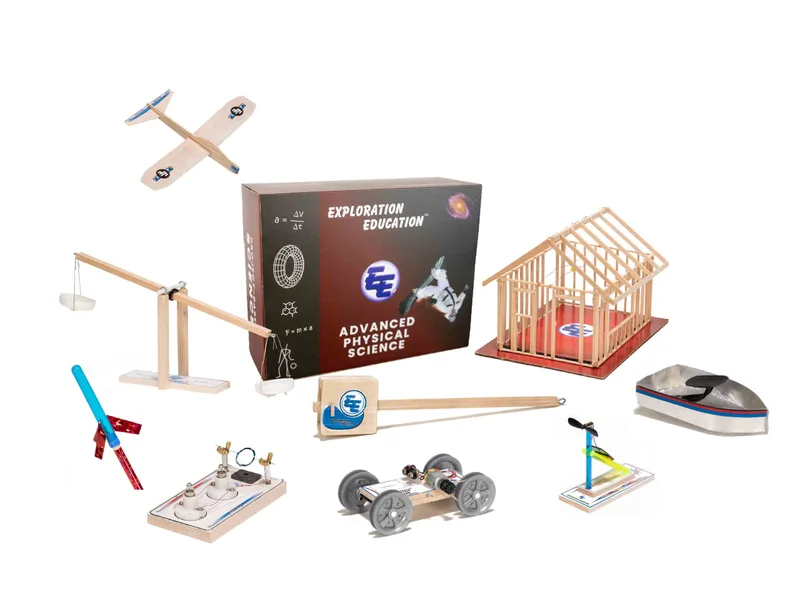
The Open-and-Go Crate Model
Teaching middle school physical science at home usually runs into a logistics wall. You buy a well-regarded physics book, flip to chapter three, and discover the lab requires two meters of enameled magnet wire, an iron core, and three specific plastic pulleys that take four days to ship. The lab gets skipped, and science turns back into reading paragraphs and filling out worksheets.
Exploration Education solves this entirely through packaging. The box arrives packed with small bags labeled by project, containing every wheel, axle, solar cell, wire, and balance component needed across 36 chapters.
Structure and Independence
The Advanced track expands on their standard middle-school course by adding 72 lessons and three advanced builds, bringing the total to 180 lessons and 10 major builds. The workflow is predictable:
- The student opens the computer application to read a concise, interactive lesson covering mechanics, electricity, or energy transfer.
- An animated schematic or audio walkthrough demonstrates the concept.
- The student steps away from the screen to the workbench, follows the physical build instructions, and executes the test.
- They record data and answer synthesis questions in their physical student workbook.
Because the digital prompts explain each step clearly, seventh to tenth graders can manage the workflow independently. Your role shifts from lecturer to quality control inspector when grading lab write-ups at the end of the week.
The Trade-Offs
This is classical, hands-on physical science. It emphasizes mechanics, forces, thermodynamics, sound, light, and basic circuits. What it does not offer is high-level advanced calculus or theoretical modern astrophysics. If your ninth grader wants deeply abstract, equation-heavy math drills, this curriculum may feel too tactile. But for grounding real-world physical laws in tangible hardware, it remains one of the most reliable packages available.