

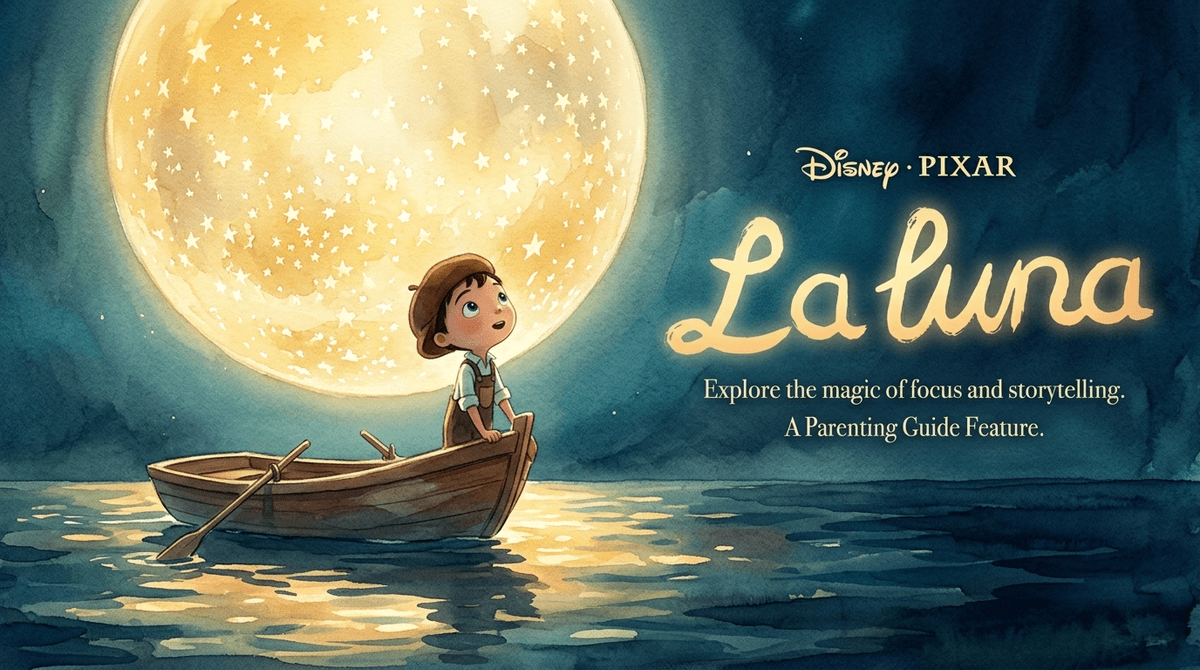
TL;DR: In a world of loud, fast-paced "brain rot" content, Pixar’s La Luna is the ultimate palate cleanser. It’s a seven-minute wordless short that teaches kids how to "read" a story through body language and visual cues rather than just zoning out to dialogue. It’s the perfect gateway to media literacy, emotional intelligence, and deep focus.
Quick Links for Wordless Mastery:
- The Gold Standard: La Luna
- The Next Step (Movie): Wall-E
- The Best Wordless Show: Shaun the Sheep
- The Best Wordless Game: Journey
- The Best Wordless Book: Journey by Aaron Becker
We’ve all been there: you look over at your kid and they are three levels deep into a YouTube Rabbit hole. Maybe it’s a neon-colored "unboxing" video, or perhaps they’ve discovered the bizarre, nonsensical world of Skibidi Toilet. Their eyes are glazed, the volume is too high, and you can practically feel their attention span shrinking to the size of a TikTok clip.
It’s not that all modern content is "bad" (though let’s be real, a lot of it is just digital noise), but it’s often passive. Kids are being told exactly what to feel and think through constant dialogue, loud sound effects, and rapid-fire editing.
If you’re looking to pivot toward more intentional viewing—something that actually builds a kid's "media muscles"—you need to start with wordless storytelling. And there is no better "Starter Kit" for this than the 2011 Pixar short, La Luna.
Directed by Enrico Casarosa (who also gave us Luca), La Luna is a fable about a young boy going to "work" for the first time with his Papa and Grandpa. They row a wooden boat out into the middle of the sea at night, wait for the moon to rise, and then... well, I won't spoil the magic, but it involves a long ladder, a lot of glowing stars, and a very specific family business.
The most important thing? No one says a word. There’s some expressive grumbling and "mhmms," but zero dialogue.

When we talk about "media literacy," we often think about identifying fake news or understanding advertising. But for younger kids (Ages 4-10), media literacy starts with visual inference.
In La Luna, because there is no narrator telling you that the Grandpa and Papa are disagreeing, the child has to look at their body language. They have to notice the way the boy looks back and forth between them, trying to find his own way to do things.
This forces a kid’s brain to move from Passive Viewing (just letting images wash over them) to Active Viewing (interpreting, analyzing, and predicting).
1. It Builds Emotional Intelligence (EQ)
Without dialogue, kids have to rely on facial expressions and "micro-expressions" to understand the characters. When the boy in La Luna finds a giant star, his awe is written all over his face. When he figures out a clever way to solve a problem that his elders couldn't, his pride is silent but massive. Research shows that kids who practice identifying emotions in media are better at doing it in real-life social situations.
2. It Lengthens Attention Spans
Modern kids' TV often uses "staccato" editing—cuts every 2-3 seconds—to keep kids from looking away. Wordless shorts like La Luna or Hedgehog in the Fog use longer takes and slower pacing. It teaches kids that it’s okay to sit with a single image for ten seconds. It’s essentially a "focus workout."
3. It Bridges the Language Gap
Whether you have a toddler who isn't speaking yet or a child who struggles with auditory processing, wordless stories are the great equalizer. Everyone is on the same playing field.
Once your kid has "leveled up" with La Luna, you can start introducing more complex wordless or "near-wordless" media. Here are the top recommendations:
Ages 5+ The first 30-40 minutes of Wall-E are a masterclass in wordless storytelling. It’s basically a silent film set in a post-apocalyptic wasteland. Watching a rusty robot fall in love with a high-tech probe without a single line of dialogue is more moving than most "chatty" rom-coms.
Ages 3+ If you want a series that isn't "brain rot," this is it. Produced by Aardman (the Wallace & Gromit folks), it’s pure slapstick comedy that relies entirely on timing and expression. It’s genuinely funny for adults, too.
Ages 8+ For older kids, this Studio Ghibli co-production is a beautiful, dialogue-free story about a man shipwrecked on a deserted island. It’s more of an "art film" vibe, but it’s a great way to show that wordless stories aren't just for "little kids."
Ages 7+ In the gaming world, Journey is the gold standard. There is no text, no voiceover, and no "tutorial." You just wake up in a desert and start moving toward a mountain. It’s a profound experience that teaches kids about cooperation and exploration without the toxicity of a voice-chat lobby.
Ages 3-8 Don't confuse this with the game above! This is a wordless picture book about a girl who draws a magic door and enters another world. "Reading" a wordless book with your child is one of the best ways to gauge their comprehension—they have to tell you what’s happening in the story.
While wordless media is generally "safe" (it lacks the snarky dialogue or "Ohio" memes you might worry about), there are different ways to approach it based on age:
- Ages 2-4: Use it as a bonding tool. Narrate what you see. "Oh look, the boy is scared! See his big eyes?"
- Ages 5-8: Let them take the lead. Ask, "Why do you think the Grandpa is mad at the Papa?" or "What do you think happens next?"
- Ages 9+: Challenge them to find the "theme." La Luna is really about tradition vs. individuality. Can they see that without being told?
If you watch La Luna with your kid, don't just turn it off when the credits roll. Ask one or two intentional questions to see if their "active viewing" brain was turned on:
- "How did the boy solve the problem differently than his Dad or Grandpa?" (This highlights the theme of finding your own path).
- "Even though they didn't speak, how did you know they were a family?" (This points to body language and shared habits).
- "What was your favorite sound in the movie?" (Since there's no talking, the sound design—the tinkling stars, the creaking boat—becomes its own character).
We can’t protect our kids from the fast-paced, noisy digital world forever. They’re going to see the weird YouTube shorts and the frantic Roblox gameplay eventually.
But we can give them a solid foundation. By introducing wordless masterpieces like La Luna, we’re teaching them that stories don’t have to be loud to be powerful. We’re teaching them to look closer, listen better, and think for themselves.
And honestly? Sitting in silence for seven minutes watching stars glow on the moon is a pretty great "digital wellness" break for us parents, too.