

TL;DR
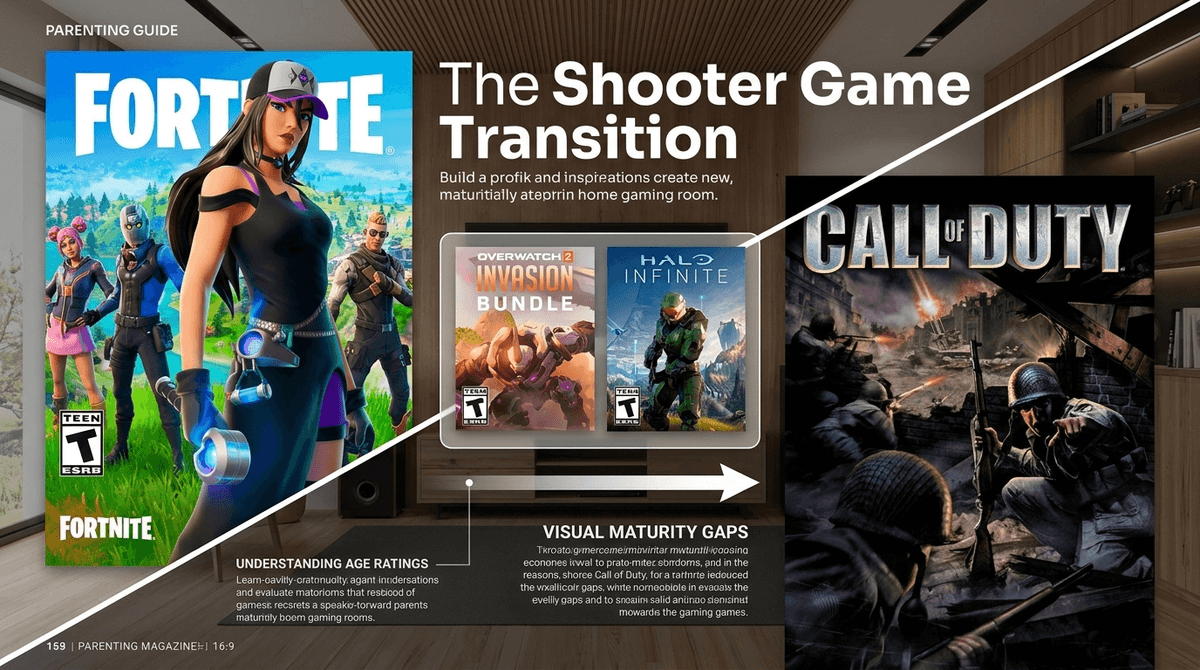
If your kid is asking for Call of Duty, they’ve likely outgrown the cartoonish chaos of Fortnite and want something that feels "adult." The jump from T-rated (Teen) to M-rated (Mature) isn’t just about the blood; it’s about the proximity chat toxicity and the psychological intensity of realistic combat. Before you say yes, consider "bridge" games like Overwatch 2 or Halo Infinite.
Quick Links for the Transition:
- The Gateway: Fortnite
- The Goal: Call of Duty
- The Better Middle Ground: Overwatch 2
- The Sci-Fi Alternative: Halo Infinite
- The Tactical Choice: Tom Clancy's Rainbow Six Siege
It happens to every gaming household eventually. One day they’re obsessed with Roblox and asking you what "Ohio" means, and the next, they’re telling you that Fortnite is "for babies" and they need the new Call of Duty (CoD) to stay relevant at the lunch table.
As parents, we tend to lump all "shooting games" into one bucket, but the gap between Fortnite and Call of Duty is wider than the gap between a Marvel movie and Saving Private Ryan. One is a colorful, gravity-defying sandbox where Peter Griffin can have a shootout with a giant banana; the other is a gritty, high-stress military simulation designed to trigger a literal shot of adrenaline.
Here is the breakdown of how to navigate this request without being the "uncool" parent, while still keeping your kid’s digital wellness intact.
When a parent looks at Fortnite, they see weapons, but when a player "dies," they just get beamed up by a little robot. There is no blood, no bodies, and the stakes feel low. It’s basically digital tag with fancy skins.
Call of Duty is a different beast. We’re talking:
- Realistic Violence: Blood splatter on the screen, realistic death animations, and sound design that makes every gunshot feel heavy.
- Proximity Chat: This is the biggest red flag. In many CoD modes, you can hear the voices of the people you are playing against when you get close to them. If you think the comments section on a viral video is bad, a CoD lobby is a masterclass in creative profanity, racism, and misogyny.
- The "Sweat" Factor: CoD is hyper-competitive. The community refers to high-effort players as "sweats." This leads to much higher levels of frustration and "gamer rage" compared to the more whimsical Fortnite.
Most kids aren't actually craving the gore. They are craving status. In middle school culture, Fortnite has become associated with "the littles." Playing Call of Duty is a rite of passage. It’s a signal that they are moving into young adulthood.
They also love the customization. CoD features a "Gunsmith" system where they can tweak every internal part of a weapon. For a kid who likes engineering or technical details, this is incredibly addictive. It’s the "entrepreneurship" of Roblox applied to military hardware.
If you aren't ready to hand over an M-rated game to an 11-year-old (and honestly, you probably shouldn't), there are several T-rated games that offer the "seriousness" they want without the trauma.
This is a "hero shooter." It’s polished, competitive, and has a massive professional league. It feels more "grown-up" than Fortnite because it requires intense teamwork and strategy, but the characters are still stylized and the violence is bloodless.
The gold standard for sci-fi shooters. It’s rated T, but it feels like a "real" soldier game. The combat is satisfying, the story is epic, and while there is "violence," it’s mostly against aliens and robots. It’s a great way to test if they can handle a first-person shooter (FPS) perspective without the gritty realism of CoD.
Don’t let the bright colors fool you. Splatoon 3 is a highly technical, fast-paced shooter where you shoot ink instead of bullets. It’s incredibly popular with older kids who want to prove their skill without the toxic "military bro" culture.
If your kid likes the "large scale war" feel of CoD’s Ground War or Warzone modes, this is the perfect T-rated substitute. It’s massive, cinematic, and lets them live out fantasies in a universe they already know.
Check out our guide on the best first-person shooters for middle schoolers
If you decide your teenager is ready for Call of Duty, you cannot just "set it and forget it." This game requires active parenting.
- Mute Everything: Go into the audio settings and set "Voice Chat" to "Friends Only" or "Off." There is zero educational or social value in your child hearing a 24-year-old in another state scream obscenities.
- Turn Off Graphic Content: Most CoD titles have a "Graphic Content" filter in the settings that can disable some of the more intense blood and gore effects.
- Monitor the Spending: CoD is notorious for "bundles"—character skins and weapon blueprints that can cost $20+ a pop. It’s Roblox levels of wallet-draining but with a tactical aesthetic.
- The "Rage" Rule: Because CoD is designed to be high-stress, it can lead to some pretty ugly behavior. If the controller starts hitting the couch (or the wall), the console goes off.
Get step-by-step instructions for setting up CoD parental controls
Instead of a flat "no," try to understand the "why." Here are a few conversation starters:
- "I know a lot of kids are playing CoD. What specifically about the game looks fun to you compared to Fortnite?"
- "The ESRB rating is M for a reason. How do you feel about the more realistic military stuff vs the cartoon style you're used to?"
- "The online chat in that game is notoriously toxic. How are you going to handle it if someone starts saying really offensive stuff to you?"
If they can't have a mature conversation about the game, they aren't mature enough to play the game. It’s a simple litmus test.
Fortnite is a playground; Call of Duty is a battlefield.
Most 10-to-12-year-olds are better off in the "bridge" category with games like Overwatch 2 or Halo Infinite. If you do make the jump to CoD, do it with the chat muted and your eyes wide open.
Gaming can be a great way for kids to develop hand-eye coordination and strategic thinking, but we don't need to rush them into adult environments before they have the emotional tools to filter out the noise.
- Audit their current play: Check their Fortnite stats. Are they playing "No Build" or the creative modes? This tells you if they like the shooting or the building.
- Watch a stream together: Sit down and watch 15 minutes of Call of Duty gameplay on YouTube. You’ll know within five minutes if it’s a "yes" or a "not yet" for your family.
- Explore the Screenwise Guide: Is my kid ready for M-rated games?