

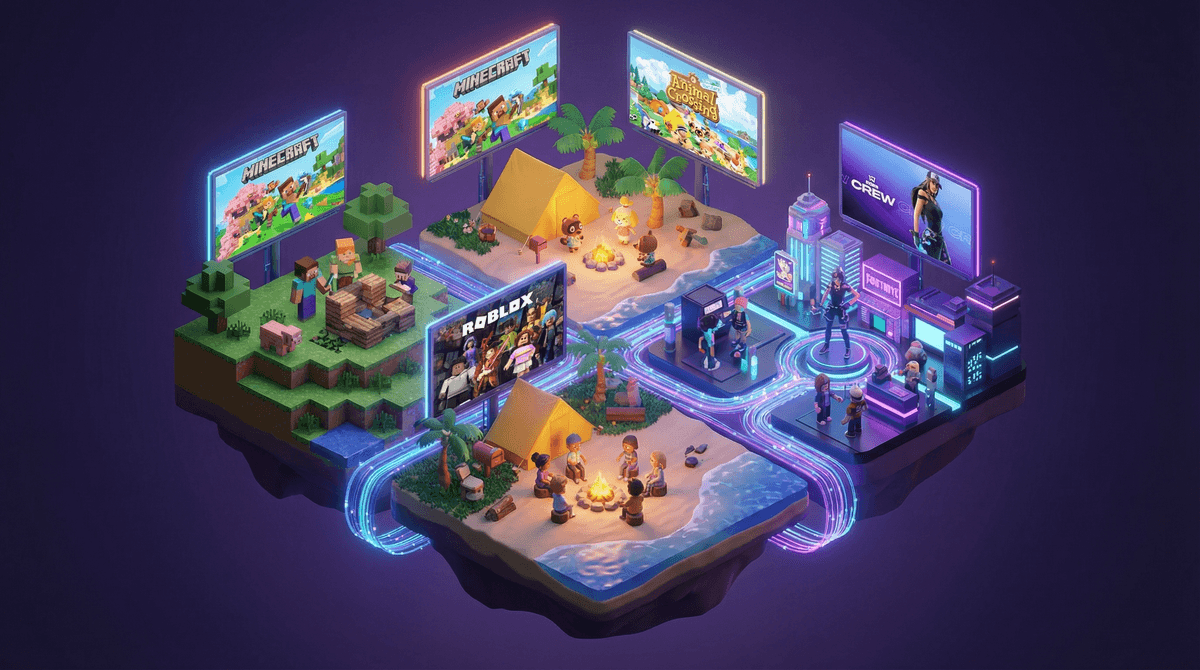
Virtual world games are exactly what they sound like: digital spaces where kids can explore, build, socialize, and yes, spend money. We're talking Roblox, Minecraft, Fortnite Creative, Animal Crossing, and dozens of other platforms where the line between "playing a game" and "hanging out with friends" has basically dissolved.
Unlike traditional video games with a clear beginning, middle, and end, these are persistent worlds that keep going whether your kid is logged in or not. Think of them as the digital equivalent of the neighborhood where kids used to ride bikes until the streetlights came on—except now the streetlights never come on, there's an in-game store on every corner, and you have no idea who else is riding bikes with your kid.
Here's the thing: these games aren't just games anymore. They're social hubs, creative outlets, and for many kids, their primary hangout spot.
The social piece is huge. For tweens and teens especially, virtual worlds are where friendships actually happen. They're not just playing—they're building together, chatting, showing off their latest creation, or just existing in the same space while they talk about school drama. During the pandemic, these platforms became lifelines, and that habit stuck.
The creative element is real. In Minecraft, kids are building elaborate cities, redstone computers, and pixel art that would make you weep. In Roblox, they're literally coding their own games and experiences. Some kids are learning genuine skills—game design, basic programming, project management, even entrepreneurship. The top Roblox creators are making six figures. (Yes, really.)
The infinite variety never gets old. These aren't single games—they're platforms containing thousands of games and experiences. Bored of one? There are 47 million others to try. The algorithm keeps serving up new content, and the FOMO is designed in.
Virtual worlds have virtual economies, and those economies are very good at extracting real money from your wallet.
Roblox has Robux. Minecraft has Minecoins. Fortnite has V-Bucks. Your kid will tell you "everyone has them" and "I need them for this one thing" and suddenly you're explaining why we're not spending $50 on a virtual pet that does literally nothing.
Here's what you should know: these currencies are deliberately confusing. Learn more about how Robux is in fact real money and why the conversion rates are designed to obscure actual costs. That 800 Robux package? That's about $10. That "cheap" item for 350 Robux? That's $4.38 in real money for a digital hat.
The good news: You can set spending limits. Most platforms let you require approval for purchases, set monthly budgets, or disable purchases entirely. This guide to Roblox parental controls walks through the specifics.
The better news: Some kids genuinely are learning about money management, saving up, and making trade-offs. If you frame it right ("here's your monthly gaming budget, you decide how to spend it"), it can be educational.
The stranger danger conversation is real, but it's more nuanced than "never talk to anyone online."
Chat features vary wildly. Minecraft can be played solo or on private servers with just friends. Roblox has open chat with millions of strangers. Animal Crossing limits communication to preset phrases (unless you're using Nintendo's app). Know what your kid is playing and who they can talk to.
Predators exist, but so does normal social development. Yes, you should monitor. Yes, you should have conversations about not sharing personal information. But also: kids need to learn how to navigate social situations, including online ones. The goal isn't to prevent all contact with other humans—it's to build judgment and keep communication open.
User-generated content is unmoderated chaos. In Roblox especially, anyone can create anything. Some games are wholesome. Some are... concerning. There are games that simulate school shootings, games with sexual content, games designed to scam kids out of their Robux. The platform tries to moderate, but with 40 million+ games, it's whack-a-mole.
Practical steps:
- Play together initially to see what they're actually doing
- Set up parental controls (seriously, do this today)
- Keep devices in common areas for younger kids
- Have regular check-ins about who they're playing with
- Trust your gut—if something feels off, investigate
Ages 6-8: Minecraft in Creative Mode or on a private family server is your friend. Animal Crossing is genuinely delightful. Roblox can work but requires heavy parental controls and supervision. Stick to curated experiences.
Ages 9-12: This is peak virtual world age. They can handle more independence but still need guardrails. Set clear rules about chat, friend requests, and spending. Consider alternatives to Roblox if you're concerned about the chaos factor.
Ages 13+: They're going to be in these spaces with or without your blessing. Focus on digital literacy, critical thinking about online interactions, and keeping communication open. Set boundaries around screen time and money, but recognize this is legitimate social time.
Virtual world games aren't inherently good or bad—they're tools. They can teach creativity, collaboration, and problem-solving. They can also be time sinks, money pits, and exposure to content you'd rather your kid not see.
The question isn't "should my kid play these?" for most families. They're too ubiquitous, too social, and too central to modern childhood to avoid entirely. The question is: How do we do this intentionally?
Set boundaries that make sense for your family. Use parental controls. Talk about money and online safety. Play together sometimes. And remember: your kid building a virtual treehouse with friends is still building something, still socializing, still learning. It just looks different than it did when we were kids.
- Audit what they're actually playing. Sit down for 20 minutes and watch. You might be surprised (in good ways and bad).
- Set up parental controls this week. Not someday. This week.
- Establish a money policy. Whether it's "no spending ever" or "here's $10/month," clarity prevents arguments.
- Schedule a weekly screen-free activity. Balance matters. Board games, bike rides, baking—whatever works for your family.
Want to dig deeper into a specific game? Check out our guides to Roblox, Minecraft, and Fortnite for platform-specific advice.