

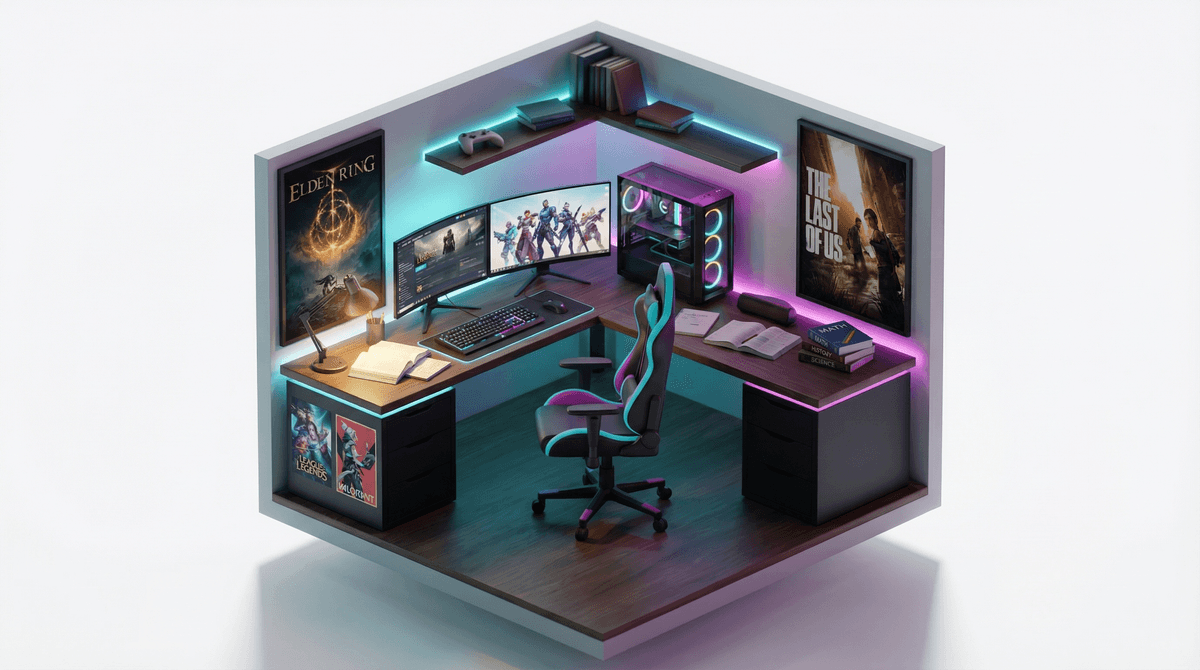
Here's where things get real: teen gaming isn't just about playing anymore. We're talking about games with complex narratives, mature themes, online voice chat with strangers, microtransactions that would make a Vegas casino blush, and social dynamics that can feel like a second job.
The teen gaming landscape spans everything from competitive esports titles like Valorant and League of Legends to story-driven experiences like The Last of Us and open-world adventures like Elden Ring. Your teen might be grinding ranked matches at 11pm, watching Twitch streams for "research," or genuinely engaged in creative problem-solving that would impress their teachers (if only they applied the same energy to homework).
The shift from kid gaming to teen gaming isn't just about ESRB ratings jumping from E to M. It's about online interactions becoming more intense, time investments getting serious, and the line between "hobby" and "lifestyle" getting blurry.
Let's be honest: gaming gets a bad rap. But before we panic about screen time, let's acknowledge what teens are actually getting from gaming:
Social connection that feels real. For many teens, gaming IS their social life. Squad-based games like Fortnite or Apex Legends aren't just games—they're where friend groups hang out. Yes, even if they're also seeing each other at school. The Discord server is the new mall food court.
Mastery and achievement. Teens are in this weird developmental space where they're seeking competence and autonomy. Ranking up, completing difficult challenges, or finally beating that boss provides concrete evidence of growth. Unlike algebra homework, gaming gives immediate feedback and visible progress.
Creative expression. Games like Minecraft, Roblox, and The Sims 4 are legitimate creative platforms. Some teens are learning actual coding, 3D modeling, or game design through these experiences.
Stress relief and escapism. Teen life is genuinely stressful. Gaming provides a controlled environment where they have agency, unlike the chaos of high school social dynamics or academic pressure.
That said—and this is important—all of these benefits can tip into problems when gaming becomes the ONLY source of these things.
Forget "video games cause violence" (they don't, full stop, the research is clear). Here are the actual concerns:
Time Displacement
When gaming crowds out sleep, physical activity, face-to-face socializing, and responsibilities, that's a problem. Not because gaming is evil, but because balance matters. A teen who games 4 hours on Saturday afternoon? Probably fine. A teen who's gaming until 3am on school nights and skipping meals? Not fine.
Online Toxicity
Teen gaming spaces can be genuinely nasty. Racist, sexist, homophobic language is unfortunately common in competitive games. Voice chat can expose teens to harassment, especially girls and LGBTQ+ kids. Learn more about gaming toxicity and how to address it .
.
Addictive Design
Modern games are engineered to keep players engaged. Battle passes, daily rewards, FOMO-inducing limited-time events—this isn't accidental. Some teens can self-regulate; others struggle against design patterns created by teams of PhDs in behavioral psychology.
Money, Money, Money
"Free-to-play" is a lie. Games like Genshin Impact or FIFA can drain hundreds or thousands of dollars through microtransactions, loot boxes, and cosmetics. Teens don't always grasp real-money implications of V-Bucks or Robux.
Blurred Lines Between Gaming and Gambling
Loot boxes, gacha mechanics, and randomized rewards trigger the same psychological responses as slot machines. Some countries have literally classified these as gambling. Your teen might be developing problematic patterns without realizing it.
Ages 13-14: Still in that transition zone. They want more mature content but may not be ready for everything. Games rated T (Teen) are generally appropriate, but read the content descriptors. Stardew Valley, Hollow Knight, and Splatoon 3 hit that sweet spot of engaging without being inappropriate.
Ages 15-16: Can probably handle most M-rated content, but context matters. The Last of Us Part II has intense violence but also sophisticated storytelling about trauma and humanity. Grand Theft Auto V? That's mostly just chaos and objectification. Know the difference.
Ages 17-18: Legally able to buy M-rated games. At this point, content restrictions matter less than time management and online safety. Focus conversations on healthy habits rather than what they can play.
Play together or watch them play. You don't need to become a gamer, but spending 30 minutes watching them play and asking genuine questions shows interest and gives you insight into their world. Plus, teens are often thrilled to be the expert teaching you something.
Set clear expectations about time, not arbitrary limits. Instead of "2 hours max," try "gaming comes after homework and dinner, and screens off by 10pm on school nights." Focus on protecting sleep and responsibilities rather than micromanaging minutes.
Talk about online interactions explicitly. Discuss what to do when someone is toxic in chat (mute, report, leave), how to recognize manipulation or grooming, and why they shouldn't share personal information. Make yourself a safe person to tell if something uncomfortable happens.
Monitor spending, not by surveillance but by structure. Use family payment methods for gaming purchases, require approval for transactions, and have honest conversations about why games are designed to make you want to spend money. Here's how to set up parental controls for spending.
Watch for warning signs of problematic gaming: declining grades, withdrawal from other activities, irritability when not gaming, lying about gaming time, or gaming interfering with sleep. These suggest a conversation with a therapist might be helpful, not punishment.
Teen gaming isn't inherently good or bad—it's a tool, a social space, and a hobby that can be healthy or harmful depending on how it fits into their life. Your job isn't to eliminate gaming or become the fun police. It's to help your teen develop self-awareness, time management skills, and the ability to recognize when something that feels good is actually becoming a problem.
The teens who navigate gaming healthiest aren't the ones with the strictest parents. They're the ones whose parents stayed curious, set reasonable boundaries, and kept communication open even when things got complicated.
And remember: you're not trying to raise a teen who never games. You're trying to raise an adult who can manage their relationship with gaming (and all digital media) in a healthy way. That's a much more realistic and useful goal.