

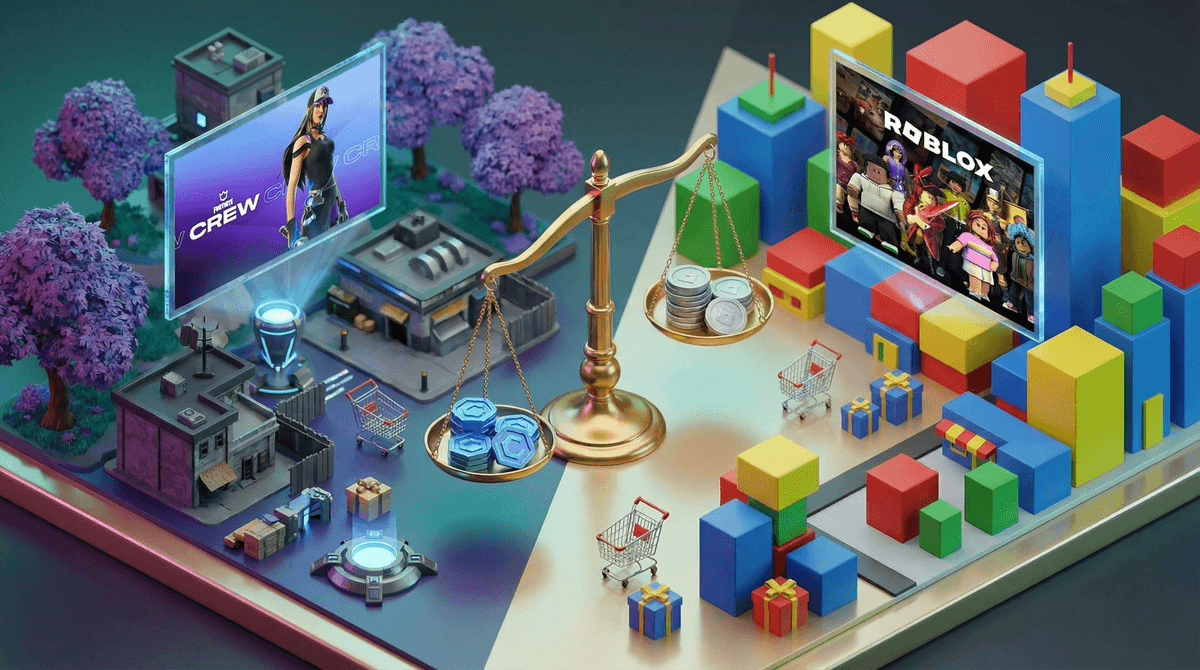
Let's start with the basics: V-Bucks are the in-game currency for Fortnite, and Robux are the currency for Roblox. Both are virtual currencies that kids spend very real money on to buy cosmetic items, accessories, game passes, and other digital goods.
Here's the thing that trips up a lot of parents: these aren't like arcade tokens where you buy them, use them, and you're done. They're entire economic systems designed to keep kids engaged, spending, and coming back for more. And honestly? They're really, really good at it.
V-Bucks (100 V-Bucks = roughly $1) primarily buy cosmetic items in Fortnite — skins for your character, emotes (those dances your kid won't stop doing), pickaxes, gliders, and items from the rotating Item Shop and seasonal Battle Pass. You can't buy gameplay advantages, which is actually a good thing. But the FOMO (fear of missing out) is real when that exclusive skin is only available for 24 hours.
Robux (80 Robux = $1, though the exchange rate gets slightly better with larger purchases) work differently because Roblox isn't one game — it's a platform with millions of user-created games. Kids spend Robux on avatar items, game passes that unlock features in specific games, private servers, and even developer products. Some kids are spending Robux, others are actually earning it by creating games or items.
The short answer? Social currency. These aren't just about looking cool in a game — they're about status, identity, and belonging.
In Fortnite, having the latest skin or that exclusive emote from a collaboration (Marvel, Star Wars, whatever) is like wearing the right sneakers to school. Kids literally judge each other by skins. The "default" skin (what you look like if you haven't bought anything) has become an insult. That's... kind of brutal, honestly.
In Roblox, it's even more complex because kids are building their entire digital identity. They're not just playing a character in one game — they're creating an avatar that represents them across thousands of experiences. And in certain Roblox games, having premium items or game passes can actually affect gameplay, not just appearance.
Both platforms have also mastered the art of the limited-time offer. Fortnite's Item Shop rotates daily. Roblox drops exclusive items for events. The message to kids is clear: buy now or regret it forever.
Let's talk numbers, because this is where parents get blindsided.
Fortnite's Battle Pass costs 950 V-Bucks (about $8-10) and lasts roughly 10 weeks per season. If your kid completes it, they can actually earn enough V-Bucks back to buy the next one, which is honestly pretty fair. The catch? Individual skins in the Item Shop run 800-2,000 V-Bucks ($8-20), and the really cool collaboration skins can hit 1,500-2,500 V-Bucks ($15-25). One skin. For one character. That you can't even see most of the time because it's a third-person shooter.
Roblox Premium subscriptions run $4.99-$19.99/month and give kids a monthly Robux stipend plus a 10% bonus when buying more Robux and the ability to trade items. Many kids have this. Individual items in the avatar shop can range from 5 Robux to literally thousands. Game passes in popular games? Often 100-1,000 Robux each. And here's the kicker: because Roblox is so social, kids are constantly discovering new games that require new passes.
The average parent report? $20-50/month if you're being "reasonable," but it can easily spiral to $100+ if you're not watching closely.
Honestly? Roblox tends to be the bigger money pit, but for different reasons than Fortnite.
Fortnite's spending is more predictable. A Battle Pass per season, maybe a skin here and there if you set boundaries. The game itself is contained, so once you've bought what you want, you're kind of done until next season.
Roblox is endless. There's always a new game, a new experience, a new limited item, a new thing your friend has. The platform is specifically designed for continuous discovery and spending. Plus, because it skews younger (peak usage is ages 9-12 vs. Fortnite's 10-15), you're dealing with kids who have less impulse control and less understanding of money.
That said, Fortnite's individual item prices are often higher, so one impulse purchase can hurt more.
The psychological tactics are real. Both platforms use every trick in the book: limited-time offers, social pressure, fear of missing out, rotating shops that create urgency, and "discounts" that make spending feel smart. Learn more about how these platforms use behavioral psychology .
.
Gift cards are your friend. Seriously. Physical V-Bucks or Robux gift cards create a tangible connection to real money and built-in spending limits. When the card is empty, it's empty. No surprise charges.
The "everyone has it" argument is partially true. In many middle schools, the majority of kids have spent something on these platforms. But "everyone" spending doesn't mean unlimited spending. Most families set monthly limits.
Earning systems work. Lots of parents tie V-Bucks or Robux to chores, grades, or other responsibilities. It teaches budgeting and makes kids think twice about impulse purchases when it's their "earned" currency.
You can absolutely say no. Despite what your kid says, they will survive without the Griddy emote or that limited-edition Dominus hat. The FOMO is designed to feel urgent, but it's manufactured urgency.
Here's what tends to work for most families:
Monthly budgets: $10-25/month is common. Could be a gift card, could be a set amount they can request, could be tied to an allowance system.
Require parental approval for purchases. Both Fortnite and Roblox have parental control settings. Use them. Require a PIN for purchases.
No credit cards on file. Use gift cards or prepaid methods only. This prevents accidental purchases and creates natural limits.
The "wait 24 hours" rule. If they want something, they have to wait a day. You'd be surprised how many "must-have" items become less essential after sleeping on it.
Teach the real-money conversion. Make sure your kid can tell you how much 1,000 Robux or 1,500 V-Bucks costs in actual dollars. If they can't do that math, they're not ready to spend.
Neither V-Bucks nor Robux is inherently evil, and both platforms do offer legitimate value — Fortnite is a genuinely fun game with friends, and Roblox can teach creativity, game design, and even entrepreneurship for kids who get into creating content.
But let's be real: these are sophisticated money-making machines designed to extract maximum spending from their users, and kids are especially vulnerable to their tactics.
The "winner" in this battle? Probably Roblox, if we're measuring by total spending potential and longevity. Fortnite might get bigger individual purchases, but Roblox has the infinite-platform advantage. However, for your wallet, the real winner is whichever one you set clear boundaries around.
Your job isn't to ban these currencies or pretend they don't matter to your kid's social life. Your job is to teach digital financial literacy in an environment that's actively working against that education. Start with small amounts, clear limits, and conversations about why these companies want their money so badly.
And maybe, just maybe, your kid will learn something about marketing, impulse control, and the real value of digital goods. Or at least they'll learn that you're not going to cave every time a new skin drops.
- Set up parental controls on Fortnite and Roblox right now if you haven't already
- Have a conversation about your family's monthly budget for in-game purchases
- Explore whether Roblox is actually teaching entrepreneurship or just spending habits
- Consider alternatives: games like Minecraft offer one-time purchases with unlimited play