

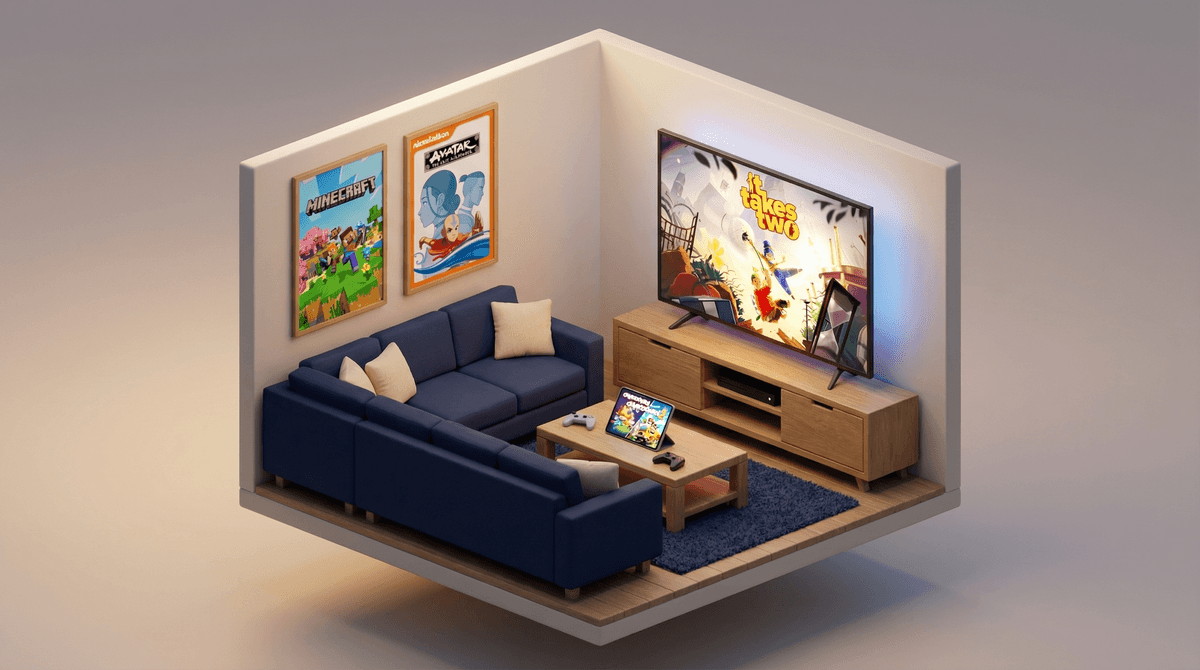
Here's something that might sound counterintuitive: screen time doesn't have to be solitary time. In fact, some of the best opportunities to teach collaboration, communication, and genuine teamwork skills are hiding inside the very games, shows, and apps we're often trying to limit.
We're talking about intentionally choosing and structuring media experiences that require kids to work together—whether that's siblings cooperating in Minecraft, a family debriefing a plot twist in Abbott Elementary, or kids strategizing their way through Overcooked without having a meltdown (the kids OR the parents).
The key word here is intentional. Because yes, your kid can play Fortnite for three hours and learn absolutely nothing about teamwork except that randoms on voice chat are the worst. But with the right setup, structure, and conversation, digital media can actually be a surprisingly effective teamwork laboratory.
Let's be real: teamwork is one of those skills everyone says matters but nobody really teaches explicitly. Schools do group projects (which mostly teach kids that one person does all the work). Sports teach teamwork, sure, but not every kid is into sports, and even then, you're limited by seasons and schedules.
But games? Shows you watch together? These are low-stakes environments where kids can practice:
- Communication under pressure (explaining a strategy while zombies are approaching)
- Role division (who's gathering resources vs. who's building)
- Conflict resolution (when someone accidentally breaks something important)
- Celebrating shared wins (that feeling when you finally beat the boss together)
Plus, and this is important: when you engage WITH your kids around media—not just restricting it—you're modeling that screens can be social, collaborative tools rather than isolation devices. You're also getting a window into how they think, problem-solve, and handle frustration.
Multiplayer Games That Actually Require Cooperation
Not all multiplayer games teach teamwork. Some just teach kids to yell at each other. Here's what actually works:
Ages 6-10:
- Minecraft in creative or peaceful mode—building projects together requires planning, resource sharing, and patience
- Animal Crossing: New Horizons—visiting each other's islands, trading items, collaborative decorating
- Kirby and the Forgotten Land—genuinely cooperative gameplay where players help rather than compete
- Lego games (any of them)—puzzles literally require two players working together
Ages 10-14:
- Overcooked—chaotic kitchen cooperation that's hilarious and surprisingly challenging
- It Takes Two—specifically designed for two players who must coordinate every action
- Stardew Valley multiplayer—farm management that rewards planning and division of labor
- Fortnite (yes, really)—in duo or squad modes with people they actually know, it teaches communication and strategy
Ages 14+:
- Among Us—social deduction that teaches reading people and building consensus
- Phasmophobia—ghost hunting that requires coordinated investigation
- Deep Rock Galactic—class-based cooperation where everyone has essential roles
Shows and Movies That Spark Teamwork Conversations
The content itself matters less than what you do with it. But some shows naturally set up great discussions:
- Ted Lasso—literally about building team culture (great for ages 10+)
- Avatar: The Last Airbender—team dynamics, different strengths, working through conflict
- The Great British Bake Off—competition that's actually supportive
- Sports documentaries like Welcome to Wrexham or The Last Dance
The move here: pause and talk about what's happening. "Why do you think that character is frustrated?" "What could they have done differently?" "How did they solve that problem together?"
1. Play with them, not just near them
Sitting on your phone while they play isn't collaborative screen time. You need to actually pick up the controller, join the world, be the sous chef in Overcooked who keeps burning the soup. Yes, you'll be bad at it. That's actually great—it models that learning is a process and gives them a chance to teach YOU.
2. Set up sibling co-op sessions with structure
Don't just say "you two can play together." That's a recipe for a fight. Instead:
- Choose games that require cooperation (not competitive modes)
- Set a shared goal ("build a house together" not "play Minecraft")
- Establish roles beforehand ("you're in charge of materials, you're in charge of design")
- Check in at intervals to mediate and celebrate progress
3. Do family movie nights with intention
Pick something everyone can engage with, then actually talk about it. Not a quiz, just genuine curiosity:
- "What would you have done in that situation?"
- "Why do you think those characters aren't getting along?"
- "What did you notice about how they solved that problem?"
4. Try collaborative board games too
Not everything needs a screen. Pandemic, Forbidden Island, and Codenames are all about working together against the game, not each other.
This takes more effort than solo screen time. That's the trade-off. You can't just hand them a device and walk away. But the payoff is that screen time becomes something that builds skills and connection rather than just fills time.
Not every session will be magical. Sometimes they'll still fight. Sometimes you'll want to throw the controller. That's actually part of the learning—working through frustration together is a teamwork skill.
Age gaps matter. A 7-year-old and a 12-year-old have very different abilities. You might need to find games with adjustable difficulty or take turns playing different roles. Mario Kart has assist modes that help level the playing field.
Voice chat is a whole separate conversation. Playing with friends online can be great for teamwork, but you need to know who they're talking to and set up appropriate safety measures.
Screen time gets a bad rap, and honestly, a lot of it deserves that rap. But the screen itself isn't the problem—it's how we use it. When you're intentional about choosing collaborative experiences, participating actively, and using media as a jumping-off point for real conversations, you're not just "letting them have screen time." You're creating opportunities to practice skills they'll use their entire lives.
Plus, there's something pretty special about finally beating that boss together after twelve tries, or watching your kids figure out how to coordinate a complex Minecraft build without your help. Those are real moments of growth, even if they happen to take place in a digital world.
This week:
- Pick one cooperative game or show from the lists above
- Schedule 30-60 minutes to engage with it together (really together, not phone-in-hand together)
- Afterward, have a 5-minute conversation about what worked and what was frustrating
This month:
- Establish one regular "collaborative screen time" session per week
- Notice when teamwork skills from games show up in real life (and point them out!)
- Explore more games that teach cooperation
The goal isn't to turn all screen time into an educational exercise. But carving out even a small portion for genuine collaboration? That's a win worth celebrating.