

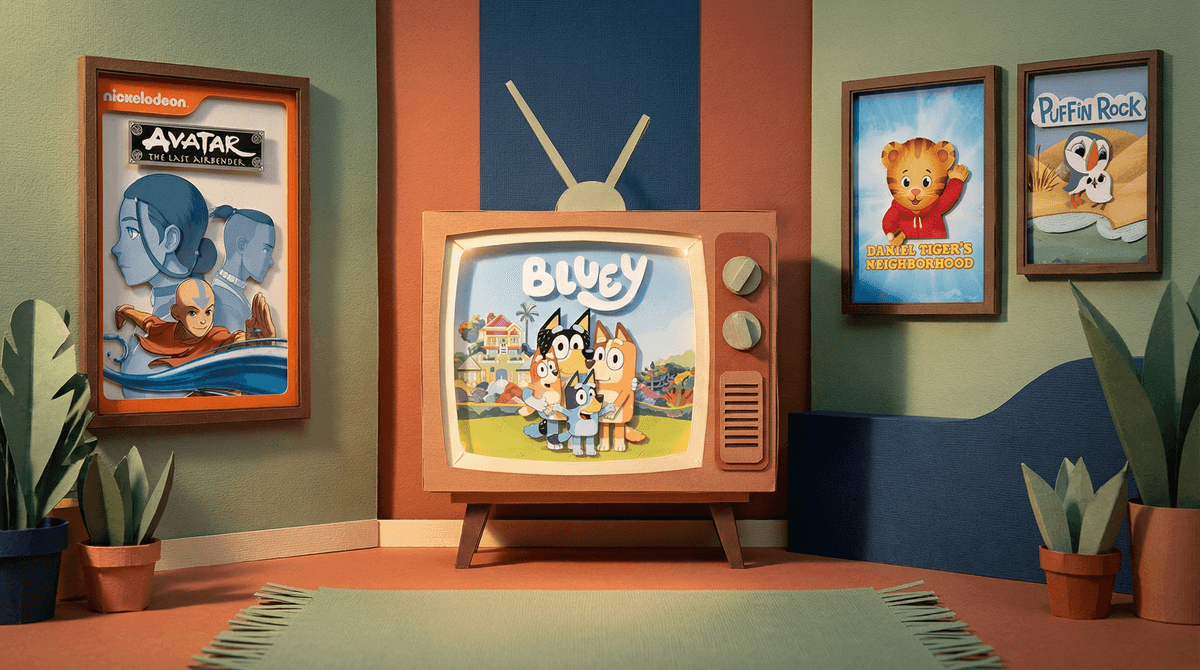
Here's the thing about screen time: we're all worried about how much kids are watching, but we rarely talk about what they're actually absorbing. And honestly? Some shows are teaching the exact opposite of what we want our kids to learn—instant gratification, impulsive reactions, chaos for chaos's sake.
But there are shows out there that actually model patience, emotional regulation, and delayed gratification. Not in a preachy, after-school-special way, but through characters who pause before reacting, work through frustration, and learn that some things are worth waiting for.
The research backs this up: kids learn behavioral patterns from what they watch. A 2011 study in Pediatrics found that kids who watched fast-paced, chaotic programming showed immediate decreases in executive function (the brain's self-control center). Meanwhile, shows with slower pacing and intentional problem-solving actually improved kids' ability to regulate their behavior.
So yeah, not all screen time is created equal.
Self-control is one of those foundational skills that affects everything—from how kids handle disappointment when they lose a game, to whether they can sit through homework, to how they navigate friendships when things get tense.
And here's what's wild: the shows that model self-control tend to be the ones kids will actually rewatch. Because they're not just sugar-rush entertainment—they're genuinely engaging stories where characters face real challenges and work through them thoughtfully.
The alternative? Shows where problems are solved in 30 seconds, characters yell instead of talk, and everything moves at a pace that would make a hummingbird anxious. You know the ones. Your kid watches them and suddenly can't sit still, talks in a louder voice, and seems generally more chaotic.
Let me break this down by age, because what works for a 4-year-old is very different from what resonates with a 10-year-old.
Ages 3-6
Daniel Tiger's Neighborhood is the gold standard here. Every episode explicitly teaches emotional regulation strategies—"When you feel so mad that you want to roar, take a deep breath and count to four." It's almost annoyingly effective. Kids actually use these strategies in real life.
Bluey is the show that parents don't hate watching (high praise). The episodes model patience, working through disappointment, and waiting for things you want. Plus, the parents actually act like real parents—sometimes tired, sometimes making mistakes, but always trying. The episode "Sleepytime" is a masterclass in patience and comfort.
Puffin Rock is slower-paced, gentle, and models curiosity without chaos. The narrator (Chris O'Dowd) has this calm energy that's the opposite of overstimulating.
Ages 6-9
Avatar: The Last Airbender (yes, even for the younger end of this range—it's rated TV-Y7) is phenomenal for teaching emotional regulation. Aang literally has to learn to control his emotions to master different elements. Uncle Iroh is basically a self-control guru. The show deals with anger, grief, patience, and growth in ways that are accessible to kids.
The Magic School Bus Rides Again models the scientific method, which is essentially structured patience—observe, hypothesize, test, revise. Kids learn that answers don't come instantly; you have to work through problems methodically.
Hilda on Netflix has this wonderful pacing where the main character encounters problems and has to think through solutions. She makes mistakes, reflects, and tries again. It's not frenetic or chaotic—it's thoughtful adventure.
Ages 9-12
The Great British Baking Show Junior (or the adult version, honestly) is all about patience, following processes, and handling disappointment gracefully. When something goes wrong, contestants problem-solve rather than melt down. The whole vibe is "let's work through this together."
Anne with an E shows a character learning to regulate her impulsiveness and emotional intensity. Anne has to learn patience, delayed gratification, and how to navigate social situations without always reacting from her gut.
The Mysterious Benedict Society is built around kids solving complex puzzles that require patience, teamwork, and careful thinking. No one's rushing to solutions—they have to work through problems methodically.
Shows that glorify impulsivity, where characters act without thinking and face no real consequences. Shows where problems are solved through yelling or chaos. Shows with frenetic pacing that never let a scene breathe.
I'm not going to name names (okay, fine: a lot of shows on kids' YouTube channels are basically designed to be as stimulating as possible with zero modeling of self-regulation), but you know them when you see them. Your kid finishes an episode and is bouncing off walls, speaking in a louder voice, and generally seems more dysregulated.
Trust your gut on this.
Here's the thing: even the best show isn't magic. You can't just park your kid in front of Daniel Tiger's Neighborhood and expect them to suddenly have perfect self-control.
Co-view when you can. Even just being in the room, commenting on what characters are doing ("Oh, she's taking a deep breath to calm down—that's smart"), helps kids connect what they're seeing to real-life skills.
Reference the shows later. When your kid is frustrated about something, you can say, "Remember how Bluey had to wait for her turn? What did she do while she was waiting?" It creates a shared language around self-control.
Limit binge-watching. Even good shows lose their impact when kids watch five episodes back-to-back. One or two episodes, then move on to something else. The goal isn't more screen time—it's intentional screen time.
Not all TV is created equal. Some shows are genuinely teaching kids skills they'll use for the rest of their lives—patience, emotional regulation, problem-solving, delayed gratification. Other shows are just... noise.
The shows that model self-control tend to have slower pacing, characters who think before acting, and storylines where problems aren't solved instantly. They're not always the flashiest options, but they're the ones that actually stick with kids.
And honestly? They're the ones you won't mind watching for the 47th time.
Want to dig deeper into what your kids are watching? Screenwise can help you understand your family's screen habits in context with your community, and give you personalized recommendations based on your values.
Or if you're wondering about a specific show, ask our chatbot whether it's actually teaching what you want your kids to learn.