

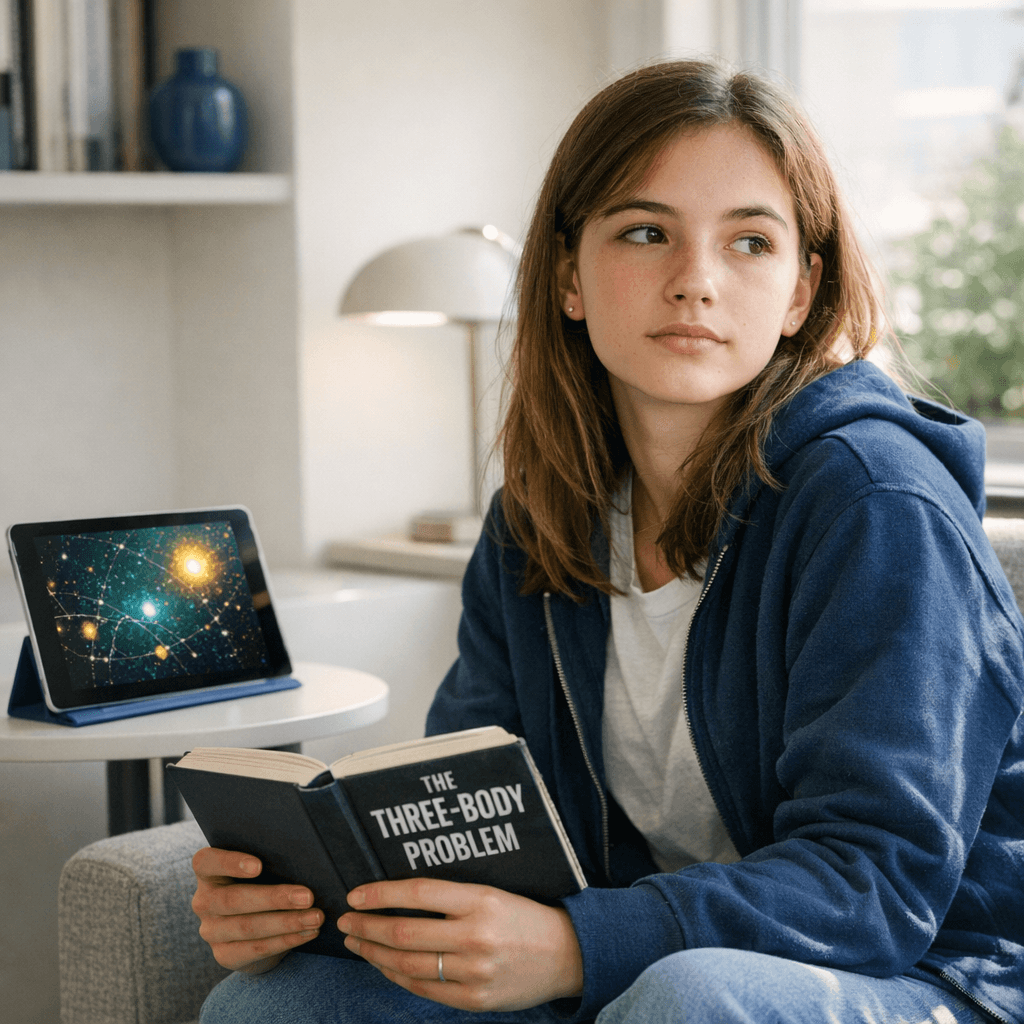
The Three-Body Problem and Mind-Bending Sci-Fi for Teens
Netflix's The Three-Body Problem is a sophisticated sci-fi series that tackles humanity's first contact with alien intelligence—and it's not for the faint of heart. We're talking graphic violence, sexual content, and philosophical questions that'll keep your teen up at night (in a good way). If your teen is ready for mature, cerebral sci-fi that respects their intelligence, here's what you need to know about this show and similar mind-benders worth exploring.
Quick picks for different readiness levels:
- Ready for Three-Body Problem? Also try: The Expanse, Arrival, Dark
- Want the ideas without the intensity? Try: Ender's Game, Project Hail Mary, Interstellar
- Testing the waters? Start with: The Martian, A Wrinkle in Time, Everything Everywhere All at Once
The Netflix adaptation of Liu Cixin's groundbreaking trilogy isn't your typical "aliens invade Earth" story. It's a slow-burn exploration of humanity's response to learning we're not alone in the universe—and that our cosmic neighbors might not be friendly. The show jumps between timelines, from China's Cultural Revolution to present-day Oxford, weaving together theoretical physics, virtual reality, and existential dread.
The content reality check: This show earned its TV-MA rating. There's a brutal suicide in the first episode, graphic violence throughout, sexual content including nudity, and scenes depicting the horrors of the Cultural Revolution. About 40% of families in our community report their kids have access to Netflix with varying levels of supervision, and this is exactly the kind of content where that supervision matters.
But here's what makes it worth considering for older teens: it treats big ideas with genuine respect. The science is mostly accurate (the physics concepts are real, even if dramatized), the characters grapple with actual philosophical dilemmas, and the show doesn't dumb down complex ideas about game theory, astrophysics, or the Fermi Paradox.
Ages 16+: If your teen has handled shows like The Last of Us or Westworld, they can probably handle Three-Body Problem's content—but the pacing is slower and more cerebral. This isn't action-packed sci-fi; it's a mystery that unfolds over episodes.
Ages 14-15: Read the book first. The Three-Body Problem novel covers similar ground with less graphic content, and it's actually a great way to gauge if your teen is interested in hard sci-fi before committing to the show. The book won the Hugo Award and is legitimately excellent.
Ages 13 and under: Not yet. The violence and mature themes aren't gratuitous, but they're intense and frequent enough that younger teens aren't ready.
If your teen loved The Martian (or you're looking for something with similar "science saves the day" energy), this is the move. A lone astronaut wakes up on a spaceship with no memory, has to figure out his mission, and encounters an alien species. It's funny, scientifically grounded, and genuinely moving. Ages 13+
The science is accessible—Weir explains complex concepts through problem-solving—and there's no graphic content. This is the perfect "gateway" to hard sci-fi for teens who think they don't like science.
Yes, the author's personal views are problematic. Yes, this book is still a masterpiece that teens should read. A child genius is trained to lead humanity's fight against an alien species, but the moral complexity of the ending will spark conversations you'll want to have. Ages 12+
The book raises questions about military ethics, the cost of war, and whether the ends justify the means—all wrapped in a page-turner that even reluctant readers devour. Follow it up with Speaker for the Dead, which is even more philosophically rich.
For teens ready to think about gender, society, and what makes us human, Le Guin's classic about a planet where inhabitants can change their biological sex is essential reading. It's slower-paced than modern YA, but the ideas are timeless. Ages 14+
This is literary sci-fi—beautiful prose, deep worldbuilding, and questions that don't have easy answers. Perfect for the teen who wants to be challenged.
In a future where humanity has conquered death, "scythes" are appointed to kill people to control population. It's a trilogy that explores mortality, power, and corruption with genuinely surprising twists. Ages 13+
The violence is present but not gratuitous, and the ethical questions—who decides who dies? what gives someone that right?—make for incredible family discussions. Learn more about the Scythe series.
Six seasons of the best hard sci-fi on TV. Set in a future where humanity has colonized the solar system, it's a political thriller with realistic physics, diverse characters, and plotting that rewards attention. Ages 15+
Fair warning: it's TV-14 but earns it with violence and some sexual content. However, the worldbuilding is extraordinary, and teens who love complex narratives will be hooked. It's on Amazon Prime (which 62% of families in our community use, with 32% reporting supervised access for kids).
This German Netflix series about time travel will hurt your brain in the best way. Four families, four time periods, and a mystery that gets more intricate with each episode. Ages 15+
It's TV-MA for some violence and sexual content, but it's also one of the most carefully constructed shows ever made. Every detail matters. Watch it with subtitles (the dubbed version loses something), and prepare to draw family tree diagrams.
Alternate history where the space race never ended. What if the Soviets landed on the moon first? How would that change everything? Ages 14+
It's on Apple TV+ and rated TV-MA, but most of the mature content is in later seasons. The first season is relatively tame and incredibly compelling. Great for teens interested in space exploration or alternate history.
When alien ships land around the world, a linguist is recruited to communicate with them. This is thoughtful, emotional sci-fi that's more about language and time than explosions. Ages 13+
Rated PG-13, it's accessible for younger teens but sophisticated enough for adults. The ending will have you talking for days. Check out our full guide to Arrival.
Christopher Nolan's epic about astronauts searching for a new home for humanity. It's long (nearly three hours), scientifically ambitious, and emotionally devastating. Ages 12+
PG-13 rating, stunning visuals, and real physics (they had Kip Thorne consulting). The time dilation scenes hit different when you're a parent watching with your teen.
Multiverse chaos that's also about family, identity, and finding meaning in absurdity. It's weird, funny, and surprisingly moving. Ages 14+
Rated R for language and some violence, but it's also one of the most creative films in years. Great for teens who want something completely different.
The science is mostly real: Shows like The Three-Body Problem and The Expanse take their science seriously. Your teen might come away with genuine interest in physics, astronomy, or mathematics. Explore more about how science fiction can inspire STEM learning .
.
These aren't escapism: Unlike Marvel movies or Star Wars, hard sci-fi often presents bleak futures and uncomfortable questions. That's part of the appeal for teens—it treats them like adults who can handle complexity.
Watch together when possible: Not every show needs to be family viewing, but these work better with discussion. The ideas are big enough that even adults need to process them.
The "Dark Forest" theory: If your teen watches The Three-Body Problem, they'll encounter this concept: maybe the universe is silent because any civilization that reveals itself gets destroyed. It's genuinely unsettling. Be ready to talk about it.
Instead of asking "did you like it?", try:
- "What would you do in that situation?"
- "Do you think the characters made the right choice?"
- "How realistic do you think that science is?"
- "What would first contact actually look like?"
These stories raise questions about human nature, survival, and our place in the universe. Your teen is probably already thinking about these things—good sci-fi just gives them a framework to explore it.
The Three-Body Problem represents a new era of prestige sci-fi that respects audience intelligence. If your teen is ready for mature content and complex narratives, it's an incredible entry point to hard science fiction. If they're not quite there yet, the books and shows listed above offer plenty of on-ramps to the genre.
The real gift of good sci-fi isn't predicting the future—it's asking better questions about the present. And teens who engage with these stories learn to think critically about technology, ethics, and humanity's biggest challenges.
Your average teen is getting 4.2 hours of screen time daily across all devices. If they're going to spend some of that watching TV, these are shows that'll actually stick with them.