

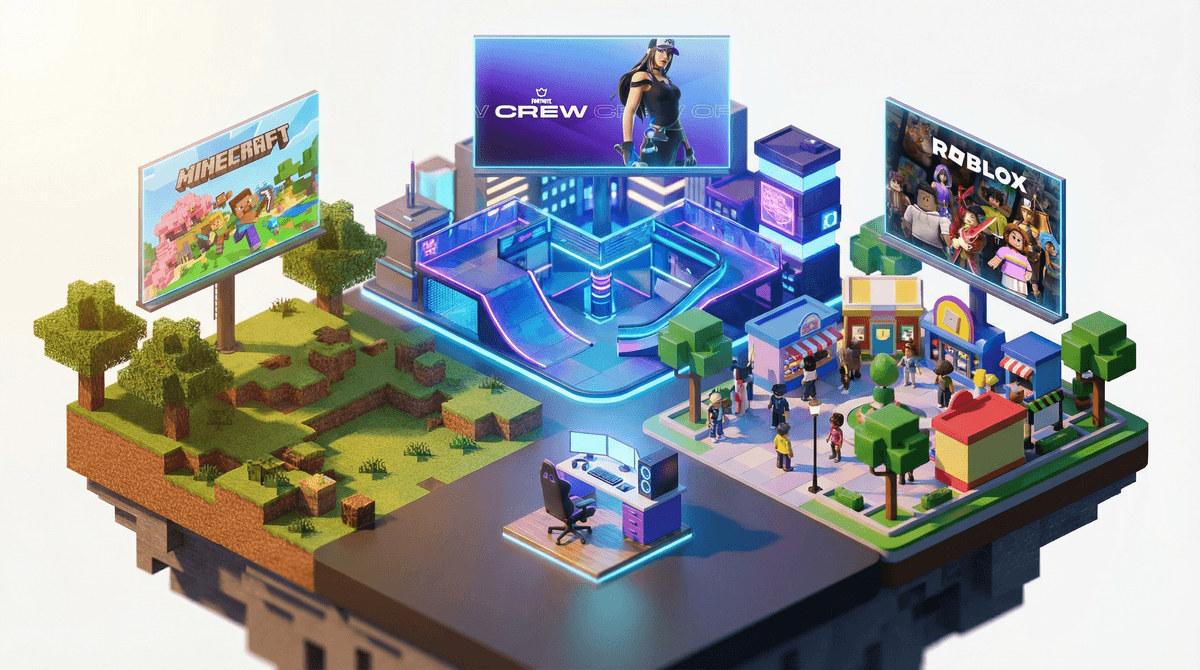
Roblox vs. Minecraft vs. Fortnite: Which Game Is Right for Your Kid?
All three games are age-appropriate for most kids, but they're wildly different experiences:
- Minecraft (Ages 7+): Creative sandbox, minimal violence, best for builders and explorers. Solo or multiplayer.
- Roblox (Ages 9+): Social platform with thousands of user-created games. Highest social risk, but incredible creativity engine.
- Fortnite (Ages 10+): Fast-paced shooter with cartoon violence. Competitive, social, and surprisingly creative.
The real question isn't which is "best" — it's which matches your kid's interests and your family's comfort level with online interaction.
Let's clear up the basics, because parents often lump these together as "those games all the kids play."
Think digital LEGOs meets survival adventure. Kids mine resources, build structures, and explore blocky worlds. It can be played solo, with friends on private servers, or on public multiplayer servers. The "monsters" are cartoonish and easily avoided in Creative mode. It's been around since 2011 and has serious staying power — this isn't a flash-in-the-pan trend.
ESRB Rating: E10+ (Everyone 10+), though most 7-year-olds handle it fine, especially in Creative mode.
This one confuses parents the most. Roblox isn't actually a game — it's a platform where users create and play millions of different games. Think of it as YouTube, but for games instead of videos. Your kid might be playing an obstacle course (obby), a role-playing game, a horror experience, or a virtual pet simulator. All within Roblox.
The variety is both the appeal and the challenge. Quality ranges from genuinely impressive to absolute garbage. And because it's user-generated content, moderation is... inconsistent.
ESRB Rating: E10+, but the platform hosts games with varying age-appropriateness.
A battle royale shooter where 100 players drop onto an island and fight until one remains. Yes, it's a shooter, but the violence is cartoonish — players get "eliminated" and respawn for the next match. No blood, no gore, just colorful chaos.
Beyond the main battle royale mode, Fortnite has expanded into creative building modes , concerts (yes, really), and social hangout spaces. It's become less "just a shooter" and more of a social platform wrapped in a game.
ESRB Rating: T for Teen (13+), though plenty of younger kids play with parent approval.
Social Interaction
Minecraft: Can be played entirely solo or with a small group of friends on a private server. Public servers exist, but you can avoid them. Voice chat isn't built-in, though kids often use Discord or other apps to talk while playing.
Roblox: Inherently social. Most games involve interacting with strangers. Built-in text chat (which can be restricted) and voice chat (for 13+ with ID verification). This is where the safety concerns with Roblox come into play — predators, scammers, and inappropriate content are real risks.
Fortnite: Heavily social and competitive. Voice chat is common, and trash talk is endemic. Squad-based gameplay means your kid is often teaming up with strangers. The competitive nature can bring out the worst in people, especially in voice chat.
Bottom line: If you want minimal social risk, Minecraft in solo or friends-only mode wins. If your kid thrives on social interaction and you're ready to actively manage it, Roblox and Fortnite can work.
Money (Oh God, the Money)
Minecraft: One-time purchase ($26.95 for most platforms). Optional marketplace content (skins, worlds) exists but isn't pushed hard. Least expensive long-term.
Roblox: Free to play, but the Robux economy is everywhere. Kids can spend real money on in-game items, game passes, and avatar accessories. It's designed to make Robux feel like play money, but Robux is absolutely real money. Many parents report spending $20-50/month once kids get hooked. The positive spin: some kids learn entrepreneurship by creating and selling their own games or items.
Fortnite: Free to play. Monetization comes through the Battle Pass (seasonal, ~$10) and the item shop (skins, emotes, etc.). The FOMO is real — limited-time skins create urgency. Parents report similar spending to Roblox, but it's more cosmetic-focused. You're never paying to win, just paying to look cool.
Bottom line: Minecraft is cheapest. Roblox and Fortnite are "free" in the same way a casino is free to enter.
What They're Actually Learning
Minecraft: Spatial reasoning, resource management, creativity, basic logic (redstone circuits), and persistence. Kids who build elaborate structures or automate farms are developing real problem-solving skills. It's also surprisingly calming for many kids — a digital zen garden.
Roblox: Depends entirely on what they're playing. Some games teach nothing. Others involve scripting (Lua programming), game design, and entrepreneurship. The platform has legitimate educational potential, but it requires curation. Check out Roblox educational games if you want to steer them toward quality.
Fortnite: Quick decision-making, spatial awareness, teamwork (in squad modes), and frankly, coping with failure. The game is hard, and kids lose constantly. That can build resilience or frustration, depending on temperament. The creative modes offer building and game design opportunities similar to Roblox.
Bottom line: Minecraft is the safest bet for "learning." Roblox has high potential but requires guidance. Fortnite teaches skills, but they're more about fast-twitch gaming than creativity.
Ages 7-9
Minecraft is the clear winner here. Start with Creative mode (no monsters, infinite resources) or Peaceful difficulty in Survival mode. Keep it solo or friends-only at first.
Roblox can work for mature 9-year-olds, but requires heavy parental involvement. Use Roblox parental controls to restrict chat and limit game access to pre-approved experiences.
Fortnite is generally too intense for this age group, both in terms of violence and social dynamics. The competitive nature and voice chat culture aren't great fits for most kids under 10.
Ages 10-12
All three are on the table, but with different considerations.
Minecraft remains excellent. Kids this age often get into multiplayer servers, mods, and more complex builds. Consider setting up a private server for them and their friends.
Roblox is peak age for engagement. They're old enough to navigate the platform but still young enough to need supervision. Set spending limits and have regular conversations about online safety.
Fortnite works if your kid can handle competitive gaming. Some kids thrive on it; others crumble under the pressure. Watch for signs of rage-quitting or obsessive behavior. Consider turning off voice chat initially.
Ages 13+
They're likely playing all three (or have strong opinions about which they won't touch). At this age, the conversation shifts from "is this appropriate?" to "how are you managing your time and emotions around this?"
Monitor for signs of gaming interfering with sleep, homework, or real-world relationships. Competitive games like Fortnite can become consuming. Roblox's social dynamics get more complex as kids enter teen years.
Minecraft
Lowest risk overall. Main concerns:
- Public multiplayer servers can expose kids to inappropriate chat or griefing (other players destroying their builds)
- Some user-created content (mods, texture packs) can be inappropriate
- YouTube videos about Minecraft vary wildly in quality and appropriateness
What to do: Start with solo or friends-only play. If they want public servers, research kid-friendly options with active moderation. Talk about not sharing personal information.
Roblox
Highest risk of the three. Concerns include:
- Predators using chat to groom kids
- Scams (promising free Robux, stealing account info)
- Inappropriate user-generated content (sexual, violent, or disturbing games slip through moderation)
- Gambling-style mechanics in some games
- Cyberbullying
What to do: Use the Roblox parental controls aggressively. Restrict chat to friends-only or disable it entirely for younger kids. Regularly check what games they're playing. Have ongoing conversations about online safety. Consider setting up a separate email for their account so you can monitor login attempts.
Fortnite
Moderate risk, mostly social. Concerns include:
- Toxic voice chat (slurs, bullying, adult language)
- Intense competitive pressure
- FOMO-driven spending
- Time sink — matches are quick, making "just one more" a constant temptation
What to do: Disable or mute voice chat for younger players. Set time limits and stick to them. Talk about how the game is designed to keep them playing. Consider using parental controls to require approval for purchases.
Choose Minecraft if:
- Your kid loves building, exploring, or creative play
- You want the lowest-risk option
- You prefer a one-time purchase over ongoing spending
- Your kid is under 10
- They enjoy solo or small-group play
Choose Roblox if:
- Your kid is social and loves variety
- You're willing to actively manage safety settings and monitor play
- They're interested in game design or creating content
- You can set and enforce spending limits
- They're at least 9-10 and mature enough for online interaction
Choose Fortnite if:
- Your kid is competitive and enjoys fast-paced action
- They're at least 10-11 and can handle losing without melting down
- You're okay with cartoon violence
- They want to play what their friends are playing (because let's be real, that matters)
- You can manage the time-sink nature of battle royale games
You don't have to choose just one. Many kids play all three at different times, depending on their mood. Minecraft for chill creative time, Roblox for social hangouts, Fortnite for competitive excitement.
The "best" game is the one that fits your kid's personality and your family's values around screen time, spending, and online interaction. None of these games are inherently harmful, but all three require some level of parental awareness and boundary-setting.
Start with the one that feels most manageable to you. You can always expand later as you get more comfortable with the digital landscape.
- Have a conversation with your kid about which game interests them and why
- Set clear expectations around time limits, spending, and online behavior before they start
- Play together for the first few sessions — you'll learn more in 30 minutes of co-play than in hours of research
- Check in regularly about what they're playing, who they're playing with, and how they're feeling about it
And remember: these are tools for connection and creativity, not just time-wasters. With the right guardrails, all three games can be positive parts of your kid's digital life.
Want to dive deeper into any of these games? Check out our detailed guides on Minecraft parental controls, is Roblox safe for kids, and Fortnite age rating and parent guide.