

The Ultimate Guide to Superhero Books for Kids
TL;DR: Superhero books can actually be fantastic gateway reads for reluctant readers. From board books with bright capes to graphic novels with complex storylines, there's a hero book for every age and reading level. Here are the best ones that won't make you cringe.
Jump to age group:
Kids are drawn to superheroes for the same reasons we all are—the fantasy of having power when you feel powerless, the clear good vs. evil narratives, the cool costumes. But here's what makes superhero books particularly valuable: they often tackle themes like identity, responsibility, and using your unique gifts in ways that the movies gloss over in favor of CGI destruction.
Plus, if you've got a kid who's obsessed with Marvel movies or DC shows but won't touch a book, superhero books can be the bridge. The familiar characters lower the barrier to entry.
This one's gold for emotional regulation. It's basically "everyone has feelings" but with capes, which somehow makes it way more effective with the preschool crowd. The rhyming text keeps kids engaged, and the illustrations show heroes managing their frustration without punching things—a useful lesson when your kid is melting down about the wrong color cup.
A sweet book about how dads are everyday heroes. It's not groundbreaking literature, but it's a nice bedtime read that doesn't make you want to fake a coughing fit to get out of reading it for the 47th time. The illustrations are fun without being overstimulating.
Part of a series featuring a raccoon superhero who tackles everyday kid challenges. This one's about cleaning up, but it doesn't feel preachy—Manny just happens to use his "super" powers to organize his mess. Good for the kid who responds better to play than direct commands (so, all of them).
Okay, these aren't technically superhero books, but hear me out: Rosie Revere, Ada Twist, and the gang are basically superheroes whose powers are curiosity, engineering, and persistence. The books celebrate STEM, creativity, and problem-solving without being heavy-handed about it. If your kid likes these, check out books about science for kids for similar vibes.
Real-life heroes presented in an accessible graphic novel format. Each book (I Am Rosa Parks, I Am Albert Einstein, etc.) shows the childhood of historical figures, making them relatable rather than distant. The illustrations by Christopher Eliopoulos are engaging without being chaotic. These are legitimately well-done and don't talk down to kids.
Chapter books for early readers about a kid who discovers monsters are real and he's part of a secret monster patrol. It's got the superhero elements—secret identity, special knowledge, fighting bad guys—but in a format that's less intimidating than a thick graphic novel. Good for the Minecraft-loving crowd who likes monsters but isn't ready for scary content.
This is the sweet spot age for superhero books. Kids can handle more complex plots, moral ambiguity, and longer formats.
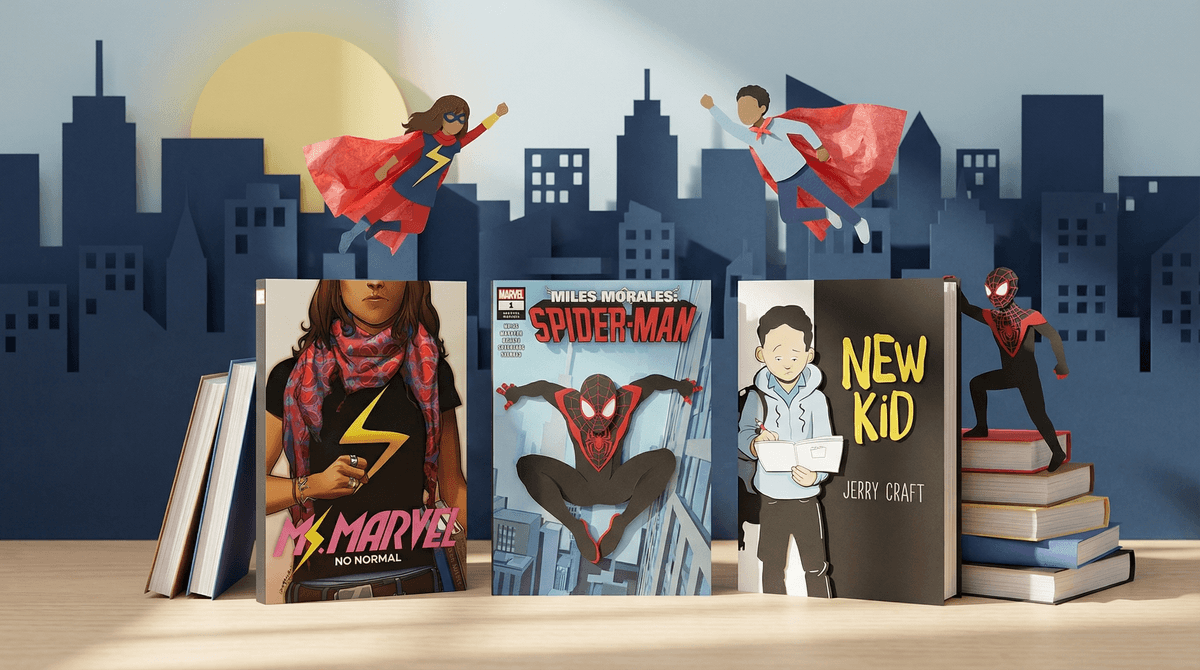
A graphic novel about a Black kid navigating a predominantly white private school. It's not explicitly about superheroes, but it deals with identity, code-switching, and finding your place—all superhero origin story themes. It won the Newbery Medal for good reason. The sequel, Class Act, is equally strong.
Post-apocalyptic adventure where kids fight zombies and monsters. It's basically a superhero team origin story set during the end of the world. The humor is on point for this age group (lots of gross-out jokes and video game references), and the graphic novel format makes it approachable for reluctant readers. There's also a Netflix show if they want more.
A Marvel character who solves problems with empathy, computer science skills, and yes, an army of squirrels. This series is genuinely funny and features a hero who tries to talk to villains before fighting them. It's a nice counterpoint to the "punch first, ask questions never" approach of many superhero stories. The graphic novel format is dense but rewarding.
A robot boy falls from the sky and befriends two kids. It's got action, humor, and heart without being saccharine. The art style is dynamic and colorful, and the story moves fast enough to keep even the most distractible kid engaged. There are currently nine books in the series, so if your kid likes it, you've got runway.
STEM-focused adventure series where kids use science to solve problems. It's Magic School Bus meets superhero origin story. Each book tackles a different scientific concept (human body, plants, sound) in a way that's actually educational without feeling like homework. Good bridge between Magic Tree House and more complex series.
By this age, kids can handle the actual Marvel and DC graphic novels, plus more sophisticated original superhero fiction.
Kamala Khan is a Pakistani-American teen from Jersey City who gets superpowers and has to balance her cultural identity, family expectations, and saving the world. This is legitimately good writing—funny, thoughtful, and doesn't shy away from complexity. The art is excellent, and it's a great entry point into Marvel comics. The Disney+ show is also solid if they want more.
A graphic novel based on a 1940s radio serial where Superman fights the KKK. It's set in 1946 and deals directly with racism, xenophobia, and what it means to be American. This is the kind of book that can spark real conversations about justice and using your power to stand up for others. Yang is a master storyteller (American Born Chinese is also excellent), and the art is gorgeous.
A novel (not graphic) about a girl dealing with her sister's death who discovers she might have healing powers. It's quieter than typical superhero fare—more about grief, family, and what makes someone a hero. Good for kids who like emotional depth with their supernatural elements.
A genius Black girl inventor teams up with a T-Rex. It's as awesome as it sounds. Lunella Lafayette is the smartest person in the Marvel universe, and the stories celebrate intelligence and creativity. The Disney Channel show is also great and has a killer soundtrack.
Jason Reynolds writing Spider-Man novels? Yes please. These are prose novels (not graphic) that deal with Miles balancing school, family, identity, and being Spider-Man. Reynolds is one of the best YA authors working today (Ghost is incredible), and he brings that same emotional intelligence to Miles's story.
A shapeshifting girl becomes the sidekick to a supervillain. This one's brilliant—it subverts all the hero/villain tropes and explores themes of identity, loyalty, and how society decides who's good and who's bad. The art style is deceptively simple but incredibly expressive. There's now a Netflix movie adaptation that's also excellent.
Real talk: most mainstream Marvel and DC comics are written for teens and adults, not elementary-aged kids. The storylines are complex (you need a PhD to understand Marvel's timeline), the violence can be intense, and the female character designs are often... let's just say not age-appropriate.
That said, there are kid-specific lines:
- Marvel Action and DC Superhero Girls are designed for younger readers
- Marvel Rising features diverse young heroes in accessible stories
- Look for books labeled "all ages" or "kids" on the cover
If your kid is obsessed with a specific character, you can also search for "[character name] comics for kids](https://screenwiseapp.com/list/new?q=what%20are%20the%20best%20kid-friendly%20batman%20comics )" to find age-appropriate options.
Some parents worry that graphic novels "don't count" as real reading. Let's clear this up: graphic novels require complex literacy skills—kids have to interpret visual information, follow non-linear panel layouts, understand facial expressions and body language, and integrate all of that with text. It's not easier reading; it's different reading.
Plus, if a graphic novel is what gets your reluctant reader to actually read, that's a win. You can always introduce traditional novels later. Many kids naturally transition between formats based on mood and interest.
For more on this, check out why graphic novels are actually great for kids.
One of the best things about the current superhero book landscape is the diversity. Kids can now find heroes who look like them, have families like theirs, and deal with challenges they understand.
Ms. Marvel deals with Muslim American identity. Miles Morales explores being Afro-Latino. Superman Smashes the Klan tackles racism head-on. These aren't "issue books" where diversity is the only plot point—they're great stories that happen to feature diverse characters dealing with real stuff alongside the superpowers.
Violence: Most superhero books for kids under 10 keep violence cartoonish—characters get knocked around but there's no blood or graphic injury. By ages 10-12, some graphic novels include more realistic fight scenes, but they're still tame compared to the movies.
Scary content: The monster-fighting books (Last Kids on Earth, Notebook of Doom) can be intense for sensitive kids. Preview them if your child is easily frightened.
Complex themes: Books like Superman Smashes the Klan and Ms. Marvel deal with racism, discrimination, and identity. These are features, not bugs—they're great conversation starters—but be prepared to discuss them.
Reading level vs. interest level: Many superhero graphic novels have a reading level of 3rd-4th grade but interest level up through middle school. Don't worry if your 5th grader is reading "below level" books—if they're engaged, that's what matters.
Start with their existing interests: If they love Spider-Man movies, start with Miles Morales books. If they're into Roblox superhero games, try Hilo or Last Kids on Earth.
Mix formats: Alternate between graphic novels and traditional books. Use graphic novels as palate cleansers between longer novels.
Series are your friend: Once a kid finds a character they love, a series gives them something to look forward to. The Hilo series has nine books; Unbeatable Squirrel Girl has multiple volumes.
Library first: Superhero books can be expensive, especially graphic novels. Libraries usually have great selections, and kids can try different series without commitment.
Read together: Even older elementary kids often enjoy having books read to them. Graphic novels work great for shared reading—you can do voices, discuss the art, and make it a bonding experience.
Superhero books aren't all the same. There's a huge range from simple board books to complex graphic novels dealing with serious themes. Don't assume all superhero content is equivalent.
The "boy book" myth: Superhero books are often shelved in the "boy" section, but plenty of girls love them too. And there are now tons of female-led superhero books. Don't let outdated gender assumptions limit what your kid tries.
Collect vs. borrow: Graphic novels are expensive ($12-20 each). Unless your kid is rereading constantly, the library is your best friend. Save the purchasing for true favorites.
Movie tie-ins vary in quality: Books released alongside movies are often rushed and mediocre. The original graphic novels and series are usually much better than movie novelizations.
Comics subscriptions: Services like Marvel Unlimited or DC Universe Infinite give access to thousands of comics for a monthly fee. Could be worth it for voracious readers, but preview the content first—most of the catalog is for older readers.
Superhero books can be fantastic tools for building reading confidence, exploring identity and values, and just having fun. The key is matching the right book to your kid's age, interests, and reading level.
Don't get hung up on whether graphic novels "count" or whether your kid should be reading more "serious" literature. If they're reading and enjoying it, that's what matters. You can always expand their horizons later.
And if you're not sure where to start, hit up your local librarian. They've seen every superhero phase imaginable and can point you toward the good stuff.
- Check your library's digital collection for instant access to graphic novels through apps like Libby or Hoopla
- Ask your kid what they're into right now (certain characters, video games, shows) and find books that connect
- Start with one book, not a whole series to test interest before committing
- Read reviews on Screenwise for specific titles to see what other parents think about content and age-appropriateness
Want to explore beyond superheroes? Check out adventure books for kids or graphic novels for reluctant readers for more options.