

The Ultimate Guide to Setting Healthy Screen Time Limits
TL;DR: Forget the "2 hours max" rules you've seen plastered everywhere. Healthy screen time isn't about a magic number—it's about protecting sleep, physical activity, face-to-face connection, and making sure screens enhance rather than replace real life. This guide breaks down research-backed strategies that actually work, including the stuff nobody tells you about implementation.
The American Academy of Pediatrics changed their screen time guidelines a few years ago, and honestly? It was a relief. They moved away from strict hour limits (except for young kids) and toward something more nuanced: screen time should not interfere with sleep, physical activity, and other behaviors essential to health.
That's it. That's the framework.
But of course, the devil is in the details. How do you actually implement this without becoming the screen time police? How do you know what's reasonable for a 7-year-old versus a 13-year-old? And what do you do when your kid's entire social life happens on Discord?
Here's what research actually shows: not all screen time is created equal.
A kid video chatting with their grandparent is fundamentally different from doomscrolling TikTok. Playing Minecraft with friends while problem-solving and collaborating is different from passive YouTube consumption. Reading an ebook is different from playing slot-machine-style mobile games designed to exploit dopamine systems.
The "2 hours max" rule treats all of this the same, which is why it feels impossible to enforce and why kids (rightfully) push back on it.
Plus, let's be real: modern life requires screens. Homework is online. Socializing happens in Roblox. Creative kids make videos, code games, write stories on Google Docs. A blanket time limit can actually interfere with legitimate, enriching activities.
Instead of arbitrary time limits, focus on these research-backed priorities:
1. Protect Sleep
This is the big one. Screen time before bed is directly linked to worse sleep quality, later bedtimes, and less total sleep. Blue light suppresses melatonin, but it's not just the light—it's the stimulation. A tense Fortnite match or an argument in the group chat will keep your kid's brain buzzing for hours.
What to do:
- No screens 30-60 minutes before bedtime (yes, this includes phones)
- All devices charge outside bedrooms overnight
- For teens who resist, start with "no social media after 9pm" and work backward
Kids ages 6-12 need 9-12 hours of sleep. Teens need 8-10 hours. If screens are cutting into that, everything else suffers—mood, focus, physical health, emotional regulation.
2. Protect Physical Activity
Kids need at least 60 minutes of physical activity daily. Not sports practice twice a week—actual daily movement. This is where screen time often creeps in and takes over.
What to do:
- Screens only after outdoor time/physical activity (especially on weekends)
- Use screens as the reward, not the default
- Consider "movement before Minecraft" as a household rule
The research here is clear: sedentary screen time is linked to obesity, weaker bones, worse cardiovascular health. But also? Kids who move more have better focus, better mood regulation, and better sleep (which helps with #1).
3. Protect Face-to-Face Connection
Family meals, car rides, bedtime routines—these are where kids process their day, share what's on their mind, and build secure attachment. Screens interrupt this.
What to do:
- No phones at the dinner table (including yours)
- No screens during car rides under 20 minutes
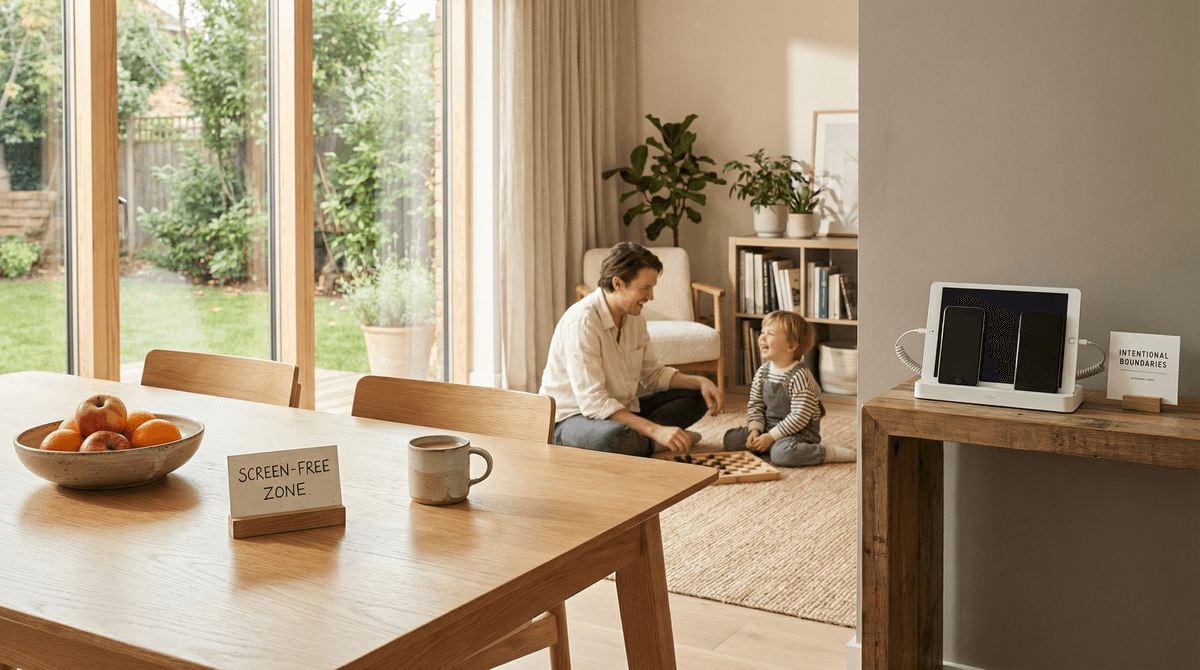
- Create "connection zones" in your home—kitchen, dining room, wherever your family naturally gathers
This isn't about quality time being superior to screen time. It's about making sure screen time doesn't replace the interactions kids need to develop communication skills, emotional intelligence, and a sense of belonging.
4. Protect Boredom
Kids need unstructured time to be bored, to imagine, to create, to figure out what they actually enjoy. Constant screen access eliminates this.
What to do:
- Build in screen-free windows during the day (like 3-5pm, or weekend mornings)
- Don't rush to "fix" boredom with a screen
- Keep books, board games, art supplies, and outdoor toys easily accessible
Boredom is where creativity lives. It's also where kids learn to self-soothe, to tolerate discomfort, and to generate their own entertainment—skills that will serve them forever.
Ages 0-2: The AAP recommends essentially no screen time except video chatting. Babies and toddlers learn through physical interaction with the world, not screens.
Ages 2-5: Very limited screen time (under 1 hour daily of high-quality content), always co-viewed with a parent. This is the age where Bluey and Daniel Tiger can be genuinely educational—but only if you're watching together and talking about it.
Ages 6-9: 1-2 hours of recreational screen time on school days is reasonable for most kids, more on weekends. At this age, focus on building good habits: screens in common areas, no YouTube unsupervised, gaming time that doesn't interfere with homework and sleep.
Ages 10-12: 2-3 hours of recreational screen time is typical, but this is where you need to start differentiating between passive consumption and active creation. A kid coding in Scratch, editing videos, or playing collaborative games with friends is different from binge-watching YouTube.
Ages 13+: Time limits become less useful here. Teens need autonomy, and they're developmentally driven to connect with peers—which now happens online. Instead of counting hours, focus on the four non-negotiables above. Is screen time interfering with sleep? Physical activity? Family connection? School performance? If not, you're probably okay.
For more on navigating social media specifically, check out this guide to age-appropriate social media.
Start with the easy wins:
- Use Apple Screen Time, Google Family Link, or Circle to set automatic bedtime shutdowns
- Charge all devices in a central location overnight
- Create phone-free zones (dinner table, car rides, bedrooms)
Then tackle the harder stuff:
- Have a family meeting to explain why you're making changes (focus on sleep, health, connection—not "screens are bad")
- Let kids have input on the rules (they're more likely to follow rules they helped create)
- Be consistent, especially in the first few weeks
Expect pushback. This is normal. You're changing habits that feel foundational to your kid's social life and sense of autonomy. Acknowledge that it's hard. But hold the line on the non-negotiables.
Model the behavior you want to see. If you're scrolling Instagram at dinner, your kid will (rightfully) call you out. If you're checking work email at 10pm, you can't enforce a phone-free bedroom rule.
Here's the thing: context matters enormously. A kid watching educational YouTube videos about space is better than watching prank videos, sure. But it's still passive consumption.
The most valuable screen time is active and social: coding, creating videos, playing multiplayer games that require communication and strategy, video chatting with friends or family.
If your kid is spending hours on Khan Academy or reading ebooks, that's generally fine—but still check in on the four non-negotiables. Even "good" screen time can interfere with sleep if it's happening at 11pm.
Watch for these red flags:
- Persistent sleep issues (trouble falling asleep, waking up exhausted)
- Declining grades or inability to focus on homework
- Loss of interest in activities they used to enjoy
- Irritability, mood swings, or meltdowns when screens are taken away
- Sneaking screen time or lying about usage
If you're seeing multiple red flags, it might be time for a bigger reset. Some families do a "screen detox" week to recalibrate. Others work with a therapist who specializes in digital wellness.
Healthy screen time isn't about hitting a magic number of hours. It's about making sure screens enhance your kid's life without crowding out the essentials: sleep, movement, real-world connection, and space to just be.
Start with the four non-negotiables. Protect sleep, physical activity, face-to-face connection, and boredom. Everything else is negotiable based on your family's values and your kid's individual needs.
And remember: you're not trying to raise a kid who never uses screens. You're trying to raise a kid who can use screens intentionally, who knows when to put them down, and who has a rich, full life that exists both online and off.
-
Audit your current situation: Track your kid's screen time for a week (most devices have built-in tools for this). Look for patterns—when are they using screens most? What's getting crowded out?
-
Identify your family's non-negotiables: Which of the four priorities above needs the most attention in your household?
-
Make one change this week: Don't try to overhaul everything at once. Pick the lowest-hanging fruit (charging phones outside bedrooms, no screens at dinner, etc.) and start there.
-
Check out Screenwise's personalized recommendations to see how your family's habits compare to others in your community and get specific next steps tailored to your kid's age and interests.
You've got this. Imperfectly, messily, one day at a time.