

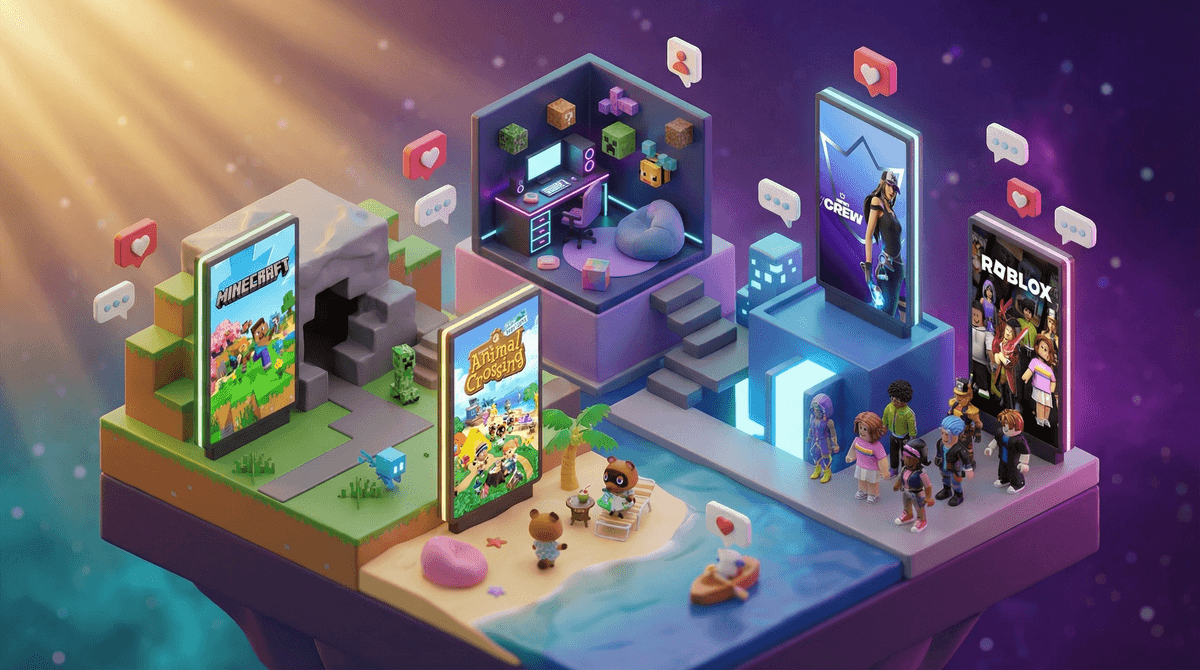
Let's start with the obvious: multiplayer games are where kids play with or against other people online. But here's what makes this category so tricky for parents—it's not just about the game itself anymore. It's about who your kid is playing with, what they're saying to each other, and whether some 32-year-old dude named "xXDarkLord420Xx" is asking for their Snapchat.
The games themselves? Often genuinely great. Minecraft teaches spatial reasoning and creativity. Roblox is basically a platform for kids to learn game design and yes, even entrepreneurship (though we need to talk about those Robux). Fortnite has legitimately impressive building mechanics and teamwork elements.
But multiplayer games come with a whole ecosystem of concerns that single-player games don't: voice chat with strangers, text messaging, friend requests, trading systems that can turn into scams, and social pressure to keep playing "just one more round" because your squad needs you.
Here's the thing—kids aren't playing multiplayer games just because of flashy graphics or addictive gameplay loops (though those don't hurt). They're playing because this is where their friends are.
In 2026, multiplayer games are the digital equivalent of the neighborhood pickup basketball game or hanging out at the mall. Your kid isn't necessarily obsessed with Fortnite—they're obsessed with playing Fortnite with Mason from school while talking about absolutely nothing important over voice chat.
This is real socialization. It counts. A kid strategizing with their friends in Among Us, learning to communicate and problem-solve together, is developing actual social skills. The fact that it's happening through avatars on a screen doesn't make it less valid than if they were playing Catan at your kitchen table.
That said—and this is important—not all multiplayer experiences are created equal. Some games have robust safety features, age-appropriate content, and communities that are genuinely kid-friendly. Others are basically Lord of the Flies with better graphics.
Ages 6-8: Supervised Multiplayer Only
At this age, kids should only be playing multiplayer games with people you know IRL. Full stop. Their impulse control isn't developed enough to handle strangers, and they can't yet distinguish between "a nice person online" and "someone who shouldn't be talking to kids."
Good options:
- Minecraft on a private server with school friends or cousins
- Mario Kart 8 (local multiplayer or with friends only)
- Animal Crossing: New Horizons (visiting friends' islands with Dodo codes you share)
- Splatoon 3 (no voice chat, kid-friendly content)
What to avoid: Anything with open voice chat, text chat with strangers, or trading systems. So basically most of Roblox at this age unless you've locked down the settings hard (here's how to set up Roblox parental controls if you're going that route).
Ages 9-11: Training Wheels Off, But You're Still Supervising
This is the age where many kids start playing Roblox, Fortnite, or Minecraft on public servers. They're developmentally ready to start navigating some social complexity, but they still need active parental involvement.
Good options:
- Fortnite (yes, really—the actual violence is cartoonish, and you can disable voice chat)
- Roblox (with strict account settings and periodic check-ins)
- Fall Guys (no chat, just silly obstacle courses)
- Rocket League (soccer with cars, minimal toxicity)
What you need to do: Have their gaming device in a common area. Know their username. Periodically ask to see their friends list and recent messages. This isn't snooping—it's age-appropriate supervision. Also, learn more about how Robux is in fact real money if they're on Roblox.
Ages 12-14: More Independence, But Teach Digital Citizenship
Middle schoolers can handle more complex multiplayer experiences, but this is also when toxicity, cyberbullying, and social pressure ramp up significantly. Your job shifts from constant supervision to teaching them how to handle difficult situations.
Good options:
- Minecraft (still great at this age, especially modded servers)
- Valorant (competitive but has decent reporting systems)
- Stardew Valley (co-op farming with friends—genuinely wholesome)
- Deep Rock Galactic (co-op mining game with surprisingly positive community)
What you need to talk about: What to do if someone says something racist, sexist, or just mean. How to block and report. Why they should never share personal information. What "doxxing" and "swatting" are (yes, really—these are real risks in competitive gaming communities).
Let's cut through the noise. Here's what you should actually worry about:
1. Voice chat is the biggest safety concern. Text chat can be monitored and filtered. Voice chat is real-time and often unmoderated. If your kid is under 10, voice chat should be off or friends-only. Period.
2. Trading systems are scam magnets. Games like Roblox, Adopt Me, and even Minecraft have in-game economies where kids can trade items. This is where scammers thrive, convincing kids to trade valuable items for nothing or clicking phishing links.
3. "Friend" doesn't mean friend. Kids will accept friend requests from anyone who seems nice or offers them free stuff. Teach them that online friends are different from IRL friends, and they should never share personal information (real name, school, address, phone number) with someone they only know online.
4. Screen time isn't the only metric. A kid playing Stardew Valley cooperatively with their best friend for two hours is having a very different experience than a kid rage-scrolling TikTok for two hours. Quality matters as much as quantity.
5. The "just one more game" problem is real. Multiplayer games are designed to keep you playing. There's always another match, another quest, another friend online. Set clear time limits before they start playing, and use tools like screen time limits or the console's built-in parental controls to enforce them.
Most "kid-friendly" games still have toxic players. Even in Animal Crossing, which is about as wholesome as it gets, there are players who grief, steal, or say inappropriate things. No game is 100% safe just because it's rated E for Everyone.
Free-to-play games make money somehow. Fortnite, Roblox, [Brawl Stars](https://screenwiseapp.com/media/brawl-stars-app—these games are free to download but make billions through in-game purchases. Your kid will feel social pressure to buy skins, battle passes, and other cosmetics. Set clear boundaries about spending before it becomes an issue.
Cross-platform play is both great and complicated. Your kid can play Minecraft with their friend who has an Xbox even though they have a Switch. Amazing! But it also means they might be playing with PC players who have access to text chat and mods that console players don't. Just something to be aware of.
The most popular games aren't always the best. Roblox is huge, but honestly? A lot of the games on there are low-quality, cash-grabby experiences. Don't be afraid to steer your kid toward smaller, better-designed games like It Takes Two or Overcooked 2.
Multiplayer games aren't inherently dangerous, and they're not going away. They're where kids socialize now, and fighting that is like trying to hold back the tide with a bucket.
The goal isn't to keep your kid in a bubble—it's to give them the skills and boundaries they need to navigate these spaces safely. That means age-appropriate games, proper safety settings, ongoing conversations about digital citizenship, and yes, sometimes saying "no" to games that just aren't right for your family yet.
Start here:
- Check the parental controls on whatever device your kid plays on (console, PC, tablet, phone)
- If they're playing Roblox, read this guide to Roblox parental controls and actually implement them
- Have a conversation about online safety that isn't just "don't talk to strangers" (because they will anyway)
- Decide on your family's rules about voice chat, friend requests, and in-game purchases before the next argument happens
If you want alternatives to the big names:
- Check out alternatives to Minecraft if you're tired of the same blocky aesthetic
- Explore cozy games for multiplayer experiences that are genuinely low-stress
- Look into local multiplayer games if you want everyone in the same room
And remember: you don't have to be perfect at this. Nobody is. The fact that you're reading this guide means you're already doing better than most.