

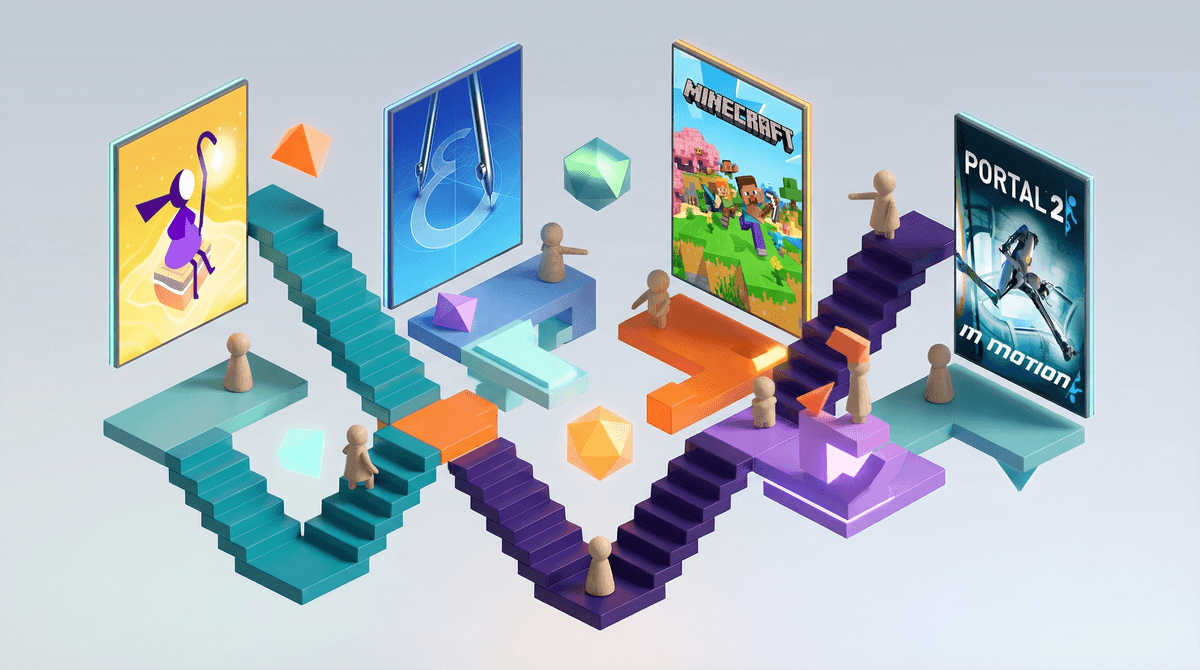
Geometry games are digital games that teach spatial reasoning, shape recognition, pattern matching, and mathematical thinking through interactive puzzles and challenges. Think everything from rotating blocks to fit through shapes (Tetris style) to building complex structures with precise measurements (Minecraft) to mind-bending puzzles that make you think about dimensions in totally new ways.
The beautiful thing about geometry games? Kids often don't realize they're doing math. They're just trying to figure out how to get that weird polygon through the portal or build a bridge that doesn't collapse. But behind the scenes, their brains are developing crucial spatial reasoning skills that translate directly to success in STEM fields.
And before you worry this is some "educational game" situation where the fun has been surgically removed in favor of worksheets disguised as gameplay—nope. Many of the best geometry games are legitimately engaging, the kind kids will choose over other screen time options.
Here's the thing parents don't always realize: spatial reasoning is a massive predictor of success in math and science. Studies show that kids with strong spatial skills in elementary school are more likely to pursue and succeed in STEM careers later. We're talking about the ability to mentally rotate objects, understand how 2D representations relate to 3D objects, and visualize how shapes fit together.
And unlike some innate talents, spatial reasoning is incredibly trainable. Playing geometry games regularly can genuinely improve these skills—which is why researchers get excited about games like Portal 2 (yes, really, there are actual studies on this).
For younger kids, geometry games build foundational concepts like shape recognition and symmetry. For older kids, they introduce concepts like angles, area, volume, and coordinate planes without the pressure of a math test.
Ages 4-7: Building Foundations
Monument Valley - This gorgeous puzzle game has kids manipulating impossible architecture to guide a character through mazes. It's like M.C. Escher for kindergarteners, teaching perspective and spatial manipulation. About 15-20 minutes per play session, minimal reading required.
[Osmo Tangram](https://screenwiseapp.com/media/osmo-tangram-boardgame - Technically requires the Osmo base (physical manipulatives + iPad), but it's brilliant for this age. Kids physically move tangram pieces to match on-screen shapes, bridging the gap between physical and digital learning.
Shapes and Colors - A simple app that teaches basic shape recognition and sorting. Not flashy, but solid for building vocabulary around geometric terms.
Ages 8-11: Getting Complex
Minecraft - Yes, I'm putting Minecraft on this list. In Creative or Survival mode, kids are constantly calculating area, volume, and spatial relationships. Building a house requires understanding perimeter and dimensions. Redstone circuits? That's basically Boolean logic. Learn more about Minecraft's educational benefits.
Geometry Dash - A rhythm-based platformer that's wildly popular with this age group. While it's more about timing than pure geometry, it builds pattern recognition and spatial awareness. Fair warning: it's challenging and can be frustrating, but kids love it.
Euclidea - This one's for kids who are ready for actual geometric construction challenges. You solve puzzles using only compass and straightedge (digitally), just like ancient Greek mathematicians. Starts simple, gets genuinely difficult. Ages 10+ will get the most from it.
Bloxorz - A classic browser game where you roll a rectangular block through a maze to drop it into a square hole. Requires serious spatial planning and mental rotation. Free, no ads, perfect for a 20-minute brain break.
Ages 12+: Real Mathematical Thinking
Portal 2 - Rated E10+ but really shines for middle schoolers. The entire game is about understanding how portals create shortcuts through 3D space. Research has shown that playing Portal 2 improves spatial reasoning test scores. The co-op mode is fantastic for siblings or parent-kid play.
The Witness - A gorgeous, challenging puzzle game that teaches pattern recognition and logical thinking. Some puzzles involve symmetry, angles, and spatial relationships. This one's meaty—plan for hours of gameplay. Best for kids who love a challenge and don't need constant action.
Kerbal Space Program - Build rockets and learn actual physics and geometry in the process. Understanding orbital mechanics requires grasping ellipses, angles, and vectors. This is the game that's inspired actual aerospace engineers.
Not all "educational" games are created equal. Here's what actually matters:
Progressive difficulty - The game should start accessible and gradually introduce new concepts. If your kid is frustrated in the first five minutes, it's not pitched right.
Immediate feedback - Good geometry games show you right away if your solution works or doesn't, and ideally why. This trial-and-error learning is how spatial reasoning develops.
Minimal extraneous stuff - If the game is wrapped in a bunch of ads, in-app purchases for hints, or random grinding mechanics, it's not really about learning geometry—it's about monetization. Learn about predatory game design .
.
Replay value - Can kids approach puzzles multiple ways? Are there optional challenges? The best geometry games reward creative problem-solving, not just memorizing solutions.
Look, I get it. You're trying to balance educational value with not having your kid glued to a screen for hours. Here's my take: geometry games are genuinely educational screen time, but they're still screen time.
A reasonable approach for most families:
- Ages 4-7: 20-30 minutes of geometry games counts as quality screen time
- Ages 8-11: 30-45 minutes, especially if they're building something complex in Minecraft
- Ages 12+: Up to an hour if they're deeply engaged in problem-solving (Portal 2, The Witness)
The key is active engagement. If your kid is frustrated-but-trying, that's learning. If they're mindlessly tapping or watching YouTube videos of someone else playing, that's not the same thing.
Some kids take to spatial puzzles immediately. Others... don't. And that's okay! Not every kid needs to love geometry games for them to be beneficial.
If your kid resists, try:
- Physical manipulatives first - Tangrams, pattern blocks, or even LEGO can build spatial skills before going digital
- Co-playing - Solve puzzles together, talking through your thinking process
- Shorter sessions - Five minutes of Bloxorz is better than zero minutes
- Different entry points - Maybe pure puzzles aren't their thing, but building in Minecraft is
And honestly? Some kids just aren't going to be into it, and that's fine. There are plenty of ways to develop spatial reasoning that don't involve screens.
Geometry games are one of the rare cases where educational value and actual engagement overlap beautifully. They're building real mathematical skills while keeping kids entertained—and that's not marketing hype, that's backed by research.
Start with age-appropriate options, keep sessions reasonable, and don't force it if it's not clicking. The goal isn't to create a geometry prodigy; it's to give kids another tool for understanding how the world works.
And if your kid ends up spending Saturday morning voluntarily solving spatial puzzles instead of watching random YouTube videos? That's a parenting win, full stop.
Want to explore more educational games? Check out our guide to educational games that don't suck.
Curious about specific games mentioned? Use Screenwise to see age ratings, parent reviews, and WISE scores for any game. We'll help you figure out if it's right for your family.
Still have questions? Find geometry games for your kids and get personalized recommendations based on your kid's age and interests.