Euclidea

Euclidea

game

Everyone, 2016, Puzzle

WISE
89%

WISE Score

Compass-and-straightedge geometry puzzles that start gentle and end up making you feel like Euclid himself (or totally stumped).

Where to Play

Screenwise Verdict

This is what educational games should be: genuinely teaching real mathematical concepts while being engaging enough that kids (and adults) willingly spend hours on it.

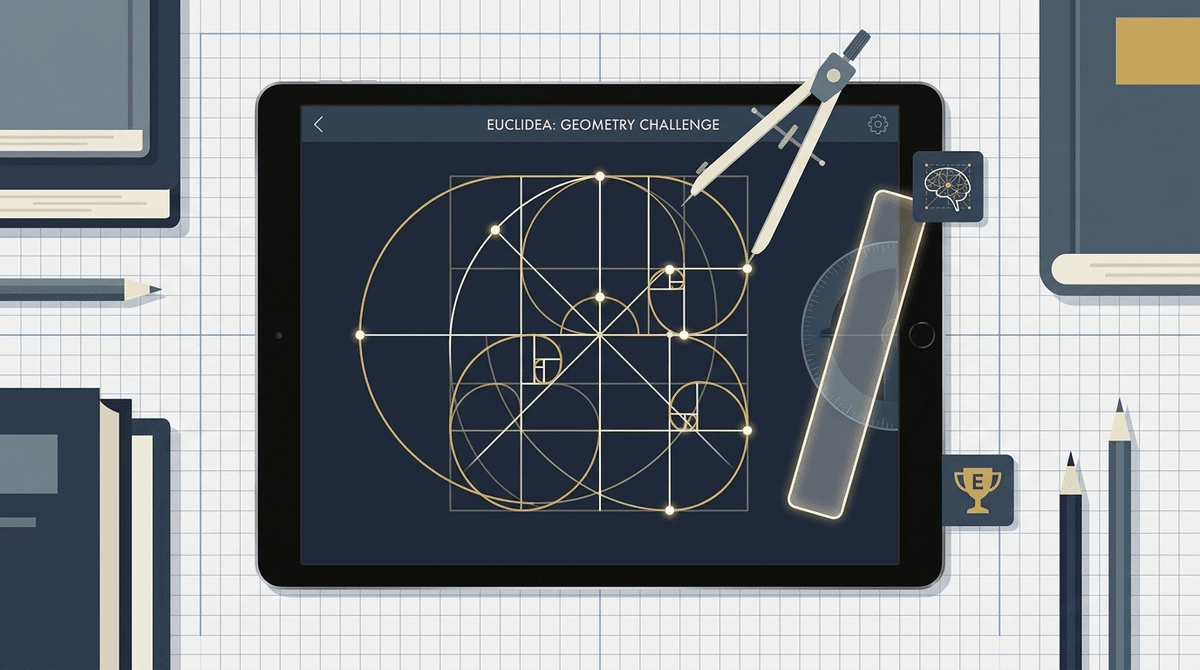
Euclidea doesn't dumb down Euclidean geometry—it makes it tactile and exploratory. You're literally doing the same compass-and-straightedge constructions that ancient Greek mathematicians did, but with instant feedback and the ability to drag points around to understand why your proof works (or doesn't). The scoring system (fewest lines vs. fewest elementary constructions) teaches that there are multiple ways to approach problems and that elegance matters in mathematics.

The difficulty curve is real. Early levels guide you gently, but by the time you're constructing regular pentagons or finding outer tangents, you're doing legitimate geometry that would appear in a high school honors course. Some kids will love this challenge; others will rage-quit. The IAP to unlock all levels is actually reasonable here—it removes the grind without adding pay-to-win nonsense.

If your kid likes math, logic puzzles, or games like Monument Valley, this is a no-brainer. If they tolerate math class but don't seek it out for fun, they'll probably find this tedious. Know your audience.

Age Fit

Best for ages 10-17 who have some geometry exposure and genuinely enjoy logic puzzles. Younger kids (8-9) with strong spatial skills could try it, but many will bounce off. Adults who loved geometry will also find it engaging.

WISE Breakdown
Wholesome
95

Pure geometric puzzle game with no social features, no competitive pressure, and a calm, methodical pace. Models patience, persistence, and the satisfaction of elegant problem-solving. Zero concerning content.

Imaginative
88

Brilliantly original take on Euclidean geometry that invites creative problem-solving—many challenges have multiple solutions. The dynamic interface (drag, zoom, pan) encourages exploration and experimentation. Unlocking new tools as you progress builds a sense of discovery, though it's more about finding elegant solutions within constraints than open-ended creation.

Safe
82

No ads, no social features, no concerning content. Has IAP to unlock all levels without earning stars, which is actually reasonable (removes grinding). Kids mode available. Main concern: some levels are genuinely difficult and could cause frustration. The progression system can feel restrictive if you get stuck.

Enriching
94

Exceptional educational value. Teaches genuine Euclidean geometry, spatial reasoning, logical thinking, and mathematical proof concepts through hands-on construction. Develops intuition about geometric relationships. Starts accessible and builds to legitimately challenging problems. Teachers and math students praise it for building imagination, intuition, and logic. This is real learning disguised as a game.

Parent Info

Why It Might Be Great

  • Teaches actual Euclidean geometry through 127 increasingly challenging puzzles—this is real math, not math-flavored busywork
  • Multiple solutions possible for many challenges, rewarding both creativity and elegance
  • Dynamic interface lets you drag, zoom, and explore relationships between geometric elements hands-on
  • Starts accessible for beginners and builds to genuinely difficult constructions (angle bisectors, tangents, regular polygons)
  • No ads, no social pressure, no timers—just you, your brain, and beautiful geometric proofs

What to Watch For

  • Gets legitimately hard—later levels can be frustrating even for adults who enjoyed geometry in school
  • Progression system locks future levels until you earn stars, which might require looking up solutions if stuck
  • Has an IAP to bypass the star requirement, which some kids might push for if they hit a wall
  • Not for kids who struggle with or dislike math—this requires patience and spatial reasoning

Conversation Starters

  • "Can you show me the construction you just figured out? Walk me through how you solved it."
  • "Which solution used fewer moves—yours or the one you found online? Why do you think mathematicians care about elegance?"
  • "What's the hardest level you've beaten so far? What made it click for you?"
  • "Did you know people were doing these exact constructions 2,300 years ago without computers?"

Ask Anything

Get a personalized guide on any topic