

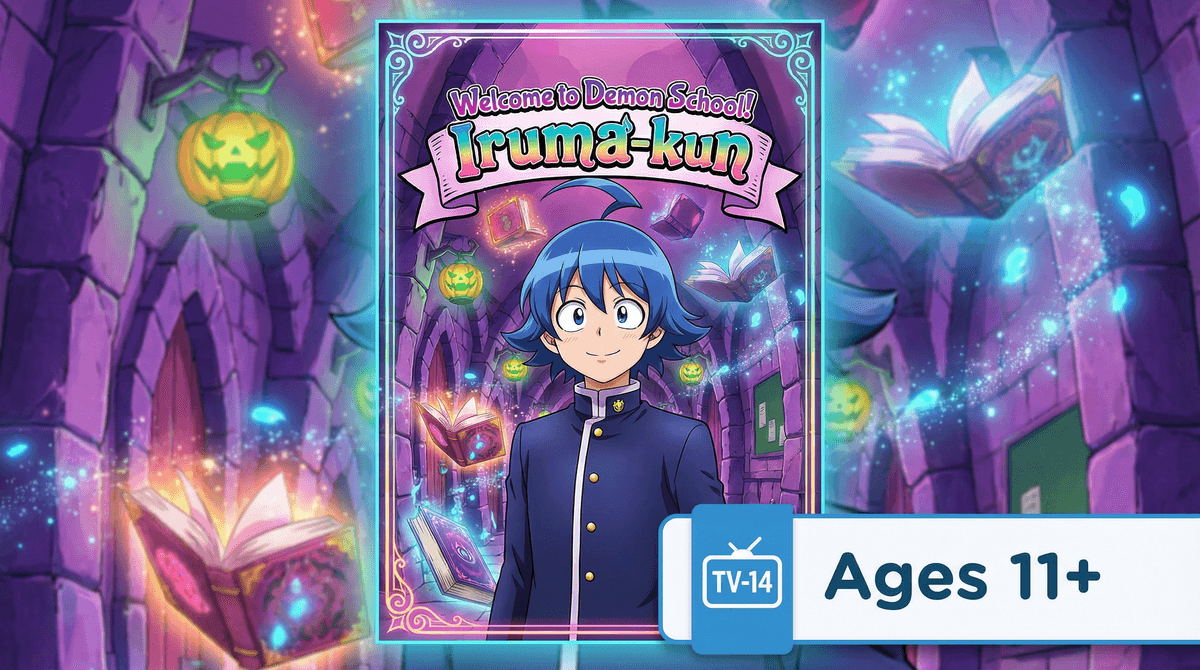
Welcome to Demon School! Iruma-kun: What Parents Need to Know About Age Ratings
Welcome to Demon School! Iruma-kun is rated TV-14 and honestly? That's pretty accurate. This anime comedy about a human boy accidentally enrolled in demon school has mild fantasy violence, some suggestive humor, and occasional scary demon imagery, but it's genuinely one of the more wholesome anime options out there. Ages 11-12+ depending on your kid's anime experience and comfort with the genre's quirks.
The premise sounds wild: 14-year-old Iruma Suzuki's terrible parents literally sell him to a demon, who then adopts him as a grandson and enrolls him in demon school. The catch? If anyone discovers he's human, he'll be eaten.
But here's what actually happens: it's a surprisingly heartwarming comedy about a kind, self-sacrificing kid who's spent his whole life being exploited by his parents, finally finding a place where people care about him. Yes, that place is demon school. Yes, his new grandpa is a powerful demon. But the show is way more about friendship, found family, and personal growth than it is about anything dark or disturbing.
Think of it as a magical school anime (like Harry Potter but make it demons) crossed with a fish-out-of-water comedy. The demon world has its own rules, hierarchy, and culture that Iruma has to navigate while keeping his human identity secret.
The appeal is pretty straightforward: Iruma is an underdog who keeps accidentally succeeding despite being completely out of his depth. He's surrounded by colorful demon classmates with wild personalities and powers. There's magic, comedy, school competitions, and that satisfying progression of watching a character grow from powerless to capable.
The show also hits that sweet spot of being genuinely funny without relying on mean-spirited humor. Iruma is kind and earnest in a way that's refreshing—he helps his demon classmates not because he's trying to hide his identity, but because that's just who he is. Kids respond to that.
Plus, the animation is vibrant and expressive, the opening songs are catchy as hell, and there's enough plot momentum to keep binge-watching sessions going.
The TV-14 rating is doing real work here, and it's worth breaking down what you're actually getting:
Fantasy Violence: This is a show about demons, so there's combat, magical battles, and some intimidating imagery. But it's stylized anime violence—energy blasts, magical attacks, dramatic poses. Nobody's getting graphically injured. The "scariest" moments are usually played for comedy or quickly resolved.
Suggestive Themes: There's some mild fanservice typical of anime—occasional cleavage shots, a few characters designed with exaggerated proportions, some blushing romantic tension. One demon character (Asmodeus Alice) is explicitly the "demon of lust" but this manifests as him being popular and charming, not anything explicit. There are a handful of jokes about demons being attracted to each other, but nothing beyond PG-13 territory.
Scary/Intense Imagery: Some demons look genuinely creepy in their "evil forms." There are moments of tension when Iruma might be discovered. The show occasionally touches on darker demon world concepts (like the fact that demons would eat humans if they found one). But the show's tone always pulls back from going too dark.
Mild Language: The subtitled version has occasional mild profanity. The English dub keeps it pretty clean.
Thematic Elements: The most potentially concerning content is actually Iruma's backstory—his parents are genuinely neglectful and exploitative, literally selling their son. The show doesn't dwell on this trauma, but it's there. Some kids might find this upsetting; others will connect with the found family healing that follows.
Ages 11-12+: This is the sweet spot. Kids this age who've watched anime before (My Hero Academia, Demon Slayer) will handle Iruma-kun just fine. It's actually lighter than both of those.
Ages 9-10: Possible for mature viewers, especially if they're comfortable with fantasy/supernatural content. Preview an episode yourself first. The demon imagery and occasional intensity might be too much for sensitive kids.
Ages 13+: Totally fine. At this age, the bigger question is whether the humor and school-comedy vibe appeals to them—some teens might find it too "young."
Anime newbies: If your kid hasn't watched much anime, be aware that the genre has conventions that can feel weird at first—exaggerated reactions, dramatic music stings, occasional cultural references that don't translate perfectly. Iruma-kun is actually a decent starter anime because it's relatively straightforward, but you might want to read this guide about introducing kids to anime.
It's actually really wholesome: Despite the demon premise, this show has genuine heart. Iruma's character arc is about learning to value himself, set boundaries, and accept love from others. His demon grandpa Sullivan is ridiculously doting and supportive. His friends are loyal. The show consistently rewards kindness and cooperation over selfishness.
The pacing is slow: This is a slice-of-life school comedy with some action, not a high-stakes thriller. Some kids will love the character development and world-building. Others might find it too slow compared to action-heavy shows.
There are three seasons available: That's a lot of content (63 episodes total as of 2024). If your kid gets into it, you're set for a while. It's available on Crunchyroll and some other streaming platforms.
The manga goes further: The source manga has more content and gets into some darker territory in later arcs. If your kid loves the show and wants to read ahead, you might want to preview those volumes first.
Cultural context matters: The demon hierarchy, the focus on "evil" as a positive trait in demon society, and the overall premise require some cultural literacy about anime storytelling. This isn't trying to make a statement about actual demons or religion—it's playing with fantasy tropes in a way that's common in Japanese media.
If your kid watches and enjoys:
- My Hero Academia: Iruma-kun has similar school-based structure and found family vibes, but it's lighter on action and violence
- The Promised Neverland: Way less dark and suspenseful, but shares the "humans in danger from demons" premise played very differently
- Komi Can't Communicate: Similar wholesome school comedy energy, but Iruma-kun adds fantasy elements
- Little Witch Academia: Very comparable—magical school, underdog protagonist, wholesome themes. Iruma-kun is slightly more mature in content
If you're on the fence, watch the first two episodes together. Episode 1 sets up the premise and establishes the tone. Episode 2 introduces the main supporting cast and shows what the actual show will be like going forward.
Some conversation starters:
- "How do you think Iruma feels about his parents selling him? Is it okay that the show treats this kind of lightly?"
- "What do you think about the demon world's values being opposite of ours? Does it bother you that 'evil' is good there?"
- "Which demon classmate would you want to be friends with?"
- "Do you think Iruma should tell his friends he's human?"
These questions can help you gauge your kid's media literacy and emotional processing while also making it a shared experience.
Welcome to Demon School! Iruma-kun earns its TV-14 rating but sits on the lighter end of that spectrum. It's a genuinely sweet show about found family, friendship, and self-worth wrapped in a demon school comedy package.
The content concerns are real but manageable: some fantasy violence, mild suggestive elements, occasionally creepy demon designs, and thematic elements around parental neglect. But the overall message is positive, the humor is good-natured, and the emotional core is solid.
For most families with kids ages 11-12+ who have some anime experience, this is a solid choice. It's not going to keep them up at night, and you might actually enjoy watching it with them.
If you want to explore more age-appropriate anime options, or you're trying to figure out whether your kid is ready for anime in general, Screenwise can help you navigate those decisions with actual data about what other families in your community are doing.