

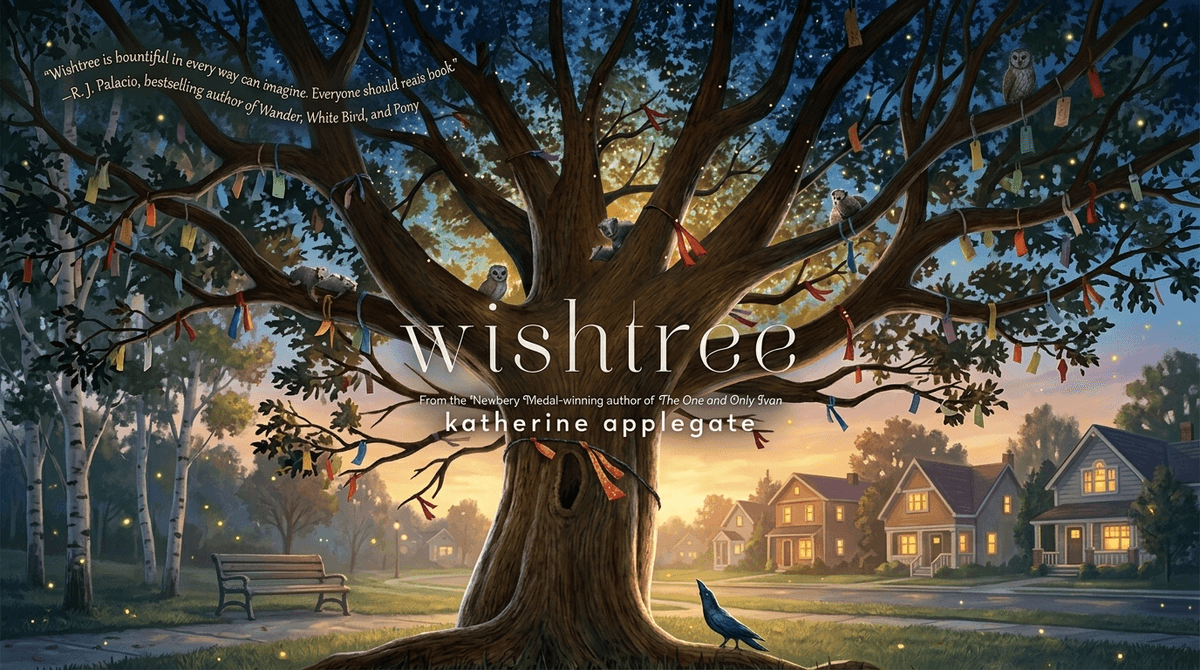
TL;DR: Wishtree by Katherine Applegate is a beautiful, short middle-grade novel about an old oak tree that witnesses a neighborhood’s struggle with prejudice. It’s currently a flashpoint in school board meetings because of its themes of inclusion and a brief mention of a non-binary character. Despite the noise, it’s a 5-star "must-read" for building empathy in kids ages 8-12.
Quick Links:
- Best for: Ages 8-12 (Grades 3-6)
- The Author’s Heavy Hitter: The One and Only Ivan
- If they like animal POV stories: The Wild Robot
- Check out our guide on how to talk to kids about book bans

If you haven’t seen the cover in your kid's Scholastic flyer or at the local library, here’s the deal: Wishtree is narrated by Red, an optimistic, 216-year-old Northern Red Oak. Red is a "wishing tree"—a local tradition where people tie scraps of fabric or paper representing their hopes to its branches.
The plot kicks off when a Muslim family moves into the neighborhood. Not everyone is welcoming. A teenager carves the word "LEAVE" into Red’s trunk, a direct threat to the new family. Red, who usually follows the "don't talk to humans" rule of the animal/plant kingdom, decides to intervene to help the young girl, Samar, find a friend and feel at home.
It’s written by Katherine Applegate, who basically owns the "poignant animal story" market. If your kid liked The One and Only Ivan or Odder, this is in that same DNA. It’s short, has plenty of illustrations, and uses simple language to tackle some pretty massive "big human" problems.
You might be wondering how a book about a tree became a "dangerous" text. We’ve seen a massive spike in book challenges over the last two years, and Wishtree is frequently caught in the net.
There are two main reasons it’s getting flagged:
- The "Inclusion" Factor: The book is explicitly about welcoming immigrants and standing up against Islamophobia. In some districts, this is being labeled as "social engineering" or "indoctrination."
- The Non-Binary Character: There is a very brief mention of a secondary character who is non-binary. For some parents and school boards, this is a non-starter for the 8-10 age group.
Here’s the Screenwise take: The "controversial" elements are handled with incredible gentleness. The book isn't a political manifesto; it's a story about being a good neighbor. If your family values empathy and standing up for the underdog, this book is a layup. If you’re sensitive about your 3rd grader reading about gender identity or religious prejudice, you’ll want to read it with them—but honestly, these are the conversations kids are already having on the playground.
Kids don't pick up Wishtree because they want a lesson in civic virtue. They pick it up because:
- The Animals are Great: Red’s best friend is a cynical crow named Bongo. Their banter is funny and keeps the story from feeling too "teachable."
- It’s Not Intimidating: The chapters are tiny. For a kid who struggles with "wall of text" syndrome, this book feels like a win.
- The Mystery: There’s a genuine tension about whether the tree will be cut down and who carved the hateful message.
From a digital wellness perspective, books like this are the perfect "brain cleanse." After an hour of the high-octane, neon-soaked chaos of Roblox or the mindless scroll of YouTube Shorts, the slow, rhythmic pace of a 200-year-old tree’s thoughts is exactly what their dopamine receptors need.
If your kid finishes Wishtree and actually—gasp—asks for another book, here is where you go next.
This is the gold standard. It’s based on the true story of a gorilla who lived in a mall for decades. It’s a tear-jerker, but it’s essential reading. There’s also a Disney+ movie, but the book is significantly better.
If they liked the "nature vs. outsiders" theme, this is the one. It’s about a robot who washes up on an island and has to learn to survive by communicating with animals. It’s a massive hit with the 7-11 age group.
Another Applegate classic. This one deals with a boy whose family is facing homelessness and his giant imaginary cat, Crenshaw, who returns to help him through it. It’s heavy, but like Wishtree, it handles the "hard stuff" with a lot of grace.
For the kid who wants more "nature" and a bit more adventure. It’s told from the perspective of a wolf traveling across the Pacific Northwest. Beautifully illustrated and very engaging.
Check out our full guide on best books for kids who love animals
Target Age: 8 to 12
- Ages 8-9 (3rd & 4th Grade): This is the sweet spot for reading together. The concepts of "mean words" and "being a new kid" are very relevant here. You might need to explain what a "Wishing Tree" is (it’s a real tradition in many cultures!).
- Ages 10-12 (5th & 6th Grade): Most kids this age will breeze through this in two nights. It’s a great conversation starter about what they see in their own schools.
Safety Considerations: The only "scary" part is the act of hate speech (the carving in the tree). It can be upsetting for sensitive kids to realize that people can be that cruel to a family just for being different. However, the book's resolution is focused on community support, which balances the scales.
If your kid comes home asking why people are "mad at the tree book," or if you're deciding whether to keep it on your own shelf, here’s how to frame the conversation:
- Focus on the "Why": Ask your kid why they think someone would carve something mean into a tree. It’s a way to talk about fear and prejudice without it feeling like a lecture.
- The Non-Binary Mention: If it comes up, it’s a great moment to model your family’s values. In the book, the character is just... a person. It’s not a "teachable moment" about gender; it’s just a reflection of the world we live in.
- Community Action: Red the tree can’t move, but he can influence the people around him. Talk to your kids about what they can do when they see someone being treated unfairly at school.
Learn more about navigating "woke" vs "anti-woke" media debates as a parent
Wishtree is not "brain rot." It is the opposite of brain rot. It’s a quiet, thoughtful, and deeply moving book that asks kids to be better than the adults they sometimes see on the news.
Is it "political"? Only if you think kindness and welcoming your neighbors are political acts. In a world where kids are increasingly siloed into digital echo chambers, a book that celebrates a diverse neighborhood coming together to protect a tree (and a family) is exactly what we should be putting in their hands.
Next Steps:
- Grab a copy of Wishtree from the library (if it hasn't been pulled!) or your local bookstore.
- Read the first 20 pages with your kid—the chapters are so short you’ll be done in ten minutes.
- If they love it, move on to The One and Only Ivan.
Get middle-grade recommendations based on your family's WISE score