

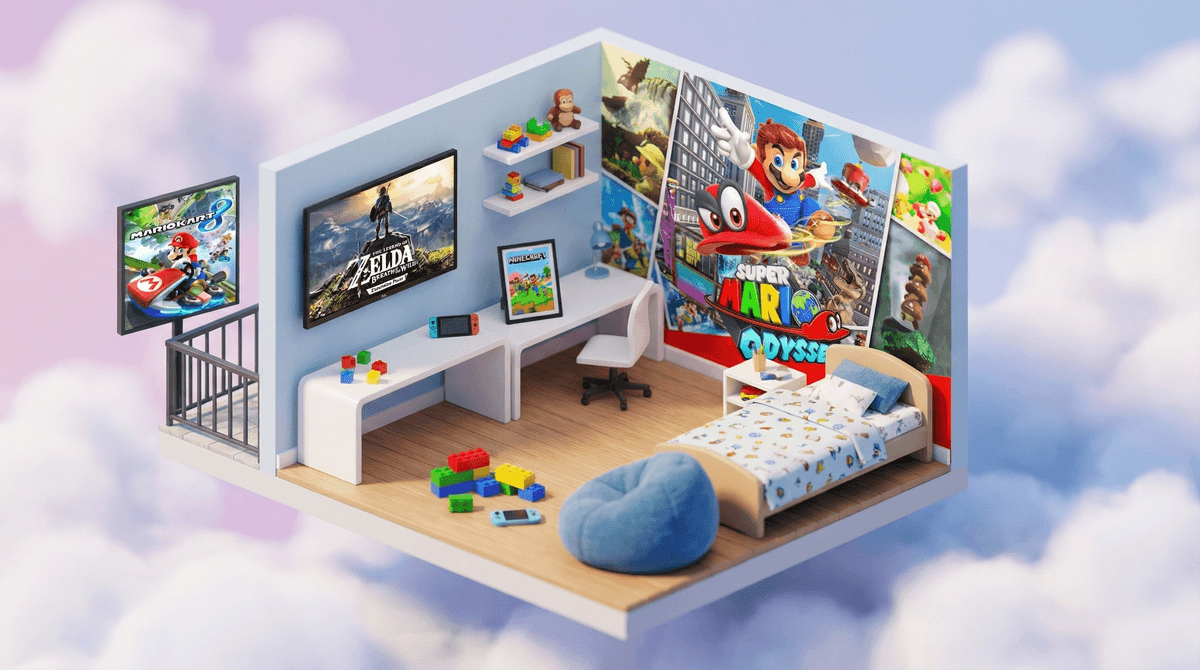
The Best Nintendo Switch Games for 9-Year-Olds
Nine is that sweet spot where kids are reading independently, handling more complex gameplay, and starting to develop their own gaming preferences. Here are the standouts for 2026:
Top Picks:
- Minecraft - Still the creativity king
- Mario Kart 8 Deluxe - Perfect for family game night
- The Legend of Zelda: Breath of the Wild - Adventure without the violence overload (which Zelda fits which age)
- Pokémon Scarlet/Violet - The gateway RPG
- Super Mario Odyssey - Pure joy in platforming form
Also Worth Your Time:
Nine-year-olds are in this fascinating developmental window. They're old enough to handle games with actual challenge and strategy, but they're not quite ready for the intensity of teen-rated shooters or the complexity of hardcore RPGs. They're building problem-solving skills, learning to handle frustration, and starting to care about things like story and character development.
The best games for this age hit a few key notes:
- Readable text - They're reading independently now, so games with story elements work great
- Genuine challenge - They don't need hand-holding, but they also shouldn't be rage-quitting every session
- Creative expression - Building, customizing, making choices
- Social connection - Many 9-year-olds want to play what their friends are playing
- Replayability - Because they'll play the same game for months (or years)
Yeah, it's been around forever. But there's a reason it's still dominating. At 9, kids are hitting their Minecraft prime - they're beyond just placing random blocks and actually building complex structures, creating redstone contraptions, and collaborating on servers with friends.
Why it works: The creative freedom is unmatched. They can build replicas of their school, design elaborate roller coasters, or recreate scenes from their favorite movies. The survival mode adds genuine challenge without being overwhelming, and the multiplayer options mean they can play with friends (though you'll want to learn about Minecraft server safety first).
Watch out for: Online multiplayer can expose kids to strangers and inappropriate chat. Stick to Realms or local multiplayer until you're comfortable with their online maturity.
This is the game that brings the whole family together. The beauty of Mario Kart is its accessibility - younger siblings can use auto-steering and still have fun, while your 9-year-old can turn off assists and actually compete.
Why it works: It's pure fun without any content concerns. No reading required, matches are quick (perfect for "one more game" negotiations), and the skill ceiling is high enough that they'll keep improving for years. Plus, it's genuinely fun for adults, which means more quality family time that doesn't feel like a chore.
The competitive factor: Some kids get really into winning. If your 9-year-old is prone to frustration, you might need some conversations about sportsmanship. The good news? Losing in Mario Kart is often hilariously random (blue shells, anyone?), which takes some of the sting out.
This is where kids start to understand what makes games art. Breath of the Wild is gorgeous, vast, and gives players genuine freedom to explore and solve problems their own way.
Why it works: The open-world design means they can tackle challenges in whatever order feels right. Stuck on a shrine puzzle? Go explore somewhere else and come back later. The combat exists but isn't gratuitous - enemies poof into smoke when defeated, and the focus is more on strategy than violence. Plus, the physics-based puzzles teach actual problem-solving skills.
The challenge factor: This game can be legitimately hard. Some kids will thrive on that challenge; others will need encouragement to stick with it. Consider playing together for the first few hours to help them get their bearings. Many families find that Zelda becomes a collaborative experience, with kids asking parents for help with tough shrines or parents asking kids how they solved a particular puzzle.
Note: Tears of the Kingdom is the sequel and equally excellent, though slightly more complex. If your kid loves Breath of the Wild, it's the natural next step.
Pokémon is the gateway drug to RPGs. At 9, kids are at the perfect age to understand type advantages, team building, and strategy without getting overwhelmed by the deeper mechanics.
Why it works: The core gameplay loop is incredibly satisfying - catch creatures, train them, battle, repeat. The open-world format of Scarlet/Violet gives kids more freedom than previous Pokémon games, and the story is actually engaging. Plus, there's something deeply appealing about building your perfect team.
The collecting obsession: Fair warning - some kids become obsessed with completing the Pokédex. This can be a good thing (goal-setting! persistence!) or a source of frustration. The trading aspect means they'll want to connect with friends who have the opposite version, which can be a nice social element.
Alternative: If your kid hasn't played any Pokémon games yet, Pokémon: Let's Go Pikachu/Eevee is slightly simpler and might be a better starting point.
This is pure platforming joy. Mario Odyssey takes everything great about 3D Mario games and refines it to near-perfection.
Why it works: The main story is accessible enough for most 9-year-olds, but the post-game content (collecting all 900+ Power Moons) provides months of additional challenge for completionists. The "capture" mechanic - where Mario can possess enemies and objects - is endlessly creative and fun. Plus, there's a two-player assist mode where a second player can control Mario's hat, making it great for playing with younger siblings.
The completionist trap: This game can trigger the "gotta catch 'em all" mentality. Some kids will happily hunt for every Power Moon; others will get frustrated. The good news is that you don't need to collect everything to finish the story, so there's no pressure.
Animal Crossing is the opposite of high-stakes gaming. It's calm, creative, and operates in real-time, which means there's no pressure to binge-play.
Why it works: Kids can design their island, catch bugs and fish, decorate their house, and interact with adorable animal villagers. There's no way to fail, no timer, no game over screen. It's digital gardening, essentially, and many kids find it genuinely relaxing.
The real-time element: The game runs on real-world time, which means if your kid wants to play at 7am, it'll be morning in the game. Some parents love this because it naturally limits playtime (there's only so much to do in one day). Others find it frustrating because special events happen at specific times. You can change the system clock to time-travel, but that's a parenting decision you'll need to make.
Social features: Kids can visit each other's islands online, which is usually wholesome but requires Nintendo Switch Online and some basic online safety conversations.
Kirby games are Nintendo's secret weapon for younger players, and Forgotten Land is one of the best. It's adorable, forgiving, and surprisingly fun even for adults.
Why it works: The difficulty is perfectly pitched for this age - challenging enough to feel rewarding but not so hard that kids get stuck. The "Mouthful Mode" (where Kirby swallows huge objects like cars and vending machines) is hilarious and creative. Plus, there's a two-player co-op mode that actually works well.
Perfect for: Kids who find Zelda too challenging or who just want something lighter and more cheerful. Also great for playing together with a younger sibling.
This is Nintendo's take on online shooters, and it's brilliant. Instead of shooting other players, you're shooting ink and trying to cover the most territory.
Why it works: It's all the strategic fun of team-based shooters without any of the violence. The matches are quick (3 minutes), the aesthetic is incredibly cool, and the skill ceiling is high enough that competitive kids can really dig into it. Plus, the single-player campaign is genuinely good.
The online factor: This is primarily an online game, which means voice chat possibilities and interaction with strangers. The good news? Nintendo's online infrastructure is pretty locked down - no built-in voice chat without the separate phone app, and communication is limited to preset phrases. Still, you'll want to have conversations about online gaming etiquette.
Watch out for: Some kids get really competitive about their rank. If your 9-year-old is prone to frustration or trash-talking, you might want to wait a year or stick to the casual modes.
This puzzle-platformer is all about spatial reasoning and problem-solving. Each level is a miniature diorama that you rotate and explore to find hidden gems and reach the goal.
Why it works: The puzzles are clever without being frustrating, and the game naturally teaches kids to think in 3D space and consider problems from multiple angles. Plus, it's cute as hell.
This co-op puzzle game requires two players to cut each other into different shapes to solve challenges. It's basically a masterclass in communication and collaboration.
Why it works: Kids have to talk through problems, plan together, and work as a team. It's genuinely fun while also building real skills. Perfect for siblings or parent-child bonding.
Yeah, we need to talk about these. Fortnite and Roblox aren't technically Nintendo exclusives (Fortnite is on Switch, Roblox isn't), but they're what many 9-year-olds are actually playing.
Fortnite: The shooting is cartoonish and players are "eliminated" rather than killed, but it's still a competitive shooter with online strangers. Some 9-year-olds are ready for this; many aren't. If you do allow it, learn about Fortnite parental controls and have clear conversations about time limits and online behavior.
Roblox: It's a platform with millions of user-created games, which means quality and appropriateness vary wildly. Some games are great for this age; others absolutely aren't. If your kid is playing Roblox, you need to be checking in regularly about which games they're playing and who they're playing with. Here's a guide to Roblox safety.
What 9-year-olds can typically handle:
- Games with reading and story elements
- Complex controls and multi-button combinations
- Strategic thinking and planning ahead
- Some frustration and challenge (with support)
- Turn-based or slower-paced online competition
- Collaborative multiplayer with friends
What might still be too much:
- Fast-paced online shooters with strangers
- Games with realistic violence or gore
- Horror games (even "mild" ones)
- Games with heavy themes (death, war, trauma)
- Highly competitive ranked modes that trigger anxiety
- Completely unsupervised online chat
Every kid is different. Some 9-year-olds are ready for more intense content; others need gentler options. You know your kid best.
Time limits matter: Even great games can become problematic if they're played for hours on end. The Switch has excellent parental controls built in - use them. You can set daily time limits, restrict online features, and even pause gameplay remotely from your phone.
Play together: Especially for new games, playing alongside your kid helps you understand what they're experiencing and gives you natural conversation opportunities. Plus, many of these games are genuinely fun for adults.
Talk about money: Many Switch games have additional content you can purchase. Have clear conversations about whether you're willing to buy DLC, what your budget is, and how they can earn gaming purchases through chores or allowance.
Online safety basics: If you're allowing online play, make sure your kid knows:
- Never share personal information (real name, school, address)
- Don't click links from strangers
- Tell you immediately if someone makes them uncomfortable
- It's okay to block or report people who are mean
The Switch has an incredible library for 9-year-olds. You've got options for every kid - whether they want creative sandbox play, competitive multiplayer, cozy life sims, or epic adventures.
The games listed here are all genuinely good - not just "good for kids," but actually well-designed, engaging experiences that respect your child's intelligence and capabilities. They'll build problem-solving skills, creativity, and perseverance while actually having fun.
Start with one or two games that match your kid's interests, use the parental controls, and pay attention to how they respond. Some kids will gravitate toward creative games like Minecraft and Animal Crossing; others will want the challenge of Zelda or the competition of Splatoon. There's no wrong choice - just different paths to fun.
And remember: gaming at this age isn't just about entertainment. It's about learning to handle challenge, working through frustration, thinking creatively, and connecting with friends. These games do all of that while actually being enjoyable.
Now go have fun. And maybe let them teach you how to play for once - you might be surprised by how much they know.