

The 20 Best Nintendo Switch Games for 8-Year-Olds
TL;DR: Eight-year-olds are in that sweet spot where they can handle more complex gameplay but still love colorful, creative worlds. Here are the top 20 Switch games that hit that balance perfectly:
Top picks: Mario Kart 8 Deluxe • Minecraft • Super Mario Odyssey • Animal Crossing: New Horizons • Splatoon 3 • Kirby and the Forgotten Land • Pokémon Scarlet/Violet • Luigi's Mansion 3 • Super Mario Bros. Wonder • Stardew Valley
Screenwise Parents
See allEight is such a good age for gaming. They can read well enough to follow instructions, their hand-eye coordination is solid, and they're starting to appreciate games with actual depth beyond "jump on the thing." But they're also not ready for the violence and complexity of teen-rated games, and honestly? The Switch library is absolutely perfect for this age group.
I'm breaking this down by what your kid is into, because not every 8-year-old wants the same experience. Some want competition, some want creativity, some just want to vibe with cute animals.
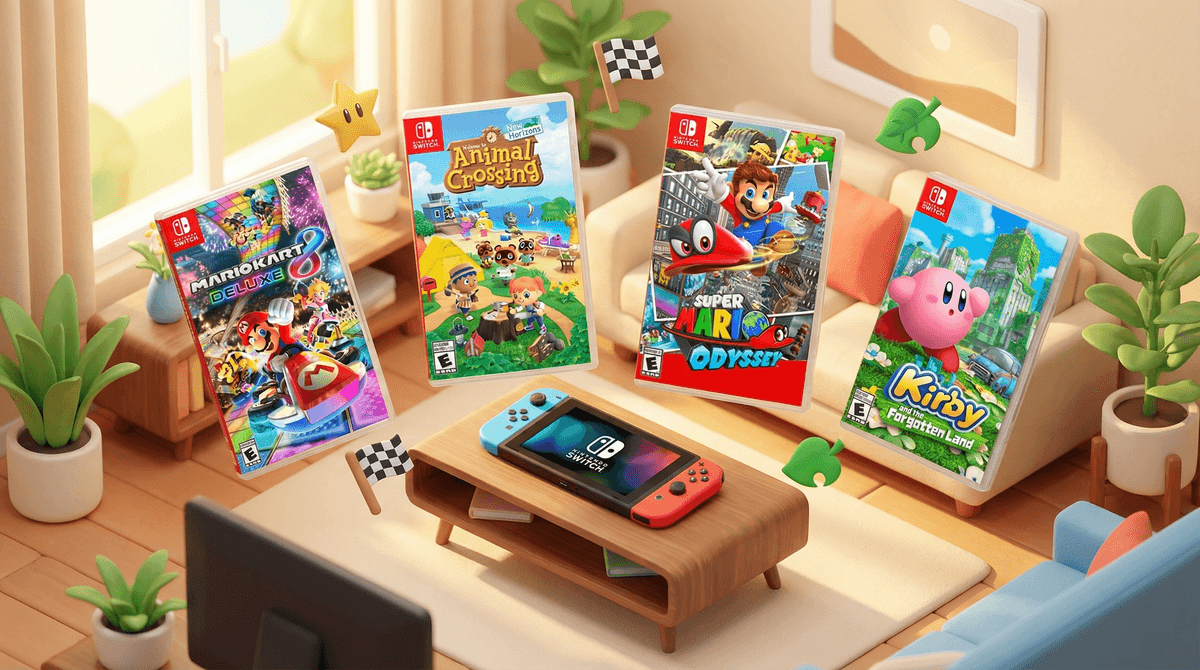
This is the game. If your 8-year-old only has one Switch game, this should probably be it. The auto-steer and auto-accelerate features mean even younger siblings can play along, but there's enough skill ceiling that your kid will still be discovering shortcuts and strategies years from now. The online play is surprisingly wholesome, and local multiplayer is chaos in the best way.
Why it works: Instant gratification, low frustration, high replay value. Also, it's the game that gets the most mileage at sleepovers.
This is Nintendo's answer to shooters, except instead of bullets, it's paint. Instead of death, you respawn in two seconds. It's colorful, fast-paced, and has that "one more match" quality that keeps kids engaged. The single-player campaign is solid, but the real draw is the online multiplayer.
Parent note: There's no voice chat with strangers (thank god), and the community is generally positive. Your kid will want to play online, and honestly, this is one of the safer online gaming experiences out there. Learn more about Splatoon's online safety features .
.
This game is chef's kiss. It's a 3D platformer where Mario travels to different kingdoms (New York City as a metropolis of realistic humans is... a choice, but kids love it). The main story is accessible for 8-year-olds, but there are 900+ moons to collect if they want to be completionists. The two-player co-op mode lets one person control Mario and another control his hat, which is perfect for playing with younger siblings.
Not sure which Zelda fits your kid? See the whole series by age and play style.
Real talk: This game is challenging. But if your 8-year-old likes exploration, problem-solving, and doesn't get frustrated easily, this is one of the best games ever made. Period. They can approach challenges in multiple ways, the world is gorgeous, and there's something magical about watching a kid figure out they can use physics and creativity to solve puzzles.
Reality check: Some kids will bounce off this hard. The combat can be tricky, and the game doesn't hold your hand. If your kid thrives on structure and clear objectives, maybe wait a year or try Zelda: Tears of the Kingdom which has slightly more guidance (though it's also more complex).
The latest mainline Pokémon games are fully open-world, which is a big shift from previous entries. Your kid can tackle gyms in any order, explore at their own pace, and catch hundreds of creatures. Yes, the graphics are rough (Nintendo fans will defend this to death, but come on, the frame rate is embarrassing). But kids genuinely don't care about that stuff, and the core gameplay loop of catching, training, and battling is still incredibly engaging.
Why it matters: Pokémon teaches strategy, type matchups, and team building. It's also a great gateway into turn-based RPGs.
Your kid gets their own island to design, decorate, and fill with anthropomorphic animal neighbors. There's no winning or losing, just vibing. They'll fish, catch bugs, plant flowers, and slowly pay off a mortgage to a capitalist raccoon (we don't talk about Tom Nook's business practices).
What parents love: It's wholesome, encourages creativity, and plays in real-time, which means there's a natural limit to daily progress. Your kid can't binge this for 8 hours straight because the game literally says "come back tomorrow."
What parents should know: The online features let kids visit other islands. You can restrict this to friends-only, which I strongly recommend. Here's how to set up parental controls for Animal Crossing.
You already know about Minecraft. Your kid has been asking for it since they were 6. The Switch version is totally solid, supports cross-play with other platforms, and yes, it's basically digital Legos with survival elements.
The deal: Creative mode is pure building with no threats. Survival mode adds resource gathering and monsters. Most 8-year-olds can handle survival mode fine, especially if they play with friends. The game teaches spatial reasoning, resource management, and collaboration. It's also a gateway to understanding game design.
This farming sim is surprisingly deep. Your kid inherits a farm, plants crops, raises animals, goes fishing, explores mines, and builds relationships with townspeople. It's like Animal Crossing but with more structure and goals. The pixel art style is charming, and there's something deeply satisfying about optimizing your farm layout.
Reading requirement: There's a fair amount of text, so your kid needs to be a comfortable reader. But if they are, this game will hook them for dozens of hours.
If your kid loves Disney characters, this is basically Animal Crossing meets Stardew Valley but with Mickey Mouse and Elsa. You restore a magical valley, complete quests for Disney characters, and decorate your own space. It's free-to-play (with optional purchases), which is either great or concerning depending on your family's approach to in-game purchases.
This is Kirby's first 3D adventure, and it's absolutely delightful. Kirby can inhale enemies and copy their abilities, and the game introduces "Mouthful Mode" where Kirby inhales massive objects like cars and vending machines. It's weird and wonderful. The difficulty is perfect for 8-year-olds—challenging enough to feel rewarding but not frustrating. Two-player co-op is excellent.
The newest 2D Mario game is genuinely innovative, which is wild for a franchise this old. The "Wonder" effects transform levels in surprising ways—platforms might start singing, or Mario might turn into a Goomba. It's creative, colorful, and the multiplayer is forgiving (if someone dies, they become a ghost that others can revive). This is the best 2D Mario game in years.
Luigi explores a haunted hotel, sucking up ghosts with a vacuum cleaner. It sounds silly, and it is, but it's also genuinely clever. Each floor has unique themes and puzzles, and the co-op mode (where a second player controls "Gooigi," a goo version of Luigi) is fantastic.
Mild spooky warning: It's not scary-scary, but there are ghosts and some mildly tense moments. Most 8-year-olds handle it fine, but if your kid is sensitive to anything remotely spooky, maybe preview it first.
All nine Star Wars movies in LEGO form. The humor is goofy, the gameplay is accessible, and there's a ridiculous amount of content. You don't need to be a Star Wars superfan to enjoy it—the LEGO games are just well-designed action-adventures with light puzzle-solving and tons of collectibles.
Toad can't jump (poor guy), so this puzzle-platformer is all about rotating the camera and finding hidden paths through diorama-like levels. It's clever, cute, and perfect for kids who like spatial puzzles. Great for developing problem-solving skills without the pressure of fast reflexes.
These are digital board games with mini-games. Superstars is generally considered better because it includes classic boards from the N64 era, but both are solid for family game nights. Fair warning: These games can cause sibling fights. The AI can be brutal, and luck plays a huge role. But when it works, it's genuinely fun chaos.
You and up to three other players run a restaurant kitchen, chopping ingredients, cooking dishes, and serving orders under time pressure. It's frantic, requires communication, and will absolutely test your family's ability to work together. This game has ended friendships and strengthened family bonds in equal measure.
Pro tip: Start with the tutorial and early levels. The difficulty ramps up significantly, and some later levels are genuinely hard.
Bowling, tennis, soccer, volleyball, badminton, and golf using motion controls. It's the spiritual successor to Wii Sports, and it's great for getting kids moving. The online play is fun, and it's one of the few games where physical activity is part of the experience.
Soccer with rocket-powered cars. It's free-to-play, easy to understand, and has a surprisingly high skill ceiling. The matches are short (5 minutes), which makes it perfect for "just one more game" sessions. The online community can be toxic in text chat, so definitely See how to turn off chat in the settings.
You command tiny plant creatures (Pikmin) to solve puzzles, fight enemies, and rescue castaways. It's part strategy, part puzzle-solving, and surprisingly emotional when your Pikmin get eaten by enemies. The game has a cozy vibe despite the occasional Pikmin casualties, and it teaches resource management and planning.
You're a goose. You're a jerk. You complete a to-do list of mischievous tasks like stealing a gardener's keys and trapping a kid in a phone booth. It's short (3-4 hours) but absolutely charming. The two-player mode adds a second horrible goose, which doubles the chaos.
About difficulty: Eight-year-olds vary wildly in gaming skill. Some can handle Breath of the Wild, others will get frustrated with Luigi's Mansion 3. Watch them play for 20 minutes before deciding if a game is too hard. And remember: struggling is okay. Some of the best learning happens when kids persist through challenges.
About online play: Splatoon 3, Rocket League, Mario Kart 8, and Minecraft all have online components. Nintendo's online service includes parental controls that let you restrict who kids can play with. Set these up before handing over the controller.
About reading levels: Games like Stardew Valley, Pokémon, and Pikmin 4 require solid reading skills. Mario Kart and Kirby barely require any reading at all.
About co-op: If you have multiple kids or want to play together, prioritize games with good co-op: Kirby and the Forgotten Land, Luigi's Mansion 3, Super Mario Odyssey, Overcooked 2, and Super Mario Bros. Wonder all shine in multiplayer.
The Switch is honestly the perfect console for this age group. These games offer genuine depth without violence, creativity without chaos, and challenges without frustration (mostly).
If you're buying just one game, go with Mario Kart 8 Deluxe—it's the most universally loved. If your kid wants something creative, Minecraft or Animal Crossing. If they want adventure, Super Mario Odyssey or Pokémon.
And remember: the "right" game is the one your kid actually wants to play. If they're begging for Splatoon 3 because their friends play it, that's probably going to bring them more joy than the "objectively better" game they have zero interest in.
Want to dive deeper into any of these games or need help deciding between options? Get help choosing the best Switch game for your 8 year old.