

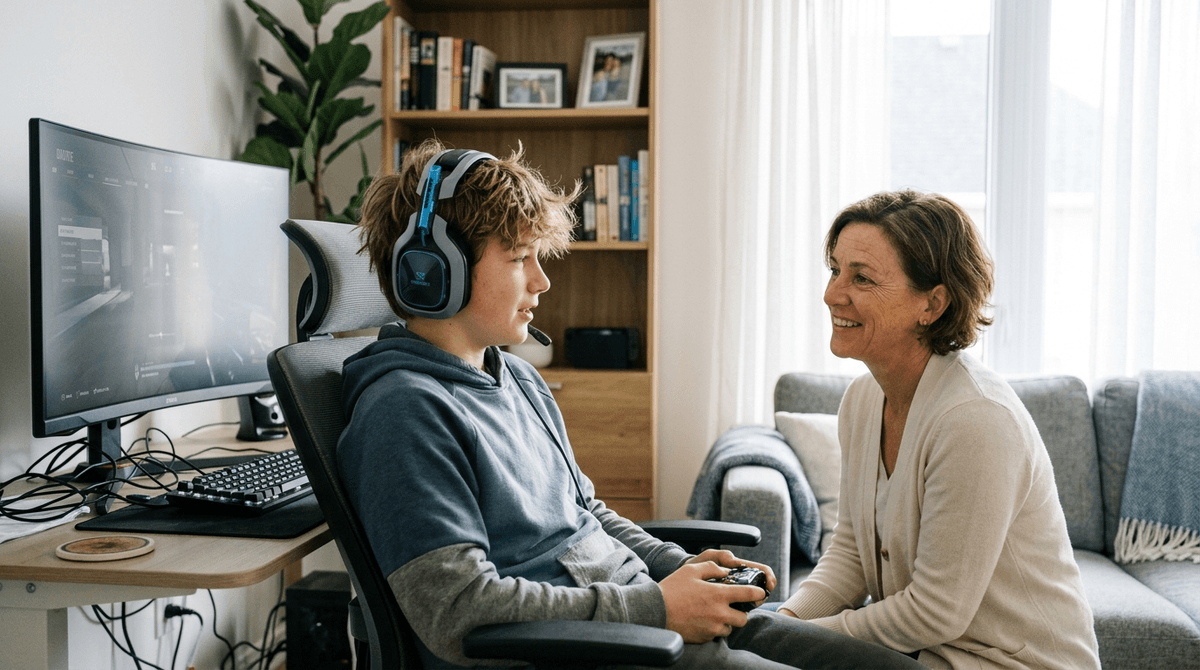

Heavy gaming pushes adolescents toward online cruelty and manipulative habits, but a warm connection at home blunts the fallout. Even when gaming borders on compulsive, a strong parent-child bond shields kids from adopting toxic behaviors.
Compulsive gaming drives teenagers toward cyberbullying and cynical, manipulative mindsets, but a supportive relationship with parents breaks that chain.
Parents usually worry that excessive gaming hurts grades or sleep schedules. The more insidious risk is social: uncontrolled screen habits often pull kids into toxic digital subcultures where cruelty and deceit feel rewarded.
Banning consoles or cutting Wi-Fi often triggers hostility and damages trust. This research shows that staying emotionally close and keeping communication open protects your teenager's character far better than heavy-handed tech crackdowns alone.
Adolescents who feel overlooked or powerless in school often hunt for control in virtual worlds. Researchers wanted to map how that pursuit of digital dominance reshapes real-world personality—specifically Machiavellianism, a trait defined by callousness, manipulation, and calculating self-interest.
Compulsive gaming breeds online hostility, which then hardens into everyday social cynicism.
- Addiction fuels bullying: Teens who reported addictive gaming habits were significantly more likely to harass peers online.
- Cruelty reshapes character: Cyberbullying acted as the bridge connecting video game addiction to Machiavellian traits, encouraging an ends-justify-the-means approach to relationships.
- Certain genres carry higher risk: Teens who favored massively multiplayer online role-playing games (MMORPGs) reported substantially higher addiction rates than those playing other game types.
- Family ties neutralize the threat: For teens with warm, supportive parent relationships, the link between gaming addiction and cyberbullying largely disappeared.
When teenagers talk trash or harass others in Discord servers and game lobbies, it is rarely "just venting." Practicing cruelty online acts as a psychological training ground, normalizing manipulation as a valid survival strategy. Kids adopt that cynical armor when they feel isolated, but they rarely lean on it if they feel genuinely understood and valued at home.
The researchers surveyed 601 high school students in Istanbul, Turkey, at a single moment in time. The study shows correlation, not causation: cynical, aggressive kids may simply gravitate toward heavy gaming rather than games causing the behavior. Self-reported questionnaires also mean some students likely minimized how cruel they actually are online.
- If your teen favors open-world MMORPGs: Set firm daily session limits early, because persistent online role-playing environments carry a significantly higher addiction risk than short-match titles.
- If you catch your teen harassing other players in voice chat: Treat the cruelty as an urgent character issue rather than casual gamer banter, because habitual online bullying steadily fosters manipulative real-world habits.
- If your teen's gaming spikes during a stressful season: Focus on daily, low-pressure connection before you reach for device confiscation, since a protective family dynamic is what prevents heavy gaming from warping their social outlook.
Gaming habits matter, but the connection at home matters more. You do not need an exhausting, round-the-clock enforcement regime to keep your teen grounded—maintaining a warm, trusted relationship protects their character even when their digital habits get messy.
Ulaş E, Incekara HI (2026). The role of Machiavellianism, cyberbullying, and family relationships in adolescent gaming addiction: a problem behavior theory approach. Frontiers in psychology. doi:10.3389/fpsyg.2026.1794127 — pubmed.ncbi.nlm.nih.gov