

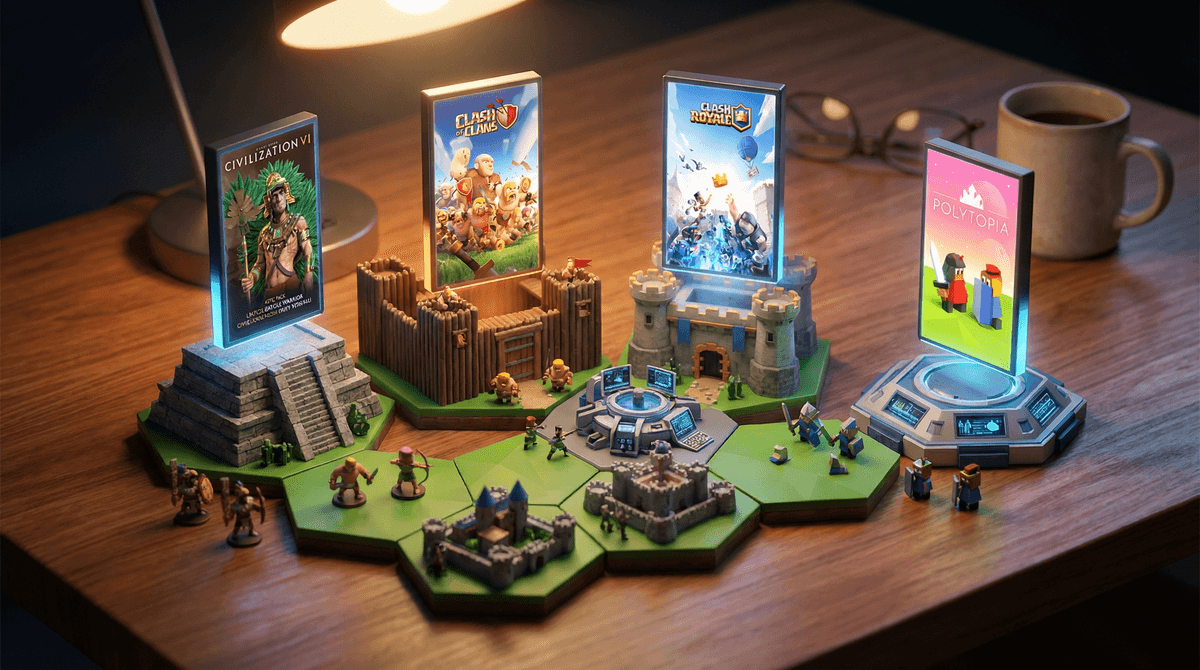
Strategy game apps are mobile games that require planning, resource management, tactical thinking, and long-term decision-making to succeed. We're talking about everything from Clash of Clans and Clash Royale to tower defense games, civilization builders, and tactical RPGs like Fire Emblem Heroes.
Unlike reflex-based action games or mindless clickers, strategy games demand that players think ahead, anticipate consequences, and adapt their approach based on changing circumstances. Your kid isn't just tapping frantically—they're (theoretically) planning, analyzing, and problem-solving.
The big question: Are they actually building cognitive skills, or just building another town hall while you build resentment over the screen time?
Strategy games hit a sweet spot in the developing brain. They offer:
A sense of control and mastery. Unlike school, where assignments are dictated and success can feel arbitrary, strategy games let kids make meaningful choices and see direct results. Build this, upgrade that, win the battle. The feedback loop is immediate and satisfying.
Complexity that respects their intelligence. Good strategy games don't talk down to players. They have intricate systems, multiple paths to victory, and genuine depth. Kids who feel underestimated in the real world often thrive in games that challenge them to think several moves ahead.
Social currency and competition. Many strategy games include clan systems, leaderboards, or PvP (player versus player) elements. Being good at these games—or at least being able to talk about them—matters in the social ecosystem of middle school.
The long game. Strategy games reward patience and planning. That dopamine hit when your three-week build strategy finally pays off? That's powerful. (It's also why these games can be so sticky.)
Let's be clear: strategy games can build genuine skills. Research shows that well-designed strategy games can improve:
- Executive function - Planning, organizing, and executing multi-step processes
- Working memory - Keeping track of multiple variables simultaneously
- Spatial reasoning - Understanding maps, positioning, and resource distribution
- Probabilistic thinking - Weighing risks, calculating odds, understanding chance
- Adaptive thinking - Adjusting strategies when circumstances change
Games like Civilization VI (more of a PC/console game but worth mentioning) or Polytopia (a mobile gem) genuinely require sophisticated thinking. Your kid is learning systems thinking, resource allocation, and strategic planning—skills that transfer to everything from project management to financial literacy.
But here's the catch: not all strategy games are created equal.
The strategy game genre has been thoroughly colonized by the free-to-play model, and that model is designed to extract maximum time and money from players. Here's what you need to watch for:
Wait timers. Build a barracks? That'll be 4 hours. Unless you pay gems to speed it up. Or unless you check back in exactly 4 hours to start the next upgrade. This isn't teaching patience—it's training your kid to structure their day around the game's schedule.
Pay-to-win mechanics. Many strategy games create artificial difficulty that can be bypassed with real money. The "strategy" becomes "who has the bigger wallet," which is a pretty dystopian lesson.
FOMO and artificial scarcity. Limited-time events, seasonal content, daily login bonuses—all designed to create anxiety about missing out. Learn more about how these mechanics manipulate behavior .
.
The clan trap. Multiplayer strategy games often include clan or guild systems where your kid's teammates depend on them to participate in wars or events. Missing a battle means letting down real people, which creates genuine social pressure to stay engaged.
Ages 6-9: Look for single-player strategy games without timers or in-app purchases. Kingdom Rush (tower defense), Plants vs. Zombies, or Monument Valley (puzzle-strategy) are solid choices. At this age, the goal is to introduce strategic thinking without the manipulation.
Ages 10-13: This is peak strategy game age. Kids can handle more complexity, but they're also most vulnerable to the social pressure and FOMO mechanics. If your kid is playing Clash of Clans or [Brawl Stars](https://screenwiseapp.com/media/brawl-stars-app, have explicit conversations about in-app purchases and time management. Consider premium strategy games like Stardew Valley (which has strategy elements) or Slay the Spire that you pay for once and own completely.
Ages 14+: Teens can handle more complex strategy games and may genuinely benefit from games like Civilization or StarCraft. The conversation shifts from "is this appropriate?" to "is this balanced with other priorities?"
Check the monetization model. If it's free-to-play, assume it's designed to manipulate. That doesn't mean it's automatically bad, but go in with eyes open. Look at reviews specifically mentioning "pay-to-win" or "predatory."
Understand the time commitment. Some strategy games can be played in 10-minute bursts. Others demand hours-long sessions or constant check-ins. Ask your kid to explain how the game works—you'll quickly learn if it's designed to respect their time or consume it.
The clan question. If your kid joins a clan or guild, understand that they're now part of a social system with real obligations. This isn't necessarily bad—teamwork and commitment are valuable—but it changes the equation. You're not just managing screen time; you're managing social commitments.
Look for educational strategy games. Games like Kerbal Space Program (space program management) or Plague Inc. (epidemiology simulation—yes, really) teach actual concepts while requiring strategic thinking.
Talk about the meta-game. Help your kid understand why the game is designed the way it is. "Why do you think they make you wait 4 hours for that upgrade?" This builds media literacy and critical thinking about game design.
Strategy games can be genuinely beneficial—they're not just empty calories. A kid who's deeply engaged in a well-designed strategy game is exercising their brain in meaningful ways.
But the mobile strategy game market is also flooded with predatory designs that exploit psychological vulnerabilities for profit. The difference between a game that builds skills and a game that builds addiction often comes down to the business model.
Your job isn't to ban strategy games (unless that's your call, and that's fine too). It's to help your kid distinguish between games that respect them and games that exploit them. Play the game with them. Ask questions. Look at the mechanics. And when you spot manipulation, call it out.
The real strategic thinking might be in choosing which games deserve their time in the first place.
- Audit current games: Look at what strategy games your kid is playing. Are they free-to-play? Do they have wait timers? Clan obligations?
- Try premium alternatives: Check out strategy games you pay for once to see the difference when the business model isn't designed around manipulation
- Set boundaries around social obligations: If your kid is in a clan, establish clear rules about when game commitments take priority (spoiler: not during homework or family time)
- Use Screenwise: Take our survey to see how your family's strategy game habits compare to your community, and get personalized recommendations for games that match your values