

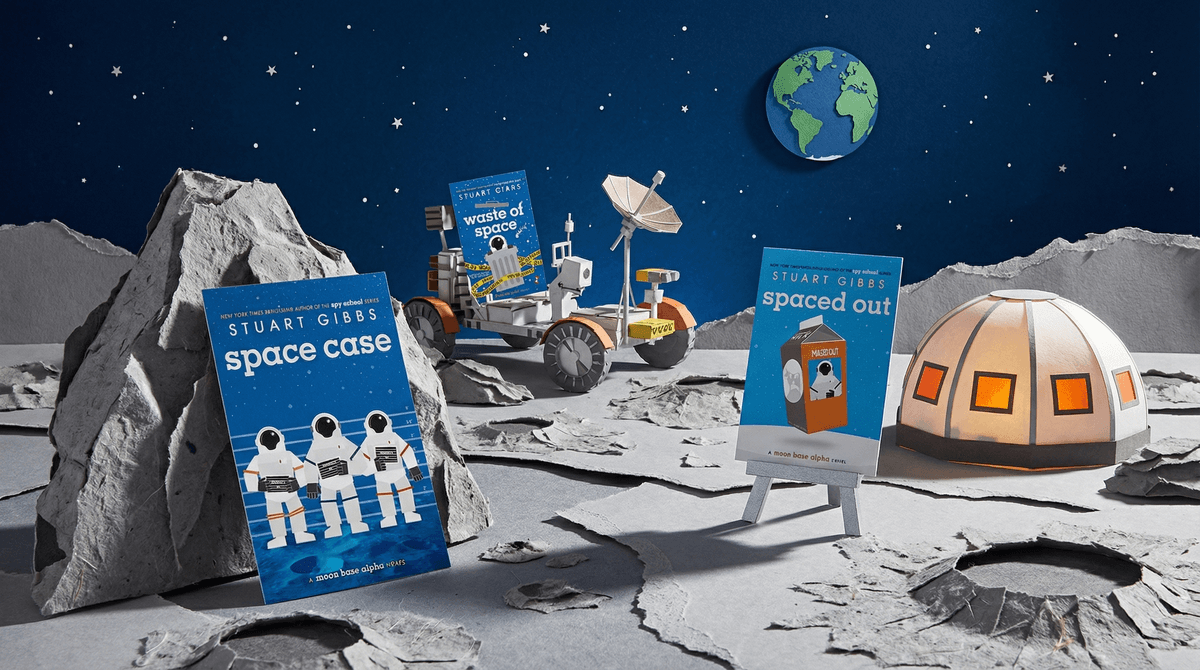
Space Case by Stuart Gibbs is a middle-grade mystery novel set on the moon. Yes, the actual moon. In 2041, 12-year-old Dashiell Gibson lives on Moon Base Alpha, the first human lunar colony, with 40 other people including his scientist parents. When one of the base's doctors allegedly dies in a tragic accident, Dash suspects foul play—and suddenly he's investigating the first murder in space.
It's part of a series (there are five books total), and it hits that sweet spot where kids get a legitimate mystery to solve alongside science-y world-building that doesn't feel like homework. Think "Knives Out meets The Martian but for 4th-6th graders."
Here's the thing about getting kids to read: they can smell "educational" from a mile away, and they'll run. But Space Case sneaks in the learning through a genuinely engaging story.
The mystery is real. Gibbs doesn't talk down to young readers. There are actual clues, red herrings, suspects with motives, and a protagonist who has to use logic and observation to piece things together. Kids love feeling smart, and this book lets them play detective alongside Dash.
The setting is inherently cool. Living on the moon sounds amazing until Gibbs shows you the reality: freeze-dried food that tastes like cardboard, no privacy, limited water, can't go outside without a spacesuit, and you're stuck with the same 40 people all day every day. It's relatable (hello, pandemic lockdowns) but also fascinatingly different. Kids get invested in the day-to-day logistics of lunar living.
The voice is funny. Dash is witty without being annoying, which is harder to pull off than it sounds. There's humor throughout that keeps the pacing light even when the mystery gets dark.
It's actually a page-turner. Parents report kids who "don't like reading" staying up past bedtime to finish it. That's the gold standard.
If you've got a kid who's even remotely interested in space, science, or how things work, this book is basically a gateway drug to STEM curiosity.
Gibbs (who has a legitimate background in science communication) weaves in real concepts: gravity differences, oxygen systems, space station design, lunar geology, the physics of living in a dome. But it never feels like a textbook. The science is there because it has to be—it's part of solving the mystery and surviving on the moon.
This is the kind of book that leads to kids:
- Actually paying attention during science class
- Asking questions about space exploration
- Looking up NASA's actual moon base plans
- Understanding that STEM careers can be exciting and relevant
And here's the beautiful part: kids don't realize they're learning. They're just reading a fun mystery that happens to be scientifically grounded. If you're looking for more books that sneak in learning, this is exhibit A.
Best for: Ages 8-12 (roughly 3rd-7th grade, depending on reading level)
Reading level: Solidly middle grade. Not too challenging for strong 3rd graders, not too babyish for 7th graders. Around 250 pages with good pacing.
Content concerns: There is a death (the inciting incident), and the book deals with the concept of murder, but it's handled appropriately for the age group. No graphic violence, no inappropriate language, no romance subplot (thank god). The scariest parts involve the dangers of space itself—running out of oxygen, equipment malfunctions, the vacuum of space—which are real dangers presented in a way that's tense but not traumatizing.
Series note: If your kid likes this one, there are four more books (Spaced Out, Waste of Space, Moon Base Alpha: The Complete Collection). The quality stays consistent throughout, which is rare.
It's a legitimate bridge between chapter books and YA. If your kid has outgrown Dog Man and Diary of a Wimpy Kid but isn't ready for full YA content, this is perfect.
Stuart Gibbs is reliable. He's also written the Spy School series and the FunJungle series. If your kid likes Space Case, you've got a whole backlist of similar quality books. Check out his other series for more options.
It's great for reluctant readers. The chapters are short, the action moves quickly, and there are enough "what happens next?!" moments to keep kids engaged. Multiple parents have reported this being the book that finally got their kid interested in reading.
Discussion opportunities abound. If you want to actually talk with your kid about what they're reading (without it feeling like a book report), Space Case gives you tons of entry points: ethics of space colonization, what it would really be like to live on the moon, how to solve problems with limited resources, critical thinking about suspects and motives.
Audio version is excellent. If you've got a kid who struggles with reading or just prefers audiobooks, the narration by Gibson Frazier is engaging. Great for road trips or bedtime listening.
Space Case is one of those rare books that checks every box: engaging story, age-appropriate content, sneaky educational value, and genuinely well-written. It's not going to win a Newbery (too fun for that), but it's going to get your kid reading, thinking, and maybe even excited about science.
In a world where we're competing with YouTube, Roblox, and TikTok for our kids' attention, a book that can hold their interest for 250 pages is worth celebrating. Plus, if they like it, you've got four more books in the series and an entire backlist of Stuart Gibbs novels to keep them going.
If your kid likes: mysteries, space, science fiction, funny protagonists, or just needs something engaging to read, grab this one.
- Get the book from your library (it's been out since 2014, so they definitely have it) or grab it used
- Try the first chapter together if your kid is hesitant—the hook is strong
- Follow up with the series if they're into it
- Explore other mystery series for middle graders if they love the detective angle
- Check out STEM-focused books if the science aspect is the draw
And honestly? This is one of those books where you might find yourself reading over your kid's shoulder because the mystery is actually compelling. That's a win.