

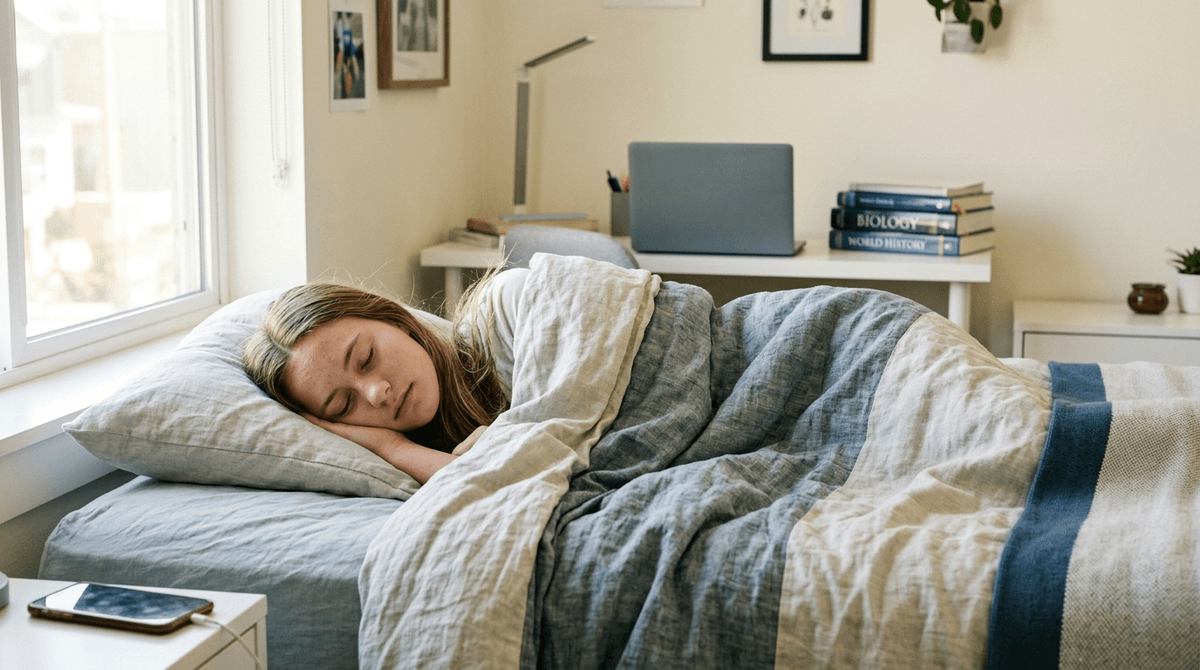

Fixing a struggling middle schooler's sleep does far more to protect their grades and friendships than cracking down on screen time or overhauling their diet.
Restorative sleep buffers up to a third of the academic and social fallout when an early adolescent battles anxiety or depression.
When a 12-year-old starts unraveling emotionally, parents usually audit everything at once: confiscating phones, pushing sports, and demanding better study habits. This paper tells you where your limited parental capital actually matters. If you only have the energy to fight one battle with an anxious middle schooler this week, fight for an earlier, darker, uninterrupted bedtime.
Childhood mental health symptoms rarely stay confined to a child's internal world; they spill directly into plummeting grades and fractured friendships. Researchers tracked 7,550 kids over three years through the Adolescent Brain Cognitive Development (ABCD) Study to figure out which daily habits actually stand between an internal crisis and an external collapse.
Sleep quality is the heavy lifter in keeping an anxious child afloat.
- Sleep explains over a third of the academic hit: Restful sleep mediated 36% of the link between anxiety and school performance, and roughly a fifth of the link to social troubles.
- Screens play a distant second fiddle: While screen habits accounted for under 7% of the functional link, sleep was five times more influential.
- Exercise and diet barely moved the needle: Physical activity and nutrition had negligible mediating effects on school or social outcomes in this age bracket.
- Combined habits matter most: Bundling solid sleep, reasonable screen boundaries, diet, and movement buffered 48% of the negative impact anxiety had on grades.
Screen time fights are often just sleep fights in disguise. Parents spend massive amounts of relational capital arguing over daytime device limits, but screens hurt anxious kids primarily when they eat into sleep architecture or delay bedtime. Weekend use proved especially disruptive to school readiness, hinting that erratic "catch-up" sleep schedules do more damage than weekday screen exposure.
The ABCD data relied heavily on parent-reported questionnaires rather than objective sleep trackers or verified school transcripts. The study is also longitudinal and observational: it proves that healthy sleep consistently travels with better grades and friendships over three years, but it cannot mathematically prove that earlier bedtimes directly raise a GPA.
- If your middle schooler is dealing with school anxiety, prioritize high-quality sleep over forcing after-school study sessions or sports.
- If you have to negotiate screen boundaries, focus your rules strictly on overnight device parking rather than daytime time limits.
- If weekend sleep schedules are drifting past midnight, pull wake-up times closer to the weekday routine to prevent Monday morning academic crashes.
- If your family is navigating high stress or financial instability, protect bedroom quiet hours above all else, as sleep serves as an even stronger social shock absorber during family hardship.
Stop feeling guilty about imperfect diets or missed soccer practices when your kid is struggling emotionally; protecting their nightly sleep does most of the protective work anyway.
Smucny J, Lesh TA, Niendam TA et al. (2026). Mediating effects of healthy lifestyle factors on associations between mental health and functional outcomes in early adolescence. Psychological medicine. doi:10.1017/S0033291726105121 — pubmed.ncbi.nlm.nih.gov