

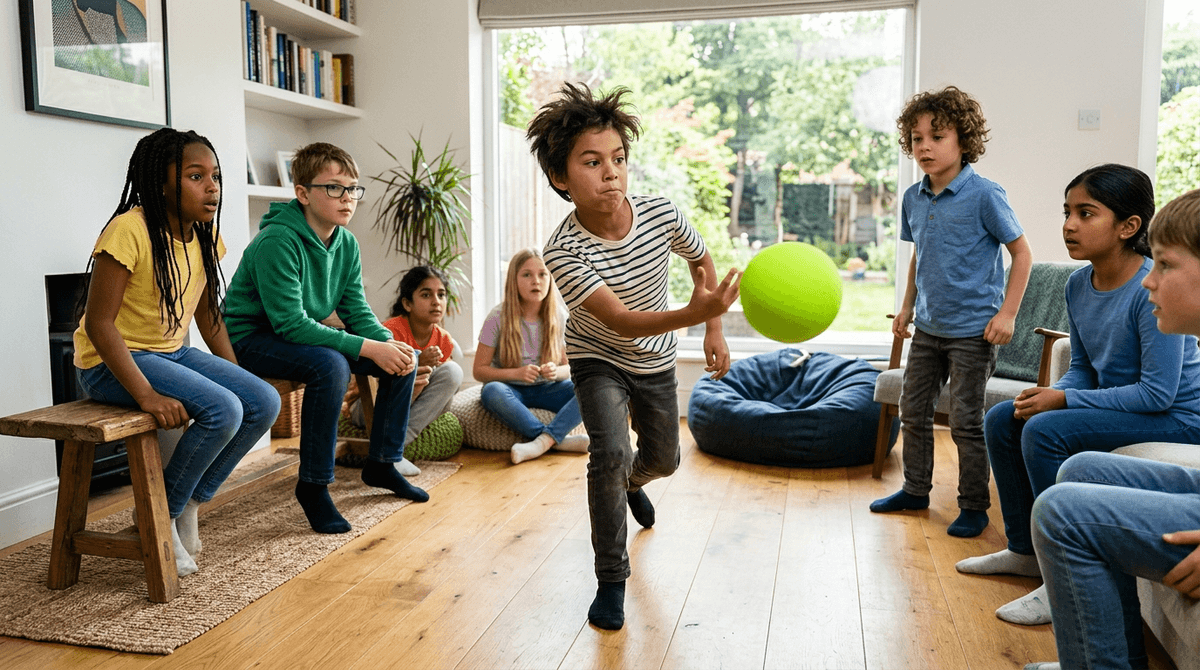
Silent Ball is the only game that successfully turns "please be quiet for five minutes" into a high-stakes competitive sport. It is the ultimate indoor reset—a low-tech, high-tension physical game that requires zero setup, works in any room with a soft ball, and rewards the kind of non-verbal situational awareness that kids usually only flex when they’re trying to sneak a snack past you.
TL;DR
Silent Ball is an indoor elimination game where the core rules are simple: no talking and don't drop the ball. It’s a perfect screen-free transition for kids who have been clocking the average 4.2 hours of daily screen time and need a physical "brain break" that doesn't involve a screen. For more ways to keep them moving, check out our best games for kids list.
The beauty of Silent Ball is that the rules are "strict" but the gameplay is fluid. If you’re looking for a quick way to burn off energy during a rainy afternoon or a long wait, this is the move.
- The Silence Rule: This is the big one. If you make a sound—a laugh, a grunt, a "hey!"—you’re out. This includes the "clapping" sound of a ball hitting your hands if it’s too loud (depending on how much of a stickler the ref is).
- The "Stay Put" Rule: Usually played sitting on desks or standing in a circle. If you leave your spot to catch a ball, you’re out. You have to be able to reach it from your station.
- The Catch Rule: If the ball touches you and you drop it, you’re out.
- The Bad Throw Rule: If you throw a ball that is "uncatchable" (aimed at someone’s head, thrown too hard, or way out of reach), the thrower is out. This prevents the game from becoming a game of dodgeball-lite.
- The Return Rule: You can't throw the ball back to the person who just threw it to you. This forces the ball to move around the room and keeps everyone engaged.
Once a group masters the basics, Silent Ball becomes less about catching and more about psychological warfare. The "Snake Eye" is the most legendary move in the game: you look directly at one person, making them think a throw is coming their way, and then—without moving your head—you flick the ball to someone on the complete opposite side of the circle.
It’s a masterclass in peripheral vision and non-verbal cues. About 70% of kids in the Screenwise community engage in these types of high-independence, "no usage" play moments during the school day, and the Snake Eye is exactly why they don't miss their tablets while they're doing it.
If the standard game is getting "mid," it’s time to introduce variations that up the ante.
In this version, the "no return" rule is scrapped, and the goal is to move the ball as fast as humanly possible. The faster the ball moves, the more likely someone is to fumble or—more likely—break the silence with a panicked giggle.
The Multi-Ball Chaos
Introduce a second (or third) ball. Now, players have to track multiple trajectories at once. This effectively kills the "Snake Eye" because you can't afford to focus on one person’s face when another ball might be flying at your ribs.
One-Handed Mode
Exactly what it sounds like. Players must keep one hand behind their back or tucked into a pocket. This turns every catch into a circus act and usually results in a lot of "silent laughing" (the kind where your face turns purple but no sound comes out).
The "Blind" Pass
This requires a high level of trust. You can only throw to someone who isn't looking at you. It sounds counterintuitive, but it forces the "catcher" to always be scanning the room. If you catch a ball you weren't expecting, you’re basically a ninja.
We talk a lot about "social worlds" in the context of Roblox or Discord, but Silent Ball is a social world in the physical realm. It builds non-verbal literacy.
When kids play this, they are reading body language, tracking intentions, and managing their own impulses (the urge to shout when they almost drop the ball). It’s a high-impact way to build the "language comprehension" strands of their brain—the same ones they use when listening to podcasts for kids—by forcing them to interpret meaning without a single word being spoken.
The "friction point" with Silent Ball isn't the game itself—it's the ball. If you use a standard basketball or a tennis ball indoors, you’re asking for a broken lamp. The "pro move" is a high-density foam ball (often called a "silent basketball" or a Nerf-style ball). It provides enough weight to throw accurately but won't shatter a window if a "Snake Eye" goes horribly wrong.
Q: What is the best age for Silent Ball? The sweet spot is 7 to 13. Younger kids (5-6) usually lack the impulse control to stay quiet for more than thirty seconds, and older teens might find it "cringe" unless there’s a competitive element or a prize involved.
Q: Can you play Silent Ball with just two people? You can, but it’s basically just a quiet game of catch. The game really shines with 5 or more people, as the unpredictability of the "target" is what creates the tension.
Q: Is Silent Ball a good "brain break" for homeschooling or homework? It’s one of the best. If your kid has been staring at a math website for an hour, five minutes of Silent Ball resets their focus by engaging their physical reflexes and forcing a "digital detox" without it feeling like a punishment.
Q: What happens if there's a dispute over a "bad throw"? In most versions, the "Ref" (usually a parent or teacher) has the final say. If there’s no ref, the two players are usually both "safe" to keep the game moving, or they both go out to teach a lesson about teamwork.
Silent Ball isn't just a way to keep kids quiet; it’s a way to keep them attentive. In a world where the algorithm is constantly screaming for their attention, a game that requires them to find the signal in the silence is a win every time.
