

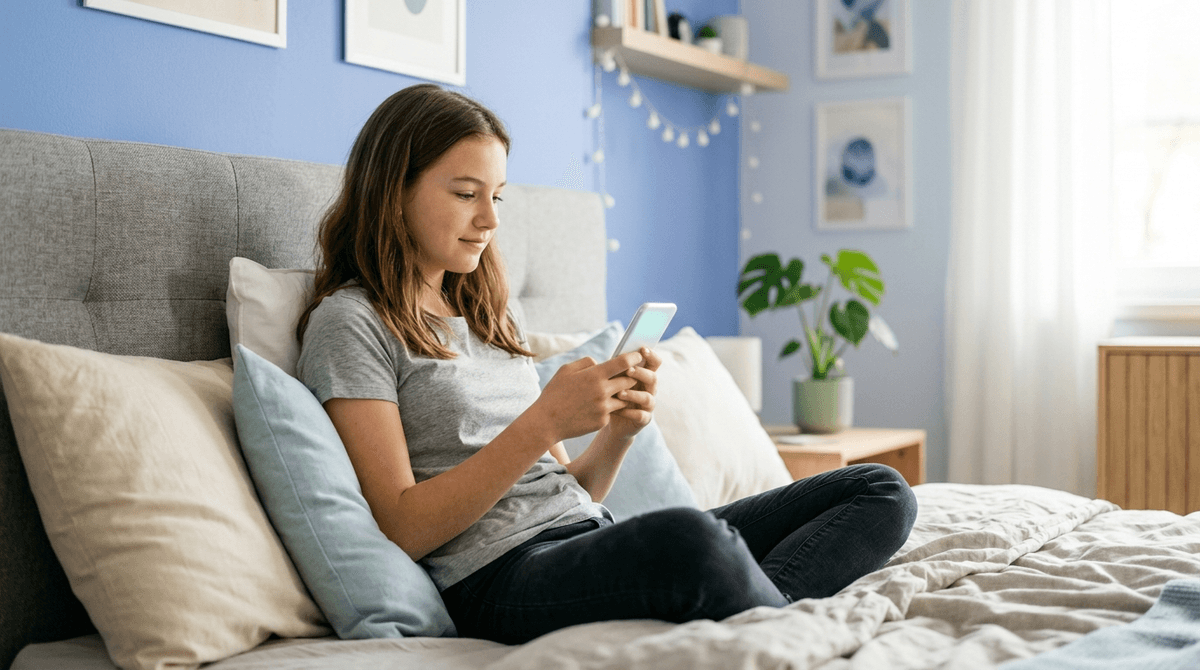

Smartphones push young teens' bedtimes back by minutes, not hours, and they don't actually ruin the quality of sleep once kids close their eyes.
Objective tracking shows that while screen time shifts young teens' bedtimes slightly later and makes their sleep schedules more erratic, it has zero measurable impact on how well they sleep or how long it takes them to fall asleep.
Panic over screens destroying teen sleep is mostly overblown. If you are locked in nightly battles over total screen hours out of fear that blue light is ruining your middle schooler's brain architecture, you can take a breath: screen use accounts for less than 10 percent of the differences in teen sleep patterns.
The real problem isn't that screens ruin sleep quality; it's simple time math. Kids stay up a few minutes later scrolling, which creeps into their total sleep budget. Shifting your focus from strict hourly limits to enforcing a consistent wake-up time fixes the actual problem.
Most screen time research relies on teenagers guessing how many hours they spent on their phones, leading to wildly inflated headlines. Researchers strapped medical-grade actigraphy wristbands on 677 middle schoolers while scraping objective usage data directly from their smartphones to see what actually happens to sleep when kids use their screens.
Smartphones nudge bedtimes back in small increments without degrading sleep quality.
- Bedtimes creep, but slowly: Every extra hour of daily screen time shifts a teen's bedtime back by about eight minutes.
- Tonight's phone use barely affects tonight's sleep: On a day-to-day level, using an extra hour of screens today only pushes bedtime back by less than two minutes tonight.
- Sleep quality remains untouched: Screen use had no connection to sleep efficiency or how long kids spent tossing and turning before falling asleep.
- Social media does more damage than gaming: Social media apps were linked to later wake-up times and unpredictable sleep schedules, whereas mobile gaming showed no connection to sleep problems.
The issue with screens is time displacement, not physiological harm. Your thirteen-year-old isn't lying awake staring at the ceiling because screen radiation suppressed their melatonin; they are sleeping less simply because scrolling delayed the moment their head hit the pillow.
Content matters more than the screen itself. Social media creates an ongoing social obligation to respond that keeps kids tethered late into the night, whereas a mobile game can be saved and set aside.
This study was observational, which means it cannot prove that phones cause later bedtimes. It is just as likely that night-owl kids reach for their phones because they are already awake. Additionally, app-specific data (social media versus gaming) was only available for the 35 percent of participants who used Android devices, and researchers couldn't isolate nighttime screen use from daytime screen use for the full group.
- If your teen has an erratic sleep schedule... ...focus on enforcing a non-negotiable wake-up time on weekends rather than counting daytime screen hours.
- If you need to prioritize which apps to restrict at night... ...crack down on social media notifications while being more lenient with offline games or passive content.
- If you want to stop bedtime creep... ...set an automatic device downtime thirty minutes before target bedtime to eliminate late-night scrolling delays.
Screens shift bedtimes by minutes, not hours, and they don't break your child's sleep quality. Stop agonizing over total daily screen hours and focus on keeping wake-up times consistent and phones out of the bedroom at night.
Clifford S, Doane LD, Lemery-Chalfant K (2026). Heterogeneous Associations Between Objectively Measured Screen Time and Sleep in Early Adolescence. Technology, mind, and behavior. doi:10.1037/tmb0000203 — pubmed.ncbi.nlm.nih.gov