

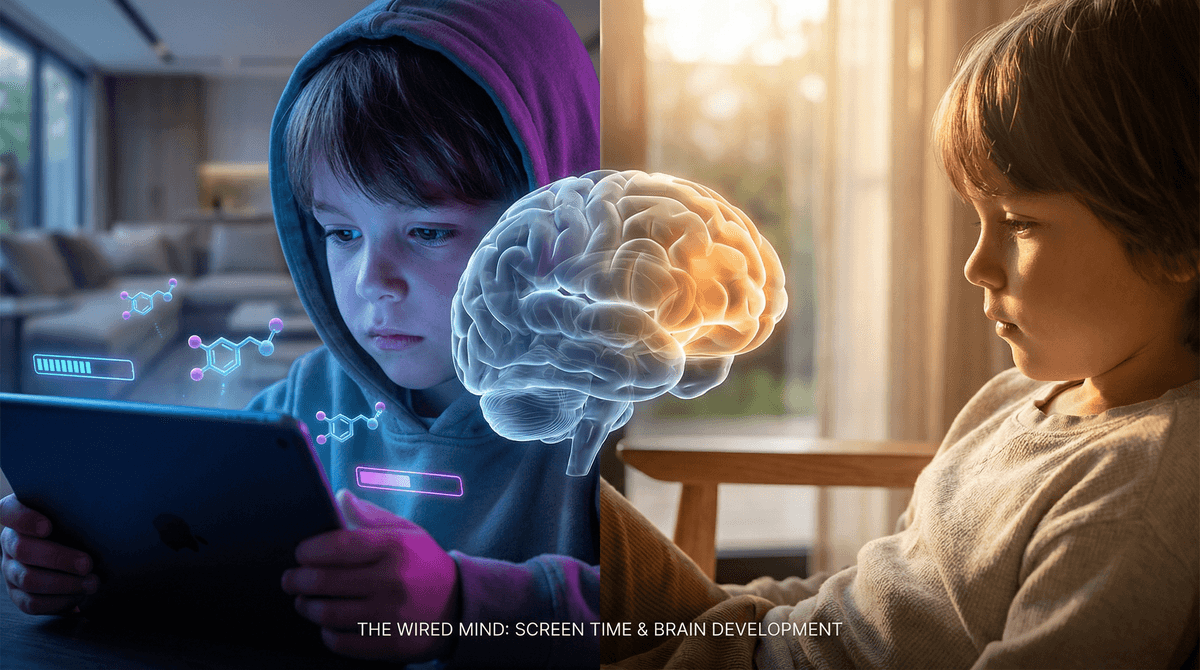
TL;DR: Your child’s brain is essentially a high-performance sports car with no brakes. Screens provide the fuel (dopamine), but their prefrontal cortex (the brakes) isn't fully installed until their mid-20s. To help them, focus on "slow" media like The Wild Robot or Minecraft in Creative Mode, and be wary of "fast" media like TikTok or Cocomelon that overstimulates the reward system.
Ask our chatbot for a personalized screen time plan for your child's age
We’ve all been there. You tell your kid it’s time to turn off the iPad, and suddenly it’s like you’ve asked them to give up a kidney. There’s screaming, there’s "just five more minutes," and there’s that glazed-over "screen stare" that makes you wonder if anyone is actually home behind those eyes.
It’s easy to feel guilty or like you’re "failing" at digital parenting, but here’s the no-BS truth: your child isn't being a brat, and you aren't a bad parent. Their brain is simply doing exactly what it was evolved to do—seek out rewards—while being hit with 2025-level technology designed to exploit that exact biological drive.
When we talk about "screen time," we’re really talking about two main players in the brain: the Prefrontal Cortex and the Dopamine Reward System.
The prefrontal cortex is the part of the brain responsible for "executive function." This includes impulse control, planning, and the ability to say, "I should stop playing Roblox now so I’m not a zombie at school tomorrow." The catch? This part of the brain is under construction until about age 25.
Meanwhile, the dopamine system is fully online from a very young age. Dopamine is the "more" molecule. It’s the hit of pleasure and anticipation they get when they open a "mystery box" in a game or see a new video pop up on YouTube.
When a kid is on a "sticky" app, they are getting constant micro-hits of dopamine. When you tell them to turn it off, you are effectively cutting off their supply. Their underdeveloped prefrontal cortex can’t handle that sudden drop, which leads to the inevitable "tech tantrum." It’s not a character flaw; it’s a physiological reaction.
Not all screens are created equal. In the world of digital wellness, we often distinguish between High-Arousal (Fast) Media and Low-Arousal (Slow) Media.
The "Brain Rot" Factor
You’ve probably heard your kids use the term "brain rot" to describe weird, repetitive content like Skibidi Toilet. While the term is a meme, there’s a kernel of scientific truth to it. High-arousal media—think fast cuts, loud noises, and bright flashing colors—overstimulates the developing brain.
Shows like Cocomelon are often criticized because the scene changes happen every few seconds. This trains the brain to expect constant novelty, making "real life" (like a teacher talking or a book) feel incredibly boring by comparison. This is how we end up with kids who say everything is "Ohio" (weird/cringe) or "mid" if it doesn't give them a dopamine spike every three seconds.
Learn more about the 'Cocomelon effect' on toddler attention spans
The Dopamine Loops of Gaming
Games like Fortnite and Brawl Stars are masterpieces of psychological engineering. They use "variable ratio reinforcement"—the same logic used in slot machines. You don't know when you'll win or get a cool new skin, so you keep playing. This is why "just one more round" is a lie kids tell themselves as much as they tell you.
If we want to protect neural pathways and encourage better impulse control, we should steer kids toward content that encourages active engagement rather than passive consumption.
Ages 7+ Minecraft is often called "digital LEGOs" for a reason. In Creative Mode, the dopamine hit comes from building and problem-solving rather than just reacting to stimuli. It builds spatial reasoning and persistence. Read our guide on setting up a safe Minecraft server
Ages 3-8 Unlike high-speed cartoons, Bluey uses a slower pace, natural colors, and focuses on imaginative play. It doesn't overtax the sensory system, making the "transition" away from the TV much easier for younger kids.
Ages 6-12 This is a "digital dollhouse." There are no high-stakes competitions or "levels" to beat. It’s open-ended play that allows kids to tell their own stories, which is great for cognitive development.
Ages 6-12 Audio content is a "brain hack" for screen time. It engages the imagination because the child has to visualize what they’re hearing, but it doesn't have the same "zombie-inducing" visual triggers. Check out more educational podcasts for kids
Ages 8-16 If your kid is obsessed with games, move them from consumer to creator. Scratch teaches the logic of coding through a visual interface. It’s high-effort, high-reward—the exact opposite of "brain rot."
The brain's needs change as kids grow. What's okay for a 14-year-old might be neurochemical chaos for a 4-year-old.
- Ages 0-2: Zero "solo" screen time is the goal. The brain needs 3D interaction and human faces to wire correctly. If you do use screens, stick to FaceTime with Grandma.
- Ages 3-5: Limit to high-quality, slow-paced shows. Avoid "auto-play" at all costs. You want the show to end so the brain can transition back to the real world.
- Ages 6-12: This is the "Golden Age" of gaming. Focus on games that involve strategy or creativity. This is also when you start seeing "Skibidi" and "Ohio" culture—it's okay to let them in on the jokes, but keep an eye on the YouTube rabbit holes.
- Ages 13+: The focus shifts to social media and the "comparison trap." Their brains are hyper-sensitive to social feedback (likes, comments), which can spike anxiety.
Ask our chatbot about the best first phone for a middle schooler
The "science" of screen time tells us that the hardest moment for a child's brain is the transition. Going from 100mph dopamine to 0mph "go brush your teeth" is a recipe for a meltdown.
Instead of shouting "turn it off" from the other room, try these science-backed "bridge" strategies:
- The 5-Minute Warning: It gives the prefrontal cortex a second to prepare for the transition.
- The "Watch With Them" Bridge: Sit down for the last two minutes of their game or show. Ask them what’s happening. This pulls them out of the "screen trance" and back into social interaction before the device goes away.
- Physical Movement: After the screen goes off, have them do something physical—jump on a trampoline, a quick dance party, or even just a big stretch. It helps reset the nervous system.
Screens aren't "rotting" your child's brain in a literal sense, but they are shaping it. The brain is plastic; it strengthens the pathways it uses most. If a child spends all their time on "low-effort, high-reward" apps like TikTok, they aren't practicing the "deep work" pathways needed for focus and patience.
The goal isn't to be a Luddite or to ban tech. The goal is digital nutrition. A little "sugar" (fun, mindless games) is fine, but the "protein" (creative coding, slow-paced shows, podcasts) should be the main course.
You're doing a great job navigating a digital landscape that didn't exist when we were kids. Stay curious, stay intentional, and don't be afraid to pull the plug when the "brain rot" gets a little too real.
- Audit the "Fast" Media: Look at your kid's favorite apps. Are they high-arousal (constant flashing/cuts) or low-arousal?
- Introduce a "Slow" Alternative: This week, try replacing one hour of YouTube with a session on Scratch or listening to Wow in the World.
- Talk about the "Dopamine Monster": Explain to your kids (in age-appropriate ways) why it's hard to stop. "Your brain is getting so much happy-chemical from Roblox that it's going to feel grumpy when we stop. That's okay, we'll help it reset."
Learn how to talk to your kids about persuasive design in apps