

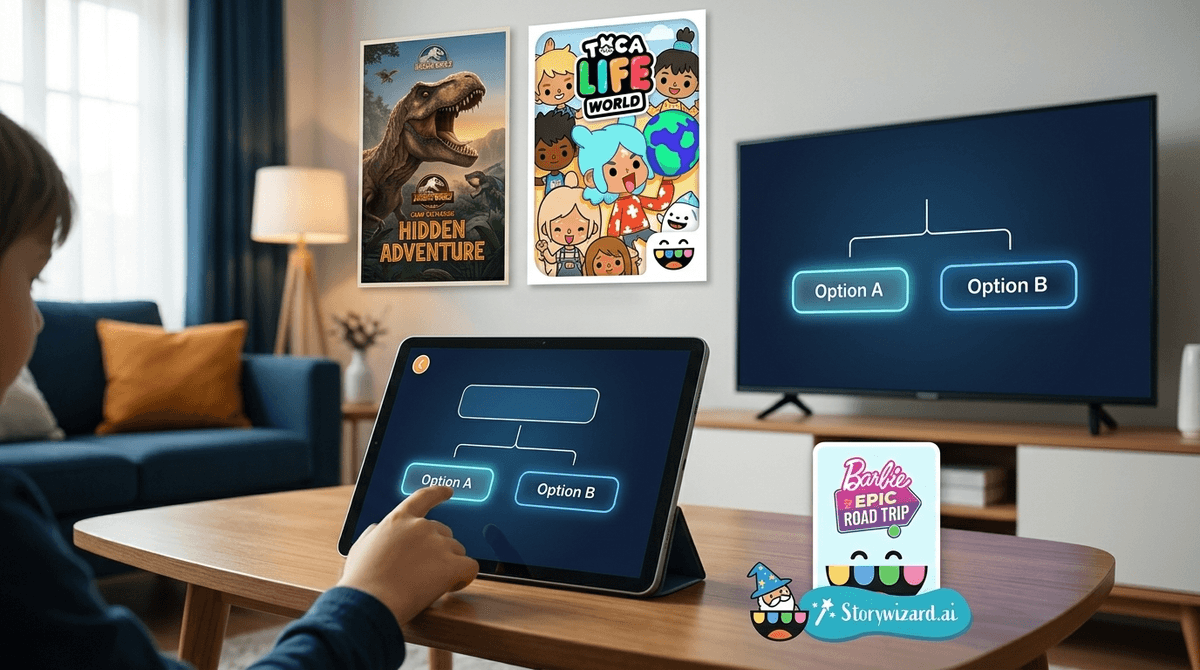
TL;DR: The Best Interactive Media for Kids in 2026
- Best for Preschoolers: Sago Mini World — Gentle, creative, and impossible to "fail."
- Best for Elementary (Netflix): [Jurassic World Camp Cretaceous: Hidden Adventure](https://screenwiseapp.com/media/jurassic-world-camp-cretaceous-hidden-adventure-movie — High stakes, high engagement, and actually requires some logic.
- Best for Creativity: Toca Life World — Where kids stop watching stories and start directing them.
- Best for Older Kids (10+): [In Space with Markiplier](https://screenwiseapp.com/media/in-space-with-markiplier-movie — A chaotic, high-production "Choose Your Own Adventure" on YouTube.
- Best AI Storytelling: StoryWizard.ai — Personalized, AI-generated interactive books that actually look good.
We’ve all been there: your kid is slumped on the couch, eyes glazed over, in what I call the "zombie-scroll" or "brain-rot" mode. Usually, it’s a 45-minute loop of Skibidi Toilet or some inexplicable ASMR sand-cutting video.
But screen time doesn't have to be a passive drain. In 2026, the line between "watching a movie" and "playing a game" has blurred into something actually useful. Interactive movies—or "branching narratives"—force kids to make choices, solve puzzles, and consider consequences. It moves them from the passenger seat to the driver’s seat.
If you're looking to swap passive consumption for active engagement, here are the best safe apps and specials for interactive storytelling right now.
Passive media is easy. Interactive media is work. When a kid watches a standard Disney movie, they’re just receiving information. When they watch an interactive special like [Puss in Book: Trapped in an Epic Tale](https://screenwiseapp.com/media/puss-in-book-trapped-in-an-epic-tale-movie, they have to pay attention to the plot to make the "right" choice.
This builds:
- Critical Thinking: "If I choose to fight the giant now, will I have enough energy later?"
- Narrative Agency: Understanding that their choices affect the outcome (a great life lesson that isn't Roblox gambling).
- Emotional Regulation: Dealing with a "bad ending" and figuring out how to go back and fix it.
Learn more about the benefits of active vs. passive screen time
Netflix is still the undisputed king of the "branching narrative" movie. Most of these work on smart TVs, tablets, and phones.
[Jurassic World Camp Cretaceous: Hidden Adventure](https://screenwiseapp.com/media/jurassic-world-camp-cretaceous-hidden-adventure-movie
This is arguably the gold standard for interactive kids' TV. It’s not just "click A or B." It involves actual survival choices, puzzles, and "video game-lite" mechanics. It’s perfect for the 7-11 age range. It can be a little intense (it is Jurassic World, after all), but the stakes make the choices feel meaningful.
Based on the popular The Last Kids on Earth book series, this special is great for the middle-grade crowd. It captures that "Ohio" energy kids love—weird monsters, goofy humor, and a bit of edge—without being actual brain rot.
[Barbie Epic Road Trip](https://screenwiseapp.com/media/barbie-epic-road-trip-movie
Don't write this off as just "pink fluff." It’s surprisingly well-structured. Kids help Barbie and her friends make decisions about their career and travel, which leads to multiple different endings. It’s a low-stress way to introduce younger kids (ages 5-8) to the concept of branching paths.
If you want to move away from the TV and onto a tablet, these apps are essentially "digital dollhouses" or interactive storybooks where the child is the director.
I talk about Toca Boca a lot because it’s one of the few apps that actually respects a child’s intelligence. It’s not a "movie" in the sense that you sit back, but it’s an interactive storytelling engine. Kids create characters, move them through sets, and essentially film their own stories. It’s the ultimate antidote to passive watching.
- Ages: 4-10
- The Catch: The in-app store is tempting. You’ll want to set up spending limits.
If you grew up with Living Books in the 90s (looking at you, Mercer Mayer’s Just Grandma and Me), this is the modern version. These are highly interactive digital books where every single item on the page can be clicked to trigger an animation or subplot. It’s a slow-paced, gentle way to engage with a story.
- Ages: 3-6
Available on Apple Arcade, this is basically Animal Crossing meets an interactive Sanrio movie. It’s narrative-heavy, requiring kids to talk to NPCs (non-player characters), solve their problems, and progress a story. It’s incredibly safe, beautifully designed, and lacks the toxic "grind" of many other 2026 mobile games.
By now, your kids probably know what ChatGPT is, or they’ve seen AI-generated "multiverse" videos on YouTube. In 2026, we’re seeing apps that use AI to let kids star in their own interactive movies.
This is a website/app where kids can input a few prompts (e.g., "A ninja cat who loves pizza") and the AI generates a fully illustrated, interactive storybook. The child makes choices at the end of each page that determine the next chapter. It’s a fantastic way to encourage literacy through tech.
While interactive movies are "better" than passive ones, they come with their own set of hurdles:
- Decision Fatigue: Some kids (especially younger ones or those with ADHD) can get genuinely stressed by "wrong" choices. If your kid is melting down because Puss in Boots got stuck in a cage, it might be time to switch back to a standard movie.
- The "One More Path" Loop: Because these movies have multiple endings, kids often want to watch them 5 or 6 times in a row to "see everything." This can turn a 20-minute special into a 2-hour marathon.
- YouTube Interactive Hazards: YouTube has "interactive" videos (using end-screen cards), but the algorithm doesn't care if the next "recommended" video is a weird ElsaGate knockoff. If they’re watching interactive content on YouTube, like [In Space with Markiplier](https://screenwiseapp.com/media/in-space-with-markiplier-movie, do it on the big screen where you can see it.
Next time you see them playing an interactive story, don't just walk past. Ask a few questions to bridge that digital-physical gap:
- "Why did you choose to go into the cave instead of the forest?"
- "Do you think the character made a good choice, or were they being a bit 'mid'?" (Yes, use their slang, it's hilarious when they cringe).
- "What do you think would have happened if you picked the other option?"
Interactive movies and apps are the "vegetables" of the screen time world—they’ve got more substance, they require more chewing, and they’re generally better for the brain than the "candy" of short-form video.
If you're looking to transition your family toward more intentional tech use, start with a Netflix interactive special tonight. It’s a low-barrier way to show your kids that screen time can be a conversation, not just a trance.
Next Steps:
- Check your Netflix "Interactive" category to see what’s currently available.
- If you have a tablet, download Toca Life World and spend 10 minutes letting your kid show you how they "film" a story.
- Take the Screenwise Survey to see how your family's interactive media habits compare to your school community.